3 Erie Ave, Brockton, MA 02302
A real address, analyzed so you can judge the output before you trust it with your own offers. Two-family, 4 bd / 2 ba, 2,361 sq ft on a quiet dead-end street. Sample listing: $649,000 asking, renovated in 2020, now showing tenant wear. Both units need paint, flooring, and kitchen and bath updates. Unit 1 rents for $1,800; unit 2 is vacant.
What the offer uses
The offer table below is the same engine as the public calculator, run on the documented inputs: ARV $760,000, repairs $55,000, list price $649,000. That is why the max offer is $477,000. Address and list price alone do not produce it. The calculator asks for an ARV, or reads sold comps you paste. The screenshot is an older screen that invented an after-repair value from the asking price. That screen is retired.

1 · What is it worth?
The ARV in this report is the midpoint of a published post-refresh range. The Zestimate is an as-is signal. Neither number is inferred from the asking price.
In a workspace, property research looks up sold two-family comps around the subject and attaches sources and tax records, so the ARV is an argument you can audit. The public calculator stays in the browser and uses only the ARV or sold prices you provide.
2 · What will the rehab cost?
This is a cosmetic turnover, not a gut: the 2020 renovation updated systems, kitchens, and baths, so the scope is refreshing two tenant-worn units. The documented repair total is the sum of these lines. In the product this list is drafted from walkthrough photos and priced line by line. On the public calculator, typing $55,000 uses this total. Leaving repairs blank on a sized listing shows a range from square feet and condition instead of a hidden flat default.
3 · What can you pay?
Profit uses the calculator's cost stack, the same one the form uses: Buying costs are 3% of the purchase price. Holding is $1,500 per month for 6 months. Selling costs are 6% of ARV. Financing is 10% interest and 2 points on 70% of the purchase for 6 months. At the asking price that stack produces -$49,871. At the max offer it produces $135,717. Break-even purchase, the highest price where that stack is still zero, is $602,781.
4 · What the numbers teach
- The max offer is the formula, not a special case for this street. 0.70 × $760,000 − $55,000 = $477,000 on any address that uses these inputs.
- Asking price is not an ARV. The Zestimate of $741,200 is as-is value. The post-refresh ARV used here is $760,000. The public form will ask you for that number when the paste has no sold comps.
- The spread at asking is too thin for this flip. Profit at $649,000 is -$49,871 under the labeled cost stack. Flip-safe here is $477,000 against a $649,000 ask.
- A two-family has a second answer. With unit rents around $1,800, buying near asking could still work as a BRRRR or house-hack where the flip math fails. The same workspace runs that analysis from the same record.
Verdict the report supports: as a flip, the max offer is $477,000. The deal breaks even around $602,781 and only clears the labeled costs well below the ask. As a rental play, run the BRRRR numbers before walking away.
What the full report adds
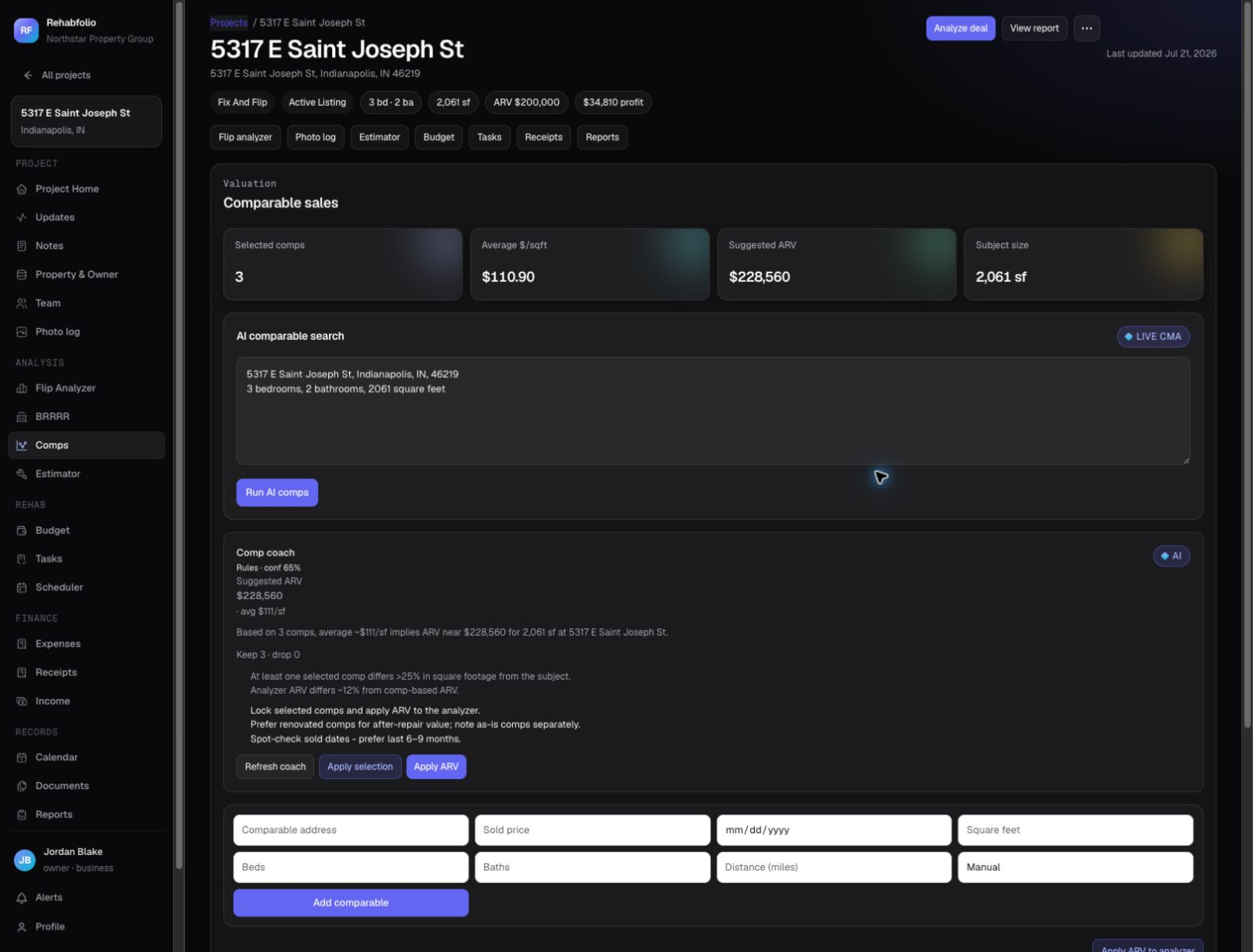
Inside a free workspace, this same analysis includes the sold comps it used, clickable source links, tax and assessor records, and stays editable, so the numbers improve after your walkthrough, contractor quote, and lender term sheet. Every AI figure is a draft until you accept it. Here is the comps view from a real workspace project:
Get this report for the flip you're watching.
Run the quick version free in your browser, no account. Create a free workspace for the full evidence-backed report.