House flip lien waivers: conditional vs final, claimants, and closeout
Lien waivers protect a flip only when they match real payments, real claimants, and the form your state and title company recognize. This guide shows how to map every potential claimant, choose conditional versus unconditional progress and final releases, match each draw to the right waiver package, and clear retainage before sale without treating paperwork as a magic shield.

Published and last reviewed September 7, 2026 · Written and reviewed by the Rehabfolio editorial team.
Who this guide is for. This guide is for new and growing United States residential investors who already have a renovation contract and a payment schedule on a one-to-four-unit house flip. It starts after the contractor is selected and the baseline payment map exists, and it ends when progress and final waiver packages, retainage release, and sale-ready title coordination are controlled. If you are still designing draws and retainage, begin with contractor payment schedules. If you are still choosing the contractor, begin with contractor vetting. If you are still building the first budget, begin with how to build your first repair budget.
The Rehabfolio editorial team builds and reviews product workflows that connect property analyses, repair scopes, contractor bids, budgets, schedules, tasks, photos, files, change orders, expenses, lender draws, lien-related documents, and project reports. That gives the team first-hand product experience tracing a line item from approved scope through field evidence, payment, waiver files, and closeout. It does not make the team a contractor, construction manager, architect, engineer, attorney, lender, title professional, inspector, insurer, accountant, or tax adviser.
Mechanics lien, preliminary notice, waiver, release, retainage, prompt-payment, licensing, consumer-protection, escrow, and title rules differ by state, locality, contract form, property type, occupancy plan, and loan. California Contractors State License Board materials are cited here as one clear public example of statutory waiver concepts, not as a national template. This guide is educational information, not legal, construction, lending, title, insurance, accounting, tax, or investment advice. Use local construction counsel, a title company, and other licensed professionals for the forms and deadlines that apply to one property.
1. Define what a lien waiver is for on a flip
A renovation payment schedule answers when money moves. A lien-waiver package answers who is releasing which rights for that money. The two belong together, but they are not the same file. Investors who only track draws often discover at listing week that a supplier, specialty sub, or second-tier labor company never signed anything and still has a path to claim against the property under local law.
Keep four evidence types separate. Observed facts are signed contracts, invoices, cancelled checks or wire confirmations, dated notices, and completed waiver forms with matching amounts and through-dates. Calculations apply visible arithmetic to contract sum, approved changes, prior payments, retainage, and amounts due this period. Assumptions estimate that an unsigned party was paid by someone else or that a form from another state will satisfy title. Opinions describe comfort about a contractor relationship. “The GC’s progress invoice is $18,400 through rough-in, the wire cleared, and the conditional progress waiver names the same amount and period” mixes facts. “They would never lien us” is an opinion until the roster and documents say otherwise.
A lien waiver is useful when it ties a specific payment to a specific claimant, period, and release type recognized in your jurisdiction. It is not useful as a substitute for verifying work, approving change orders, or ignoring preliminary notices. California CSLB consumer guidance on preventing mechanics liens emphasizes practical owner steps such as knowing who is on the job, using written agreements, and understanding waiver and release concepts. Treat that as a reminder to build process, not as permission to copy one state’s forms into another state without counsel.
Scenario: Priya Nand stops paying on trust alone. Priya’s general contractor asks for the second draw and texts “waivers coming later.” The invoice lists only the GC company. Priya already received a preliminary notice from a lumber yard and knows an electrician and plumber are on site. She replies that the draw package needs the GC invoice, field photos for the milestone, a current sub and supplier list, and conditional progress waivers for every party due money in that period, with amounts that match the payment she is about to release. The relationship can stay cooperative. The unsigned promise does not move cash.
2. Map every potential claimant before the first major draw
Most flip lien problems start as roster problems. The person you pay is not always the only person with rights. Build a living claimant map that includes at least:
- General contractor and any construction-management entity named in the contract.
- First-tier subcontractors for demolition, framing, plumbing, electrical, HVAC, roofing, insulation, drywall, paint, flooring, tile, cabinets, counters, exterior, and specialty trades.
- Material suppliers who deliver to the site or who send preliminary notices, including lumber, windows, appliances, and finish vendors.
- Equipment rental or specialty fabricators when local practice treats them as potential claimants.
- Labor-only crews or second-tier subs if your counsel says they can have rights in your state.
Update the map at contract signing, after each approved change order, whenever a new truck shows up, and whenever a notice arrives. Store company legal name, trade, contact, notice dates, contract or purchase-order reference, and which payments already include them. The payment-schedule guide covers draw verification. This guide insists that the waiver file names the same people the notice file and the field photos show.
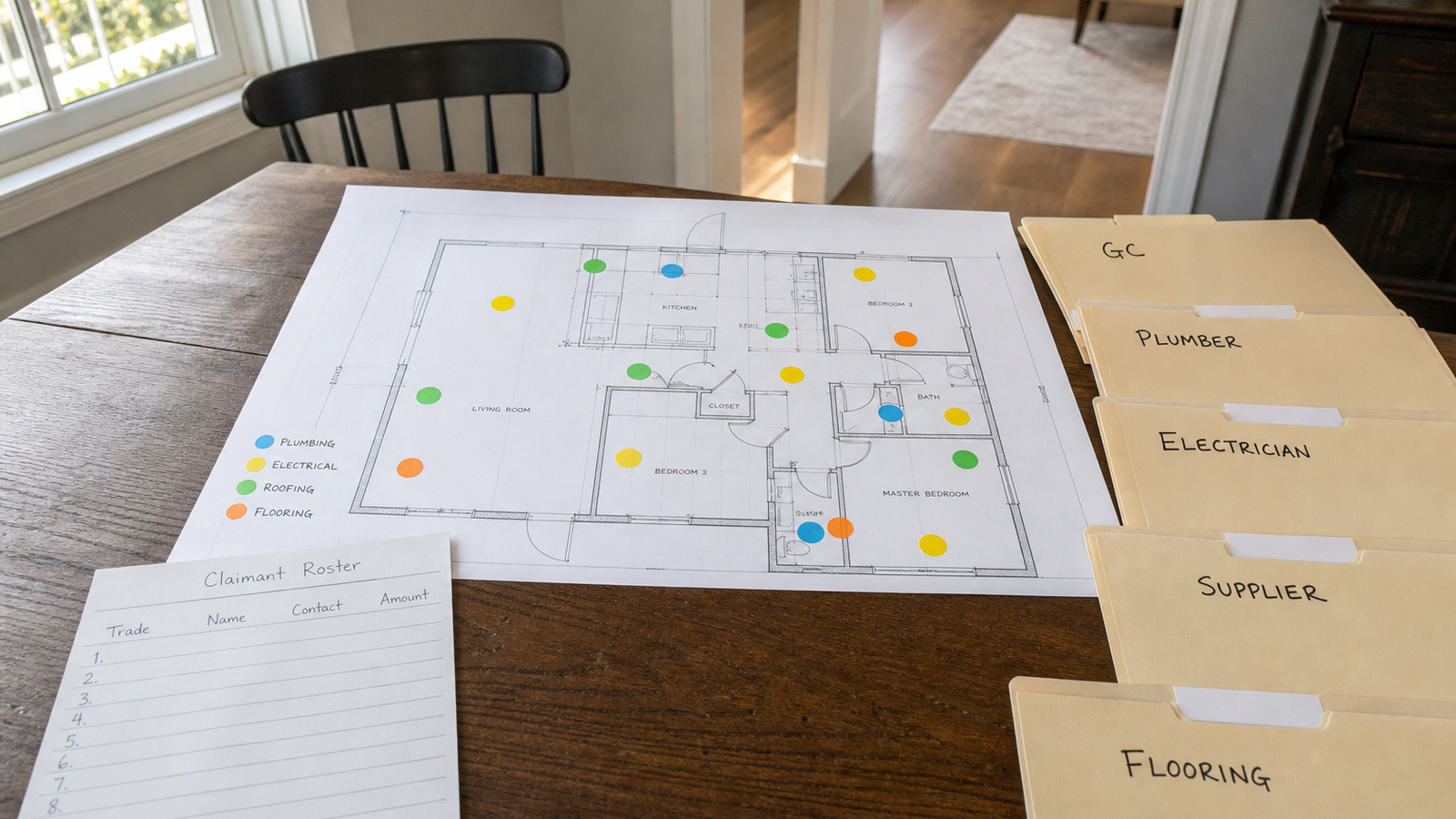
Contractor vetting reduces roster surprises but does not eliminate them. A carefully screened GC can still add a tile setter mid-project or switch suppliers after a backorder. Your control is the written list and the rule that new names join the map before they join the payment queue.
3. Separate conditional vs unconditional and progress vs final
Public California materials on conditional and unconditional waiver and release forms are a useful teaching example because they spell out four common buckets many investors hear about nationwide: conditional progress, unconditional progress, conditional final, and unconditional final. Other states may use different statutory text, different required language, or no identical four-form set. Always ask title, lender, and local counsel which documents they will accept on your property.

- Conditional progress. Typically used when you are about to make a progress payment. The release is generally conditioned on the stated payment actually being received. Pair it with the invoice and the payment you are releasing for that period.
- Unconditional progress. Typically used after a progress payment has cleared. Because it is often treated as effective on signing, do not demand or accept it for money that has not actually cleared.
- Conditional final. Typically used when final payment, including retainage where applicable, is about to be made. Conditionality again tracks actual receipt of the final amount.
- Unconditional final. Typically used after final payment has cleared and you need a closing-strength release for the signer’s covered rights. Title companies often care deeply about this package near sale.
Progress versus final is about the payment milestone. Conditional versus unconditional is about whether the release waits for funds to clear. Mixing those axes is how investors end up with an unconditional final form signed against a partial progress check, or a conditional progress form that never gets followed by the unconditional update after the wire posts.
Scenario: Mateo Ruiz refuses an early unconditional. Mateo’s flooring sub emails an unconditional progress waiver the morning Mateo plans to send a $9,200 ACH. The bank has not released the payment yet. Mateo asks for a conditional progress waiver now, sends the payment, then requests the unconditional progress waiver after the bank confirmation posts. He files both with the invoice and photos. The sub still gets paid the same day the money moves. Mateo does not collect a release that pretends the money already cleared.
4. Match each payment to the right waiver package
Every serious draw should leave a package, not a single PDF. Build a repeating checklist:
- Period and amount. State the through-date or milestone and the exact dollars being paid this cycle.
- Work evidence. Photos, inspection signoffs, and completed-scope notes for that milestone, consistent with your payment schedule and quality control hold points.
- Claimant list for this payment. GC plus every sub and supplier included in the amount, or expressly marked as paid by others with proof.
- Correct form type. Conditional before funds clear, unconditional after, progress versus final as appropriate.
- Name and math match. Legal names, job address, amounts, and through-dates match the invoice and the payment instrument.
- Exceptions noted. Disputed extras, pending change orders, or retainage held back should appear as explicit carve-outs if the form and counsel allow them.

If a hard-money or private lender funds draws, send the waiver package with the draw request instead of hunting for signatures after the inspector leaves. The hard-money comparison guide explains why draw conditions differ by lender. Match your file to the loan you signed, not to a generic internet template.
Scenario: Aisha Benton ties waivers to a kitchen draw. Aisha is releasing $22,500 for cabinet set and countertop template. Her package includes the GC progress invoice, cabinet supplier delivery tickets, template photos, conditional progress waivers from the GC, cabinet installer, and countertop fabricator, and a note that plumbing trim is not in this payment. When the wires clear, she swaps in unconditional progress waivers for those three parties for the same amounts and through-date. The next draw will cover plumbing trim with its own roster.
5. Never pay against blank, backdated, or mismatched forms
Waiver theater is worse than no waiver because it creates false comfort. Reject packages that show any of these problems:
- Blank amount, blank through-date, blank claimant name, or blank job address.
- Backdated signatures that invent a release period the parties did not actually document at the time.
- Amounts that do not match the invoice or the payment about to leave the account.
- A GC-only waiver when known subs and suppliers are unpaid for the same period.
- An unconditional form for funds that have not cleared.
- A final form used to paper over incomplete punch work or unresolved change disputes.
- Photocopied signatures reused across periods without fresh completion of the current form.
The Federal Trade Commission’s guidance on avoiding home-improvement scams stresses written agreements that capture promises about scope, cost, timing, and payment, and warns against documents with blank spaces someone could fill later. Apply that consumer-protection instinct to waivers you accept as an owner: complete writing, matching dollars, and no informal fill-in-later culture.
IRS Publication 583 emphasizes organized business records that show expenses and supporting documents. For a flip, that includes invoices, proof of payment, waiver and release forms, notices, change orders, and the final cost reconciliation used at sale. Those records support tax preparation, partner reporting, lender draws, title review, and later dispute defense.
6. Change orders create new money and new claimants
An approved change order is not only a budget event. It can introduce a new waterproofing sub, a structural engineer’s recommended contractor, a window supplier, or an abatement firm. If your claimant map and waiver routine stay frozen to the original bid list, the change becomes a silent lien gap.
Use the same authorization discipline described in the change-order guide: no lasting extra work without a written packet, then immediately add any new company to the roster, notice log, and future waiver checklist. Unapproved extras should not ride inside a routine progress invoice or hide inside a progress waiver amount that no longer matches the baseline-plus-approved-change math.
When a change is rejected, keep the rejection in the file so a later invoice cannot quietly reintroduce the work under a progress payment. When a change is approved with a schedule slip, remember that longer projects create more payment cycles and more chances for roster drift. Holding cost is not the only cost of delay. Paperwork volume rises too.
7. Retainage, final payment, and sale or title timing
Retainage exists to keep leverage for incomplete or defective work, but it only works if final documentation is planned before listing photos go live. Coordinate four clocks:
- Punch and closeout. Use the punch list and closeout guide so incomplete items are assigned, verified, and photographed before final money moves.
- Final accounting. Reconcile original contract, approved changes, prior payments, retainage, credits, and the final amount due.
- Final waiver package. Collect the conditional final forms before funds leave, then unconditional finals after clearing where your professionals require them, covering every remaining claimant.
- Title and sale. Align with the seller closing checklist so title, payoff, and buyer closing are not waiting on missing releases.
Listing a house while final waivers are still outstanding is a common flip stress pattern. Buyers, lenders, and title desks ask questions at the worst moment. Build a rule: no marketing launch that depends on clean renovation title until the closeout package owner confirms the claimant file is complete or an escrow holdback plan is written with counsel and title.
Some projects use joint checks, escrowed retainage, or title-company collection of releases. Those tools are local practice questions, not blog defaults. What travels across markets is the habit of naming claimants, matching forms to cleared payments, and refusing to treat a GC smile as a release.
8. Work a complete lien-waiver example
Baseline. Jordan Lee is renovating a 1958 ranch bought for $205,000. Approved rehab budget is $58,000 including $5,000 contingency. Contract sum with the GC is $52,000 after owner-held allowances. Retainage is 10 percent until final completion. Holding cost runs about $1,650 per month, or $55 per day. Projected after-repair sale after selling costs supports about $312,000. Current projected profit is about $27,000 against a $24,000 walk-away target.
Claimant map at freeze. GC (Horizon Build Co.), demolition, plumber, electrician, HVAC, roofer, insulator, drywall, painter, flooring, cabinet installer, and a lumber supplier that already sent a preliminary notice. Appliances will be owner-direct later and are marked outside the GC contract.
Progress cycle facts. After rough mechanicals and drywall hang, the GC invoices $16,800 for the period through drywall hang. Prior payments total $18,000. Retainage withheld on this invoice is $1,680, so cash due now is $15,120. Field photos and the city rough plumbing and electrical tags support the milestone. The lumber supplier invoice inside the period is $4,100. The drywall sub invoice is $3,600. No unpaid change orders are in this cycle.
Waiver package before payment. Jordan collects conditional progress waivers from the GC for $15,120 cash being paid this cycle (with retainage noted per counsel’s preferred form practice), from the drywall sub for $3,600, and from the lumber supplier for $4,100, all showing the same through-date and job address. Names match W-9s and notices on file. No blanks. Jordan rejects a GC-only packet that omitted the supplier.
After clearing. Two days later the bank confirms the wires. Jordan replaces the conditionals with unconditional progress waivers for the same parties, amounts, and through-date, and files them with the payment confirmations. The retainage ledger now shows $1,680 added to prior retainage of $1,800, for $3,480 held.
Late change. A signed change order adds bathroom waterproofing by a specialty sub for $2,900 and three working days. Jordan adds the specialty sub to the claimant map the same day, requires a preliminary-notice check with counsel’s checklist, and states that no waterproofing payment will release without that sub’s matching waiver. Holding cost for three days is about $165. Contingency absorbs the $2,900. Revised profit remains above walk-away.
Final payment plan. At punch completion the revised contract sum is $54,900. Total paid to date excluding retainage release is $49,410. Retainage due is $3,480 plus final non-retainage balance per the accounting worksheet, reconciled to invoices. Jordan schedules conditional final waivers from every party with remaining rights, releases final funds only after punch verification and permit closeout evidence, then collects unconditional finals after clearing for the title package used at sale. Owner-direct appliances are documented separately with paid receipts so they are not confused with GC claims.
Assumptions still open. No second-tier labor claimant appears beyond the mapped roster. The specialty waterproofing sub accepts the same form family title requested. The city final inspection posts on schedule. Opinion: Jordan believes the GC relationship is strong. That opinion does not replace the roster, the matching amounts, or the final title review.
9. A repeatable Rehabfolio lien-waiver workflow
- Freeze the payment baseline. Store contract sum, retainage rule, draw milestones, and required evidence beside the scope and schedule.
- Build the claimant map. List GC, subs, suppliers, notice dates, and owner-direct vendors. Update on every change order and new arrival.
- Assemble each draw package. Invoice, field evidence, claimant list, and correct conditional forms before money moves.
- Match names and math. Reject blanks, mismatches, and GC-only shortcuts when other parties are due.
- Confirm clearing. After payment posts, collect unconditional progress forms where your professionals require them.
- Track retainage and exceptions. Keep a visible ledger for amounts held, disputed items, and approved changes.
- Close out before sale pressure. Punch verification, final accounting, conditional then unconditional finals, and title coordination.
- Archive the chain. Keep notices, waivers, proofs of payment, and change orders with the project record used for partners, tax prep, and dispute defense.
Link the waiver record back to the fix-and-flip workflow and budget and expense tracking. The goal is one chain from approved scope to verified progress to matched payment to signed release to sale-ready file.
AI tools may help organize PDFs, draft a claimant checklist, or flag missing filenames. A person still has to verify legal names, amounts, through-dates, form type, and whether local counsel and title accept the package. Provider neutral process beats tool pitching.
Frequently asked questions
What is a lien waiver on a house flip?
A lien waiver (often called a waiver and release) is a written document in which a contractor, subcontractor, or supplier acknowledges payment for identified work or materials and releases lien rights to the extent the form and applicable law allow. It is not a handshake, a text message, or a vague invoice stamp. The exact legal effect depends on the form type, the payment that actually clears, the claimants covered, and state law.
What is the difference between conditional and unconditional waivers?
In many jurisdictions that publish statutory forms, including California as one widely cited example, a conditional waiver and release becomes effective when the stated payment actually clears. An unconditional waiver and release is generally treated as effective upon signing, so it is usually appropriate only after you know the payment has cleared. Progress forms cover a stated progress payment. Final forms cover final payment. Other states use different labels, deadlines, and statutory language, so confirm the forms your title company, lender, and construction counsel require.
Do lien waivers guarantee my flip is free of liens?
No. A waiver only releases the rights of the signer to the extent the document and law allow. It does not automatically cover unpaid subcontractors or suppliers who never signed, claimants who were left off the roster, work outside the described period, disputed extras, or rights that cannot legally be waived in your state. Build a claimant map, match waivers to payments, and involve title and counsel before sale closing.
Should I pay against a blank or backdated waiver?
No. Blank spaces for amount, date, claimant name, or through-date create avoidable dispute risk. Backdating can misstate which work period was released. The Federal Trade Commission warns consumers not to sign home-improvement documents with blank spaces someone could fill later. Apply the same discipline to waivers you accept: complete forms, matching payment evidence, and no informal shortcuts.
How do change orders affect lien waivers?
Approved change orders can add scope, money, and new subcontractors or suppliers. Those new parties may have notice and lien rights even if your baseline roster looked complete. Update the claimant map when you approve a change, require waivers that cover the revised work period and amount, and keep unapproved extras out of routine progress packages. See the change-order guide for authorization controls.
When should I collect final waivers relative to sale closing?
Final payment, retainage release, unconditional final waivers (where used), title requirements, and buyer closing often collide in the last two weeks. Collect the closeout package before you rely on clean title for listing or sale. Coordinate with the punch-list and seller-closing checklists so title, lender, and counsel see one consistent claimant file rather than last-minute scraps.
Can Rehabfolio decide which waiver form is legally valid?
No. Rehabfolio can organize the claimant roster, payment schedule, waiver files, photos, invoices, and closeout checklist so you and your professionals can review them together. It cannot interpret state lien statutes, draft enforceable releases, clear title, bind a lender, or replace construction counsel or a title company. Use licensed and qualified local professionals.
Editorial methodology, limitations, and sources
The Rehabfolio editorial team chose this topic as a distinct payment-to-release control workflow during an active renovation. It does not repeat the milestone-payment design intent of the contractor payment guide, the baseline-to-amendment intent of the change-order guide, the workmanship verification intent of the quality-control guide, or the sale logistics intent of the seller-closing guide. Those guides remain the homes for draws, authorizations, field acceptance, and closing mechanics. This guide focuses on claimant mapping, waiver types, matching releases to cleared payments, and closeout timing before sale.
Key sources include California CSLB consumer guidance on how to prevent a mechanics lien; CSLB materials on conditional and unconditional waiver and release forms; the FTC’s how to avoid a home improvement scam guidance on written agreements and blank spaces; and IRS Publication 583 on starting a business and keeping records. Local licensing boards, title companies, lenders, and construction counsel remain necessary for the forms, notices, and deadlines that apply to one property. California sources are examples, not a fifty-state code.
National and single-state sources cannot determine whether a particular claimant has rights on your lot, whether a borrowed form is enforceable where you build, or whether a title company will insure over a missing release. They also cannot replace a contract written for your jurisdiction. Confirm local requirements with licensed and qualified professionals. Examples are original composites created for teaching. Names, addresses, figures, and outcomes are illustrative, not testimonials or performance claims.
Editorial standard. We identify the audience, author, review date, topic boundary, assumptions, calculations, product evidence, and limitations. We do not invent credentials, licenses, testimonials, market statistics, or guaranteed results. AI may help organize research and draft, and a person reviews the claims, calculations, links, examples, and limitations before publication. We revise the guide when a cited rule, product workflow, or material lien-waiver practice changes. See the editorial methodology on the company page.
Keep claimants, draws, and releases in one project record.
Track the roster, conditional and final forms, retainage, and sale-ready closeout evidence before title and listing pressure arrive.
Create free account