House flip change orders: control scope, cost, and schedule
Extra work destroys flip margins when it starts as a hallway yes. This guide shows how to freeze a renovation baseline, evaluate proposed changes with evidence, recalculate profit and holding cost, and approve only the written amendments that still clear your walk-away number.

Published and last reviewed September 4, 2026 · Written and reviewed by the Rehabfolio editorial team.
Who this guide is for. This guide is for new and growing United States residential investors who already have an approved renovation scope and contractor relationship on a one-to-four-unit house flip. It starts after the baseline budget is frozen and ends when each proposed change is approved, rejected, deferred, or converted into a controlled contingency use. If you are still building the first budget, begin with how to build your first repair budget. If you are still choosing the contractor, begin with contractor vetting.
The Rehabfolio editorial team builds and reviews product workflows that connect property analyses, repair scopes, contractor bids, budgets, schedules, tasks, photos, files, change orders, expenses, lender draws, and project reports. That gives the team first-hand product experience tracing a line item from approved scope through field evidence, budget movement, payment, and closeout. It does not make the team a contractor, construction manager, architect, engineer, attorney, lender, title professional, inspector, insurer, accountant, or tax adviser.
Contract, licensing, permit, lien, prompt-payment, consumer-protection, lead-safe renovation, insurance, and lender-draw rules differ by state, locality, contract form, property type, occupancy plan, and loan. Use licensed local construction, legal, permitting, insurance, lending, and renovation professionals. This guide is educational information, not legal, construction, lending, insurance, accounting, tax, or investment advice.
1. Define what a change order is for
A renovation budget answers what you planned to buy. A change order answers what you are willing to buy differently after that plan is locked. The difference matters because hallway decisions usually arrive with incomplete price, incomplete schedule impact, and incomplete proof that the work is necessary.
Keep four evidence types separate. Observed facts are signed baseline documents, photographs, measurements, inspection notes, and dated proposals. Calculations apply visible arithmetic to those facts. Assumptions estimate unresolved cost, duration, or market effect. Opinions describe judgment about taste, risk, or buyer appeal. “The plumber photographed cast-iron waste with a crack at the stack and priced replacement at $4,800 with a three-day delay” mixes facts and a priced proposal. “Buyers will hate this bathroom if we keep the tub” is an opinion until comps and your finish plan say otherwise.
A change order is useful when it protects the property, restores a code or contractual requirement, replaces an unavailable specified item with an equal documented substitute, or buys a finish upgrade that still clears your walk-away number after holding cost. It is not useful as a way to hide a weak original bid, absorb every preference drift, or pay for work that already happened without authorization.
Scenario: Priya Nand freezes the hallway yes. Priya’s contractor texts that the hall bath “should be a walk-in shower while the walls are open.” The text includes no demolition quantity, no waterproofing detail, no tile allowance, no schedule days, and no effect on the master-bath finish that already uses the same tile lot. Priya replies that temporary protection can continue, but no lasting bath redesign starts until a written packet shows scope, price, lead time, inspection impact, and revised profit. The preference may still win. The unsigned text does not.
2. Freeze the approved renovation baseline
You cannot control change if the original agreement is vague. Before the first day of demolition, assemble one baseline package that both sides can point to without reconstructing memory:
- Signed contract, exhibits, and exclusions.
- Room-by-room and system-by-system scope with quantities where possible.
- Finish schedule and allowances with brands, grades, or equal specifications.
- Approved budget total, contingency amount, and owner-held reserves.
- Project schedule with inspection and long-lead milestones.
- Payment schedule, retainage rule, and required draw evidence.
- Permit list, insurance certificates, and lead-safe or specialty certifications when required.
Build that baseline with the methods in the repair budget, material procurement, project schedule, and contractor payment guides. The point of freezing is not rigidity for its own sake. The point is to make every later request prove what it changes.
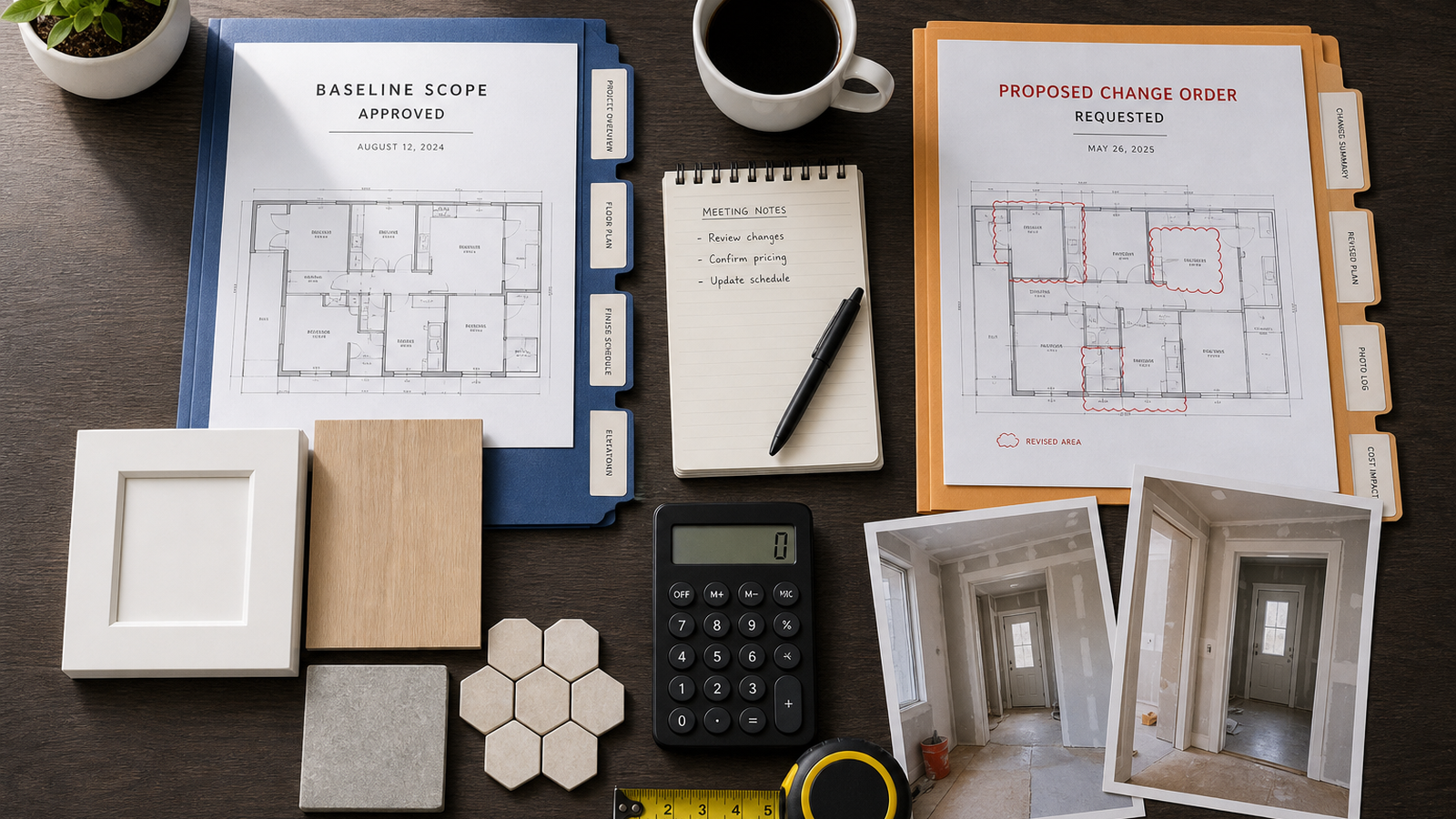
After freeze, create a simple rule: field crews may protect the house and follow the approved scope. Anything outside that scope waits for a numbered change request. If your contract already defines a change-order form, notice method, markup rule, or time limit, follow that form. Do not invent a second informal process that conflicts with the signed one.
3. Require a complete change packet before debate
A complete packet turns a persuasive story into a reviewable file. Ask for the same fields every time:
- Reason code. Hidden condition, code or inspector requirement, owner upgrade, substitution for unavailable material, design clarification, or damage repair.
- Scope delta. What is added, removed, or replaced, with quantities and locations.
- Evidence. Photos, measurements, inspector notes, supplier lead-time proof, or failed-spec documentation.
- Price delta. Labor, materials, equipment, markup allowed by contract, credits for deleted work, and tax if applicable.
- Schedule delta. Working days added or recovered, affected trades, and inspection dates moved.
- Compliance delta. New permit, revised drawing, insurance notice, lead-safe coverage, or specialty trade requirement.
- Decision deadline. The date after which price or schedule may change again because of procurement or crew sequencing.
The Federal Trade Commission’s consumer guidance on home improvement work stresses written agreements that capture promises about scope, cost, timing, and payment, and warns against signing documents with blank spaces someone could fill later. Treat a change packet the same way. If the amendment leaves blanks for price, days, or materials, it is not ready to sign.
Scenario: Mateo Ruiz rejects an incomplete sewer proposal.After demolition, Mateo’s plumber finds a belly in the clay lateral. The first proposal says “replace sewer as needed, about $6,000 to $9,000.” Mateo asks for camera stills, the length of pipe, whether the city lateral or the private lateral is involved, permit responsibility, restoration of yard and driveway, and working days. The revised packet prices 42 feet of private lateral at $7,400, three working days, and a city permit by the contractor. Only then does Mateo run the profit math.
4. Classify the request before you price emotion
Not every request deserves the same decision standard. Classify first:
- Safety or property protection. Temporary shoring, water shutoff, board-up, mold containment after a leak. Act fast on the temporary step, then write the lasting change.
- Code, inspector, or lender requirement. Often non-optional if you want to finish and sell with a clean file. Still require a written price and schedule impact.
- Hidden condition. Rot, failed stack, undersized panel, asbestos wrap, or unpermitted prior work discovered after opening. Price it against contingency and walk-away math.
- Substitution. Specified item unavailable. Demand equal or better performance, lead time, and cost delta in writing.
- Owner upgrade. Better flooring, extra recessed lights, spa shower. These compete with profit and must clear the same underwriting screen as the original offer.
- Contractor incompleteness. Work that was always in scope but omitted from the bid. That is a contract dispute, not an automatic owner-paid upgrade. Get counsel involved early if the parties disagree.
Classification prevents the most expensive confusion on flips: treating a preference like a necessity, or treating a genuine hidden condition like a contractor surprise you can ignore until listing week.
5. Recalculate cost, schedule, and profit before you sign
Every serious change has three numbers, not one. Direct cost is the labor and material delta. Holding cost is the financing, taxes, insurance, utilities, and care that accrue if the schedule slips, as explained in the holding-cost guide. Opportunity cost is the risk that a longer project collides with rate changes, seasonal buyer slowdowns, or your next purchase.

Use a short worksheet every time:
- Current projected sale proceeds after selling costs.
- Current total project cost including purchase, rehab, holding, and exit costs.
- Change-order direct cost or credit.
- Extra holding days times daily holding cost.
- Contingency remaining after the change.
- Revised projected profit versus your written walk-away profit.
If the change is an upgrade meant to raise after-repair value, do not invent the value lift. Revisit comparable sales and the same evidence standard used in first-property analysis and responsible AI underwriting review. AI tools may help organize photos and draft a comparison memo. A person still has to verify the comps, the repair quantities, and the decision.
Scenario: Aisha Benton prices a tile upgrade honestly. Aisha can upgrade hall-bath tile for $2,100 and five extra days. Daily holding cost is $95, so schedule drag is about $475. Local sold comps do not show a clear premium for the upgraded tile in this price band. She rejects the upgrade, keeps contingency for unseen mechanical work, and spends the design energy on kitchen hardware already in the baseline finish schedule.
6. Approve, reject, defer, or use contingency
After the packet and math are complete, choose one written outcome:

- Approve. Sign the amendment, update budget and schedule, notify the lender if draws are involved, and release work.
- Reject. Leave the baseline in force. If the contractor already performed unauthorized elective work, document the dispute and talk to counsel before paying.
- Defer. Useful for noncritical upgrades that can wait until contingency is proven sufficient near the end of rough-in.
- Use contingency. Appropriate for true unknowns that were reserved in the original budget. Contingency use is still a written change so the remaining reserve stays visible.
- Reduce elsewhere. Approve a necessary repair by deleting an equal or greater elective finish so the walk-away number survives.
Quality-control hold points from the quality control plan still apply after approval. An approved change that is installed wrong is not “done.” It is incomplete work that must be corrected before dependent trades bury it.
7. Check permits, lead-safe work, and insurance before release
A signed price is not enough if the change creates a compliance gap. Ask four questions before crews start the lasting work:
- Does the change need a new or revised permit, drawing, or inspection sequence?
- Does it disturb painted surfaces in pre-1978 housing such that EPA renovation, repair, and painting rules apply?
- Does the contractor’s insurance still match the enlarged scope, especially roofing, plumbing, electrical, or structural work?
- Does the project insurance binder still match vacancy, renovation activity, and liability exposure after the change?
EPA materials explain that paid work disturbing paint in pre-1978 housing and child-occupied facilities generally requires certified firms and lead-safe practices, and that the rule can apply when someone buys, renovates, and sells homes for profit. A change that replaces windows, opens painted walls, or expands demolition can trigger those duties even if the original cosmetic scope stayed small. Confirm firm certification and notices before you authorize the disturbance.
Permit sequencing belongs in the same review. The permits and inspections guide shows why a late scope change can move rough inspections, delay wall close-in, and add holding cost. Do not approve a mechanical or structural change with a price but no inspection path.
8. Connect approved changes to draws, liens, and records
Once approved, the change must appear in the money trail. Update the revised contract sum, revise milestone values if the payment schedule requires it, and keep unapproved extras out of routine invoices. Lien notices, waivers, and supplier claims can follow the enlarged work, so track new subcontractors and material vendors the same way you track baseline claimants.
IRS Publication 583 emphasizes keeping organized business records that show income, expenses, and supporting documents. For a flip, that includes the baseline contract, each signed change order, invoices, proof of payment, photos that justify the change, and the final cost reconciliation used at sale. Those records support tax preparation, partner reporting, lender draws, and later dispute defense. They are not optional clutter.
If a hard-money or private lender funds draws, send the approved change packet with the next draw request instead of surprising the draw inspector after the work is buried. The hard-money comparison guide covers why draw rules and contingency treatment differ by lender. Match your file to the loan you actually signed.
9. Work a complete change-order example
Baseline. Jordan Lee is renovating a 1956 ranch bought for $210,000. Approved rehab budget is $62,000 including $6,000 contingency. Holding cost runs about $1,800 per month, or $60 per day. Projected after-repair sale after selling costs supports about $318,000. Current projected profit is $28,000 against a $25,000 walk-away target. Kitchen and both baths are in the baseline. The hall bath is a standard tub-shower with mid-grade tile.
Finding. During demolition, the crew opens the hall-bath wet wall and photographs soft sheathing around the tub valve and a cracked cast-iron stack section. Temporary water shutoff and containment are already in place. The contractor proposes either (A) repair the stack section and reinstall the planned tub-shower for $5,200 and four working days, or (B) convert to a walk-in shower while the wall is open for $9,800 and nine working days.
Packet facts. Option A includes stack repair, new valve, cement board, and the original tile allowance. Option B includes a linear drain, waterproofing system, niche, glass panel lead time of 12 calendar days, and a $1,400 tile upgrade. Both options note a plumbing permit revision. The house is pre-1978, so the contractor’s certified renovator will run lead-safe practices for the painted trim demolition already underway.
Calculations. Option A uses $5,200 of contingency and about $240 of holding cost, leaving $800 contingency. Revised profit is about $22,560, which is below the $25,000 walk-away line by roughly $2,440. Option B costs $9,800 plus about $540 of holding cost if glass is ordered immediately, cutting profit to about $17,660. No sold comps in Jordan’s file support a $5,000 value lift for a hall-bath shower in this band.
Decision. Jordan rejects Option B as an owner upgrade that fails the walk-away screen. Jordan approves Option A as a hidden-condition repair, but only after deleting a $3,000 decorative exterior lighting package that had not been ordered. Net cost of the necessary repair after the deletion is $2,200 plus $240 hold. Revised profit returns to about $25,560, contingency remains $800 for later unknowns, and the amendment is signed before the stack work continues. The decorative lights can return only if later contingency is unused and the listing still needs them.
Assumptions still open. The city accepts the permit revision on the first submission. The glass lead time never begins because Option B is rejected. No further stack corrosion appears above the repaired section. Opinion: Jordan believes buyers in this street will accept a clean tub-shower. That opinion is supported by the existing comps file, not by the contractor’s preference for a shower package.
10. A repeatable Rehabfolio change-order workflow
- Freeze the baseline. Store the signed scope, finish schedule, budget, contingency, schedule, and payment map in one project record.
- Log every request. Create a numbered change request with reason code, photos, and the requesting person.
- Collect the packet. Require scope, price, schedule, compliance, and decision deadline before debate.
- Classify and calculate. Separate safety, code, hidden condition, substitution, upgrade, and incompleteness. Recompute profit and holding cost.
- Decide in writing. Approve, reject, defer, use contingency, or reduce elsewhere using the contract’s amendment form.
- Update dependent systems. Revise budget, schedule, procurement, permits, insurance notes, and draw packages the same day.
- Verify in the field. Apply quality-control checks before covering the work, then archive photos with the signed change.
- Reconcile at closeout. Carry approved changes into punch list, final accounting, and the sale file described in the punch list and closeout guide.
Link the change record back to the fix-and-flip workflow, rehab estimating features, and budget and expense tracking. The goal is one chain from original underwrite to field discovery to signed amendment to paid work to final profit.
Frequently asked questions
What is a change order on a house flip?
A change order is a written amendment to the approved renovation contract that changes scope, materials, price, schedule, responsibility, or another contract term after the baseline is set. It is not a verbal hallway request, a text message alone, or an invoice for work that was never authorized. Until both sides sign the amendment in the form the contract requires, the original baseline still controls.
Should I let the contractor start extra work before the change order is signed?
Usually no. Starting before authorization mixes emergency protection work with elective upgrades and makes price, schedule, and lien exposure hard to prove later. Stabilize only what is needed to protect people or the property, document that temporary step separately, then decide whether the lasting fix is approve, reject, or defer. Ask local construction counsel how your contract and state law treat unauthorized work.
How do change orders affect contractor draws and retainage?
Approved change orders usually adjust the contract sum and may adjust milestone values, retainage math, and lender draw packages. Unapproved extras should not ride inside a routine progress invoice. Keep the original contract amount, each approved change, the revised contract sum, and the amount remaining to finish as separate figures before you release money. See the contractor payment schedule guide for draw verification steps.
Do change orders that disturb paint in a pre-1978 house need lead-safe practices?
Often yes when the work is paid renovation that disturbs painted surfaces in pre-1978 housing. EPA’s renovation, repair, and painting rule generally requires certified firms and lead-safe work practices for covered work, and it can apply to people who buy, renovate, and sell homes for profit. A change that opens walls, replaces windows, or prep-sands painted surfaces can move a project into covered work even if the original scope stayed outside the rule. Confirm firm certification, notices, and work practices before authorizing the change.
What if a hidden condition appears after demolition?
Treat the finding as new evidence, not as an automatic blank check. Photograph and measure it, separate temporary protection from the proposed lasting fix, get a written price and schedule impact, then recalculate profit, holding cost, and contingency before you sign. Some findings belong in contingency. Some belong in a renegotiated scope. Some mean the finish plan must shrink so the deal still clears your walk-away number.
Can Rehabfolio approve a change order for me?
No. Rehabfolio can organize the baseline scope, proposed change packet, photos, cost and schedule deltas, contingency balance, lender notes, risks, and the written decision. It cannot inspect the house, price labor as a contractor, clear a permit, bind insurance, interpret your construction contract, give legal advice, or decide whether you should spend the money. Use licensed and qualified local professionals.
Editorial methodology, limitations, and sources
The Rehabfolio editorial team chose this topic as a distinct baseline-to-amendment control workflow during an active renovation. It does not repeat the initial budget-building intent of the repair-cost guide, the milestone-payment intent of the contractor payment guide, the workmanship verification intent of the quality-control guide, or the acquisition-window intent of the due-diligence guide. We reviewed current primary or authoritative sources on written home-improvement agreements, lead-safe renovation duties that can apply when paint is disturbed, and business record retention for construction costs. We then mapped those sources into a product workflow using tasks, owners, documents, facts, calculations, assumptions, risks, and written decisions.
Key sources are the FTC’s how to avoid a home improvement scam guidance on written contracts, scope, cost, timing, and blank spaces; the EPA’s lead renovation, repair, and painting program and contractor requirements; and IRS Publication 583 on starting a business and keeping records. Local licensing boards, permit authorities, and construction counsel remain necessary for the contract form and lien rules that apply to one property.
National sources cannot determine whether a particular hidden condition is owner-paid, whether a preference will raise sale price, or whether a lender will fund a change. They also cannot replace a contract written for your jurisdiction. Confirm local requirements with licensed and qualified professionals. Examples are original composites created for teaching. Names, addresses, figures, and outcomes are illustrative, not testimonials or performance claims.
Editorial standard. We identify the audience, author, review date, source boundary, assumptions, calculations, product evidence, and limitations. We do not invent credentials, licenses, testimonials, market statistics, or guaranteed results. AI may help organize research and draft, and a person reviews the claims, calculations, links, examples, and limitations before publication. We revise the guide when a cited rule, product workflow, or material change-order practice changes. See the editorial methodology on the company page.
Run change orders in the same workspace as the baseline budget.
Track requests, evidence, cost and schedule deltas, contingency, approvals, and the revised profit screen before extra work starts.
Create free account