How to calculate holding costs when flipping a house
Every day between purchase and sale has a cost. Build a timeline-based holding budget before you offer, update it during renovation, and price delays before they consume the deal.

Published July 20, 2026 · Written and reviewed by the Rehabfolio editorial team.
This guide is for new and growing residential investors who need to estimate the cost of owning a flip from acquisition closing through sale closing. The Rehabfolio editorial team builds and reviews property analysis, estimating, budgeting, scheduling, and expense-tracking workflows in the Rehabfolio product. That product work gives the team first-hand experience with how an assumption moves from an early deal screen into a project budget and then into actual cost records. It does not make the team a lender, appraiser, attorney, accountant, insurance producer, broker, contractor, or local code official.
This is educational information, not financial, lending, tax, legal, insurance, construction, or brokerage advice. Loan documents, tax rules, insurance coverage, permits, utility practices, contracts, and market timing vary. Obtain written figures and consult licensed local professionals when the decision depends on their field.
1. Define house flipping holding costs clearly
Holding costs, also called carrying costs, are the costs that continue because you own or control the property over time. Interest keeps accruing. Property taxes continue. Insurance coverage must remain appropriate. An empty property still uses electricity, water, gas, security, lawn service, or snow removal. A condominium association may bill dues even while the unit is stripped to the studs.
These costs are different from the purchase price, the physical renovation scope, and the costs of selling. Keeping the groups separate prevents double counting and makes the decision easier to explain.
- Acquisition costs: purchase price, title and settlement charges, inspections, recording, and lender closing charges.
- Renovation costs: labor, materials, permits, design, equipment, disposal, and construction contingency.
- Holding costs: financing and ownership costs that continue during the project and sale period.
- Exit costs: brokerage under the actual agreement, transfer and settlement charges, buyer concessions, staging, final cleaning, and loan payoff charges.
A cost can affect more than one decision without belonging in more than one budget line. For example, a year of insurance may be paid at acquisition, but the policy protects the property during the hold. Record the cash payment date, then allocate the expected project share for underwriting. Reconcile unused premium or additional premium when the policy ends.
Separate cash movement from economic cost
A loan payment can contain interest, principal, escrow, and fees. Interest is a financing cost. Principal reduces debt and affects cash available, but it also reduces the final payoff. Escrow may fund taxes and insurance that are already counted elsewhere. If you label the whole payment as cost and also count taxes and insurance, you can overstate the project.
The Consumer Financial Protection Bureau explains that a total monthly mortgage payment can include principal, interest, mortgage insurance, taxes, and homeowners insurance. It also notes that association dues may be paid separately. Review the CFPB explanation of total monthly payment, then read your actual note, escrow statement, and payoff terms.
2. Build the ownership timeline before the cost estimate

A holding-cost estimate is a rate multiplied by time. If the timeline is vague, the total is vague. Begin on the date the project becomes financially responsible for the property. For a purchase, that is commonly the acquisition closing date, but prepaid interest, insurance inception, utility transfer, access agreements, or a delayed possession term can create costs before or after that date.
End the timeline when the relevant obligation actually stops. Listing the house does not stop interest. Accepting an offer does not stop taxes, insurance, utilities, or maintenance. The practical end for a sale is usually the date funds close and the loan payoff is effective. Confirm the exact cutoff with the settlement agent, lender, insurer, utilities, and association.
Estimate five calendar phases
- Acquisition to construction start: possession, utility setup, permits, final scope, material ordering, and contractor mobilization.
- Active renovation: demolition, rough work, inspections, finishes, corrections, and final approvals.
- Listing preparation: punch list, cleaning, staging, photography, pricing, and market launch.
- Market exposure: showings, offer review, negotiation, and contract execution.
- Contract to closing: buyer diligence, appraisal, financing, title work, repairs, final walkthrough, and settlement.
Use calendar days, not only workdays. Interest, taxes, insurance, and many service charges continue through weekends and holidays. Add known municipal inspection calendars, lender requirements, delivery lead times, and local market conditions instead of copying a generic 90-day flip target.
Scenario: Aisha catches the missing sale period. Aisha budgets 88 days for renovation and assumes that is her total hold. Her agent expects two weeks to prepare and market the property, followed by a 35-day financed closing. Aisha changes the base case to 137 days. At an estimated $128 per day, the overlooked 49 days add $6,272 before any buyer repair request. The project still works, but her offer and reserve are now based on the complete timeline.
Connect this schedule to project management so a permit, inspection, material delivery, or listing task changes the forecast rather than living in a separate calendar.
3. List every cost that continues while you hold the property
Do not begin with a rule such as “use 2 percent for holding.” Begin with documents. The exact categories depend on the property, loan, ownership structure, municipality, climate, association, construction plan, and exit.
Financing costs
- Interest on the drawn or outstanding loan balance
- Servicing, construction administration, draw, extension, inspection, or unused-line fees when the documents require them
- Mortgage insurance or similar required coverage
- Default or late charges only in a downside or actual-cost record, never as a casual planning assumption
Use the signed note, fee schedule, draw rules, and a written lender projection. Interest may be calculated on the full commitment, the outstanding balance, or another defined amount. A simple annual-rate estimate is not sufficient when the loan has staged draws, minimum interest, points, extension fees, or a changing rate.
Property ownership costs
- Property taxes and special assessments
- Builder's risk, vacant-property, dwelling, liability, flood, or other applicable insurance
- Condominium, cooperative, or homeowners association dues and assessments
- Ground rent, private road, shared utility, or community charges when applicable
Insurance must match actual occupancy and renovation conditions. Do not assume a standard owner-occupied policy covers a vacant house or construction work. If flood exposure may affect coverage, lending, renovation requirements, or resale, use the FEMA Flood Map Service Center as the official starting point and ask qualified local professionals to interpret the property-specific requirements.
Property operating and protection costs
- Electricity, gas, heating fuel, water, sewer, trash, internet, and temporary service
- Heating, cooling, dehumidification, freeze protection, and drying equipment
- Lawn care, snow removal, pest service, cleaning, pool service, and site checks
- Locks, alarms, cameras, lighting, fencing, boarding, and other security measures
- Routine maintenance that protects the property but is not part of the improvement scope
The CFPB's current home-budget guidance includes taxes, insurance, supplementary coverage, association fees, maintenance, repairs, and utilities, while noting that amounts vary with local rates, climate, and the home. That consumer guidance is not a flip budget, but the CFPB ownership-cost checklist is a useful reminder that the loan payment is not the entire cost of owning property.
Project administration that changes with time
Some costs are not billed monthly but still grow when the project lasts longer. Examples include portable sanitation, dumpster rental beyond the included period, temporary fencing, storage, equipment rental, permit renewal, staging rental, repeated cleaning, property checks, and project supervision. State the billing unit and included period instead of forcing every item into a monthly average.
4. Calculate a monthly rate, daily rate, and total hold

Build the calculation in layers. First record each source amount and billing frequency. Then convert the portion expected during the project into a common planning period. Finally, add costs that occur only in a certain phase.
This formula is a planning convenience, not an accounting rule. A property-tax bill may cover a specific fiscal period. An annual insurance premium may be refundable only under the policy. Utility usage changes sharply between demolition and listing. Loan interest may change with every draw. Use the daily rate to understand sensitivity, but calculate material items from their actual terms.
Label every input by evidence quality
- Observed fact: a current tax bill, signed loan term, policy invoice, association statement, or utility tariff.
- Calculation: arithmetic derived from visible inputs, such as annual tax divided across the expected ownership days.
- Assumption: an unknown future amount, such as expected electric use or sale-closing duration.
- Opinion: a judgment about what may happen, such as a contractor's likely completion date or an agent's marketing-time range.
Do not let software or AI-generated suggestions hide those labels. A tool may organize documents, propose categories, detect a missing line, or recalculate scenarios. A person should verify the property, dates, loan terms, bills, and professional advice before accepting the budget. Use deal analysis to test the holding period alongside the purchase, repairs, financing, sale costs, and target result.
5. Work a complete 142-day flip example
Jordan is considering a dated 1,640-square-foot house. The purchase would close on August 3. The contractor proposes 74 calendar days after permit issuance. Jordan adds 12 days for permit and mobilization, 9 days for punch work and photography, 18 days of market exposure, and a 29-day contract-to-close period. The resulting base hold is 142 days.
The following numbers are illustrative assumptions, not market averages. Jordan would replace them with property-specific documents before making an offer.
Using the annualized daily method, $3,840 × 12 ÷ 365 equals about $126.25 per day. Multiplied by 142 days, recurring costs are about $17,927. Jordan then adds $1,350 of phase-specific staging rental and $900 of temporary equipment charges. The base holding-cost budget is $20,177.
Jordan does not enter the loan principal portion as another cost because it reduces the payoff balance. He does include the cash needed to make full payments in his funding schedule. He also avoids counting property tax and insurance twice when they appear inside an escrow payment.
Connect the hold to the maximum offer
Holding cost is part of the complete cost stack. If Jordan's supported sale price, renovation scope, financing, exit costs, and required return leave only $12,000 for carrying cost, the $20,177 estimate is not a reason to erase costs. It is evidence that the offer, scope, financing, timeline, sale assumption, or required return must change.
For the complete acquisition calculation, read the 70% rule and maximum-offer guide. For room-level construction planning, use the beginner renovation-budget guide. Holding contingency and construction contingency solve different problems and should remain separate.
6. Price delays before they happen
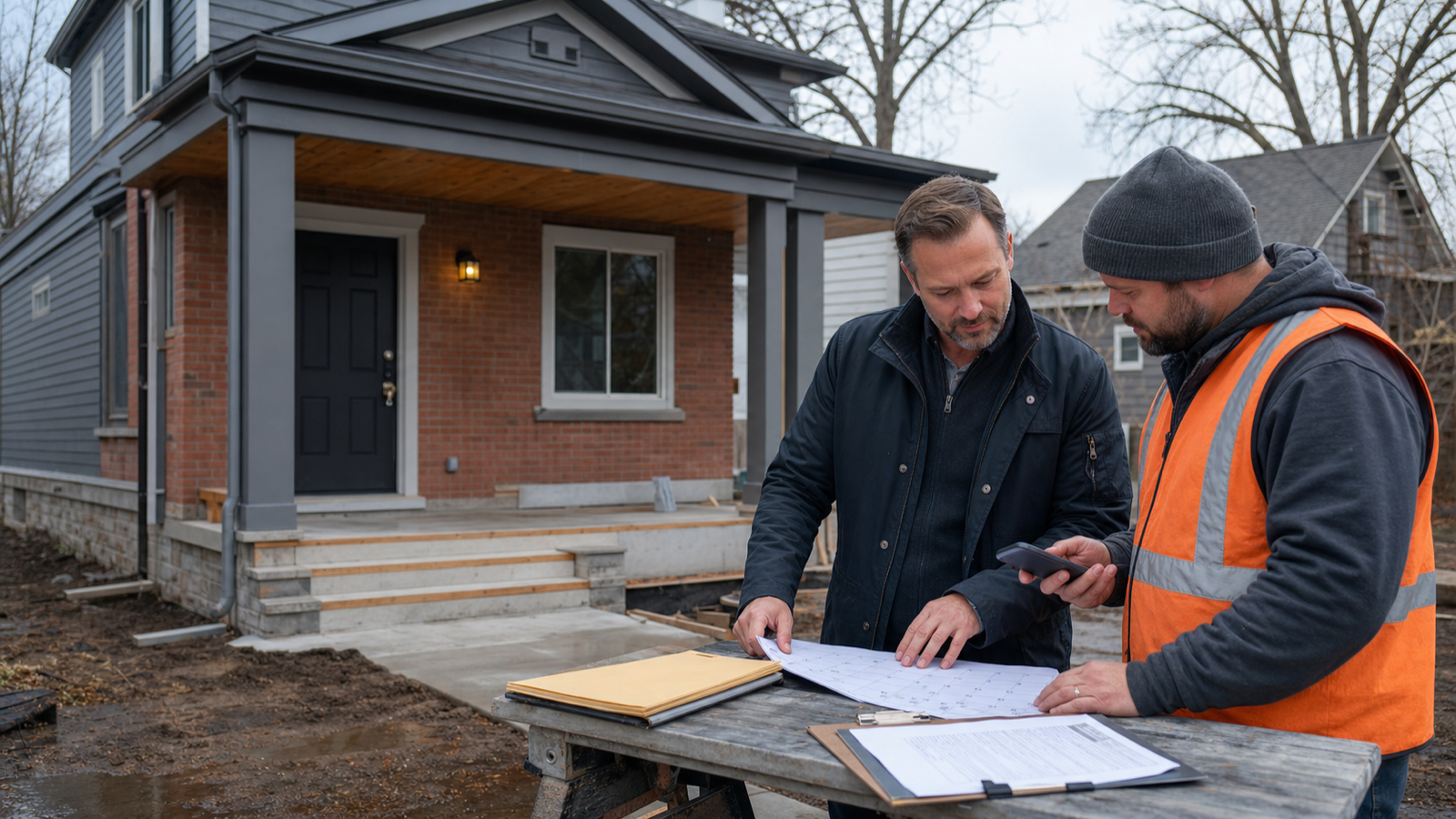
A contingency percentage can hide the real risk. A delay scenario shows which event occurs, how long it lasts, which costs continue, and whether the event creates new costs.
Start with three timelines:
- Base case: supported by current schedules and ordinary execution.
- Downside case: a plausible permit, trade, inspection, repair, market, appraisal, buyer-financing, title, or closing delay.
- Severe but survivable case: a combination that tests liquidity and lender deadlines without pretending every disaster happens at once.
Scenario: Mateo prices an extension before borrowing. Mateo's 156-day base case ends nine days before his loan maturity. The documents allow one 30-day extension for a $2,400 fee, subject to lender approval, while interest continues at about $96 per day. His downside case includes the $2,400 fee plus $2,880 of extra interest and $1,050 of tax, insurance, utilities, and site care. The 30-day delay costs about $6,330. Mateo keeps that amount outside the construction contingency and asks the lender what could prevent extension approval.
Scenario: Priya solves the schedule, not just the budget. Priya's cabinetry delay would idle electrical trim, counters, plumbing, final inspection, and photography for 24 days. Her carrying rate is $141 per day, so waiting would add about $3,384 before rental and remobilization costs. She and the contractor choose an in-stock cabinet line that costs $1,900 more but preserves the critical path. The more expensive material is the lower total project cost in this scenario.
Find the daily cost of a decision
A daily carrying rate makes schedule choices concrete. If expediting a survey costs $650 and is reasonably expected to save eight days at $126 per day, the potential avoided carrying cost is $1,008. That does not automatically justify the fee. The eight-day saving must be credible, the survey must be on the critical path, and the decision may carry other risks. The calculation simply makes the tradeoff visible.
Update the exit timing with the same discipline. A signed contract can terminate. An appraisal can require repair. Title can uncover an issue. A closing can shift across a tax, interest, insurance, or association billing date. Model the expected closing date and a later date in the sell, rent, or refinance decision.
7. Control holding costs while the project is active
You cannot reduce every holding cost, but you can prevent unpriced time from becoming invisible. The best control is a current schedule tied to commitments, invoices, inspections, and the exit plan.
Review the critical path every week
Ask which unfinished task controls the earliest realistic listing or closing date. Confirm the responsible person, required predecessor, promised date, evidence of completion, and recovery plan. Do not celebrate a finished paint task if the missing electrical inspection still blocks the entire project.
Forecast cost to complete, not only cost spent
Paid-to-date answers what already left the bank. Committed cost adds signed contracts and purchase orders. Forecast adds the best current estimate of remaining work and holding days. A project can appear under budget because several invoices have not arrived while the schedule is already late.
Change the cost forecast when the date changes
If the completion forecast moves ten days, extend interest, tax, insurance, utilities, services, equipment, and administration that continue. Add any new remobilization, permit, security, or seasonal cost. Record the reason and owner. Do not wait until the monthly bill proves a delay that the schedule already showed.
Use budget and expense tracking to keep the approved baseline, commitments, actual payments, and updated forecast distinct. Store lender statements, bills, policy documents, and receipts with reports and collaboration so partners can see the evidence behind the current number.
8. Keep records for decisions, reconciliation, and tax review
A good holding-cost record answers who was paid, how much, when, for what property, for which period, under which agreement, and how the amount was classified in the project. Save the original document, proof of payment, and any allocation calculation.
The IRS says a business may use a recordkeeping system suited to the business if it clearly shows income and expenses. Its guidance says supporting documents should identify the payee, amount, proof of payment, date incurred, and description. See the IRS business recordkeeping guidance.
Tax classification is not the same as the underwriting label “holding cost.” Current IRS Publication 551 discusses basis, settlement costs, carrying charges, construction costs, and capitalization rules. The treatment can depend on whether property is held for investment, used in a business, produced, or acquired for resale, along with taxpayer-specific rules and elections. Do not publish a project profit or file a return based only on the categories in this guide.
Reconcile the project at exit
- Replace every remaining estimate with the final invoice, statement, settlement figure, or documented accrual.
- Split loan payments among principal, interest, escrow, and fees using lender records.
- Reconcile tax prorations, insurance refunds, deposits, utility credits, association balances, and loan payoff.
- Preserve the original budget and delay forecasts instead of rewriting them to match actual results.
- Ask the tax professional to map project records to the correct return treatment.
This comparison is useful product-workflow evidence. In Rehabfolio, the early analysis, approved budget, expenses, tasks, documents, and exit result can remain attached to the same property. The editorial team uses that lifecycle to test whether a guide's categories can survive the handoff from an assumption to an actual record.
9. Use this holding-cost checklist before making an offer
- Acquisition closing date and financial responsibility start confirmed
- Permit, mobilization, construction, inspection, listing, contract, and closing periods estimated in calendar days
- Signed or proposed loan terms separated into principal, interest, escrow, and fees
- Current property tax bill and assessment schedule reviewed
- Written insurance quote matches vacancy, construction, occupancy, liability, and property risks
- Flood, association, special assessment, and local property obligations checked
- Utilities and seasonal property protection estimated by phase
- Security, lawn, snow, pest, cleaning, storage, equipment, and site services included where applicable
- Base, downside, and severe but survivable timelines calculated
- Loan maturity, extension conditions, fees, and payoff process documented
- Holding reserve kept separate from renovation contingency
- Every input labeled as observed fact, calculation, assumption, or opinion
- Weekly schedule changes connected to the cost forecast
- Source documents and proof of payment stored for reconciliation and professional review
If this is your first complete analysis, start with how to analyze your first investment property. The holding-cost budget should support the full decision, not become an isolated spreadsheet tab.
Frequently asked questions
What are holding costs in a house flip?
Holding costs are the recurring costs of owning and controlling the property between acquisition and exit. Common examples include financing charges, property taxes, insurance, utilities, association fees, security, lawn or snow service, and routine site maintenance.
When do holding costs start and stop?
For an owned property, the practical budget usually starts on the acquisition closing date and ends on the sale closing date or refinance funding date. Confirm prepaid interest, tax prorations, insurance dates, lender payoff rules, and any costs that continue after the property is listed or under contract.
How do I calculate a daily holding cost?
Add the recurring costs expected during the ownership period, divide annual items into the covered period, and divide the total by the number of planned days. Keep one-time acquisition, renovation, and selling costs in separate categories so they are not counted twice.
Should loan principal count as a holding cost?
Principal reduces the loan balance, so it is different from interest and lender fees. Track principal for cash planning and payoff reconciliation, but do not automatically treat the full payment as an economic expense. Ask an accountant how each amount should be recorded for your facts.
How much contingency should I add for holding costs?
There is no universal percentage. Build a specific delay scenario based on permit timing, construction risk, inspection availability, listing preparation, market time, buyer diligence, financing, and closing. Multiply the additional days by the costs that continue, then add any event-specific expense.
Are house flipping holding costs tax deductible?
Tax treatment depends on the activity, entity, accounting method, type of cost, and whether capitalization rules apply. IRS guidance discusses basis, carrying charges, resale activity, and recordkeeping, but it does not replace advice for your situation. Keep detailed records and consult a qualified tax professional.
Sources and further reading
- Consumer Financial Protection Bureau: principal and interest versus total monthly payment
- Consumer Financial Protection Bureau: complete homeownership cost budgeting
- Federal Emergency Management Agency: Flood Map Service Center
- Internal Revenue Service Publication 551: Basis of Assets, December 2025 revision
- Internal Revenue Service: business recordkeeping guidance
Editorial methodology. The Rehabfolio editorial team reviewed existing Rehabfolio guides for search-intent overlap, consulted current primary government sources, separated source-backed facts from illustrative calculations, and tested the worked example through the product's deal-analysis, schedule, budget, expense, document, and exit workflow concepts. Dollar amounts and timelines are teaching assumptions, not market averages or promises. Sources were last reviewed July 20, 2026.
Track the deal from first estimate to final closing.
Keep assumptions, tasks, expenses, documents, and the current forecast attached to one property.
Create free account