How to estimate rehab costs from photos before you walk the house
Listing photos and wholesaler packs can start a rehab scope. They cannot finish one. This guide shows United States residential investors how to sort a photo set, price only the work the pictures support, park hidden systems as named unknowns, and keep that preliminary number out of the offer until a walkthrough or a bid replaces it.
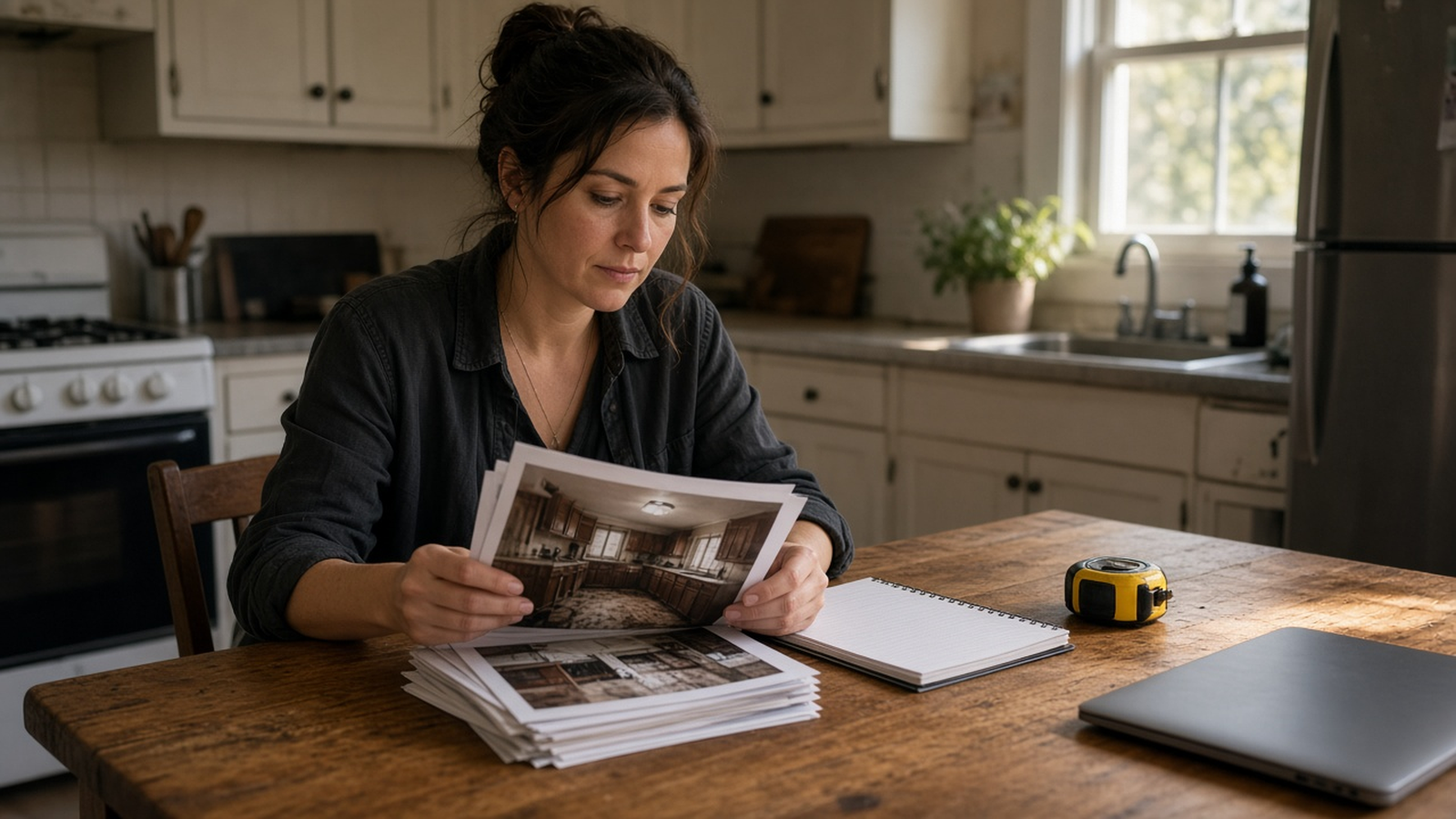
Written and reviewed by the Rehabfolio editorial team. Published and last reviewed October 3, 2026.
Who this guide is for. This guide is for beginner and early United States investors who flip, BRRRR, or wholesale one-to-four-unit houses and who often see the property first as a photo pack. It starts when you receive listing photos, a wholesaler folder, or your own phone pictures, and it ends when you either book a walkthrough or you decline the deal because the visible work already breaks your numbers. If you already have access and a tape measure, leave this page and use how to estimate a renovation budget. If you are writing the document contractors will bid, use the scope of work guide. If a model has already handed you a confident repair total, read how to use AI for underwriting before you accept it.
The Rehabfolio editorial team builds and reviews product workflows that store walkthrough photos, room notes, scope lines, allowances, and bids in one project record. That is first-hand product experience organizing a photo log beside an estimate. It does not make the team a contractor, home inspector, lead renovator, appraiser, electrician, roofer, insurer, lender, attorney, or cost estimator. Dollar figures below are original teaching examples. They are not local quotes, market averages, or results from a real project.
Photo quality, access, permit rules, lead rules, and trade pricing differ by house, city, and the exact scope you later write. This page is educational. It is not a bid, an inspection, a lead determination, or investment advice.
Tip: Keep this photo guide beside contingency, due diligence, the 70% rule, the rehab cost calculator, rehab estimating, and the fix-and-flip workflow. The photo draft feeds those steps. It does not replace them.
1. Separate a photo screen, a scope, and a bid
Beginners collapse three different documents into one number called "repairs." A listing photo set, a written scope, and a contractor bid answer different questions. Mixing them is how a bright kitchen photo becomes a purchase price you cannot defend.
- Photo screen. A dated list of what the pictures show, what they do not show, and a dollar allowance only for visible work. Its job is to decide whether the deal deserves a walkthrough, not to fund the project.
- Scope of work. A room and trade description with quantities, specs, inclusions, exclusions, and named unknowns. Contractors can price it because two bidders are looking at the same work. That document is the bid-ready scope, and you usually cannot write it from a staged listing gallery alone.
- Bid or working budget. A price from a contractor, or your own reviewed budget after access, measurements, and allowances. The renovation budget guide starts here, after the walk, not at the photo screen.
A photo screen can be wrong and still be useful. It is useful when it stops you from offering as if the house were cosmetic, and when it stays labeled as a screen after better evidence arrives. It is harmful when you paste the total into a maximum-offer formula and treat missing rooms as zero.
InterNACHI's Home Inspection Standards of Practice say a professional inspection is not technically exhaustive, will not identify concealed or latent defects, and does not require the inspector to produce repair cost estimates. A photo pack is thinner than that inspection. If a licensed visual survey of the accessible house is not a repair bid, a gallery of listing pictures is not one either.
2. Sort the photo pack before you price anything

Do not open a calculator on the first image. Sort the pack into rooms and systems, then write what is missing. A useful photo log has six columns you can keep on paper: room or system, photo count, what is visible, what is blocked, the quantity you can actually see, and a status of photo-supported, allowance, or unknown.
Work in a fixed order so you notice gaps. Exterior and roof from the street, then porch and foundation line, then each interior room clockwise from the entry, then kitchen, baths, mechanical space, electrical panel, attic hatch, and crawl or basement. If a stop has no photo, the status is unknown. Do not borrow a condition from a neighboring room because the paint color matches.
Wide listing photos hide scale. A kitchen can look "dated" and still be 8 feet or 14 feet of cabinet run. If you cannot see both ends of a run, do not invent a linear foot count. Write "cabinet run not measurable from photos" and use a range only if you label it as a range. The same rule applies to floor area. Listing square footage is a separate record. Do not treat it as a flooring quantity until you know whether it includes the basement, the garage, or an addition the photos never enter.
Staged photos are a condition problem, not just a style problem. A sofa can cover floor damage. A fridge can cover an open wall. A rug can cover a soft spot. When furniture blocks the finish, the status for that surface is unknown, even if the rest of the room looks clean. Cropped photos have the same effect. If the frame cuts off the ceiling, you do not have a ceiling photo.
Record the source and the date. A wholesaler pack from March is not the house in October if a roof has been tarped, a kitchen has been partly demoed, or a tenant has moved out. Ask whether anyone has altered the house since the pictures. If you cannot get an answer, say so in the log. Silence is an unknown, not a confirmation that nothing changed.
3. Price only what a picture can support
A photo-supported line needs four things: a visible condition, a quantity you can explain, a finish level you chose on purpose, and a unit price you are willing to replace later. If any one of those is missing, the line is an allowance or an unknown. It is not a bid.
- Paint. You can often see scuffed walls, smoke color, or damaged drywall in a wide shot. You still cannot see how many coats, the lead status of the existing paint, or whether the drywall is soft. A paint allowance for visible rooms is fair. A whole-house paint number that includes rooms you never saw is not.
- Flooring. Photos can show carpet, vinyl, or damaged hardwood in the rooms they enter. They cannot show the subfloor. Price the finish you can see, and add a named subfloor unknown if the photos show stains, slopes, or soft spots, or if you have no floor photo at all.
- Kitchen and bath finishes. Dated cabinets, a worn counter, a stained tub, and a visible appliance set can support a cosmetic package. They cannot support a plumbing reroute, a layout change, or a statement that the drains are sound. Keep layout changes out of the photo screen unless a floor plan and a contractor have already looked.
- Exterior cosmetics. Peeling porch paint, a cracked step, and a tired front door can be priced as visible work. Siding photos taken from the curb do not tell you whether the sheathing is wet.
Put labor and materials in the note even when you only have one allowance number. A $6 per square foot flooring allowance might mean material plus install in your market, or material only. Write which one you meant. When you later compare bids, the contractor vetting guide only works if every bidder sees that same assumption.
Do not use a single price per square foot for the whole house as the photo estimate. A square-foot shortcut cannot see how many kitchens you have, whether the panel was photographed, or whether the roof is a close-up or a speck in a twilight exterior. If you want a quick screen after the lines exist, you can divide the photo-supported subtotal by the area you actually priced and ask whether that unit rate is even plausible. The unit rate is a check. It is not the scope.
The free rehab cost calculator can hold a first stack of repair, holding, and selling assumptions in the browser. Use it after you have separated photo-supported lines from unknowns. If you type one blended repair number, the calculator will treat that blend as if it were known. The math is only as honest as the input.
5. Keep lead, access, and code out of the pretty total
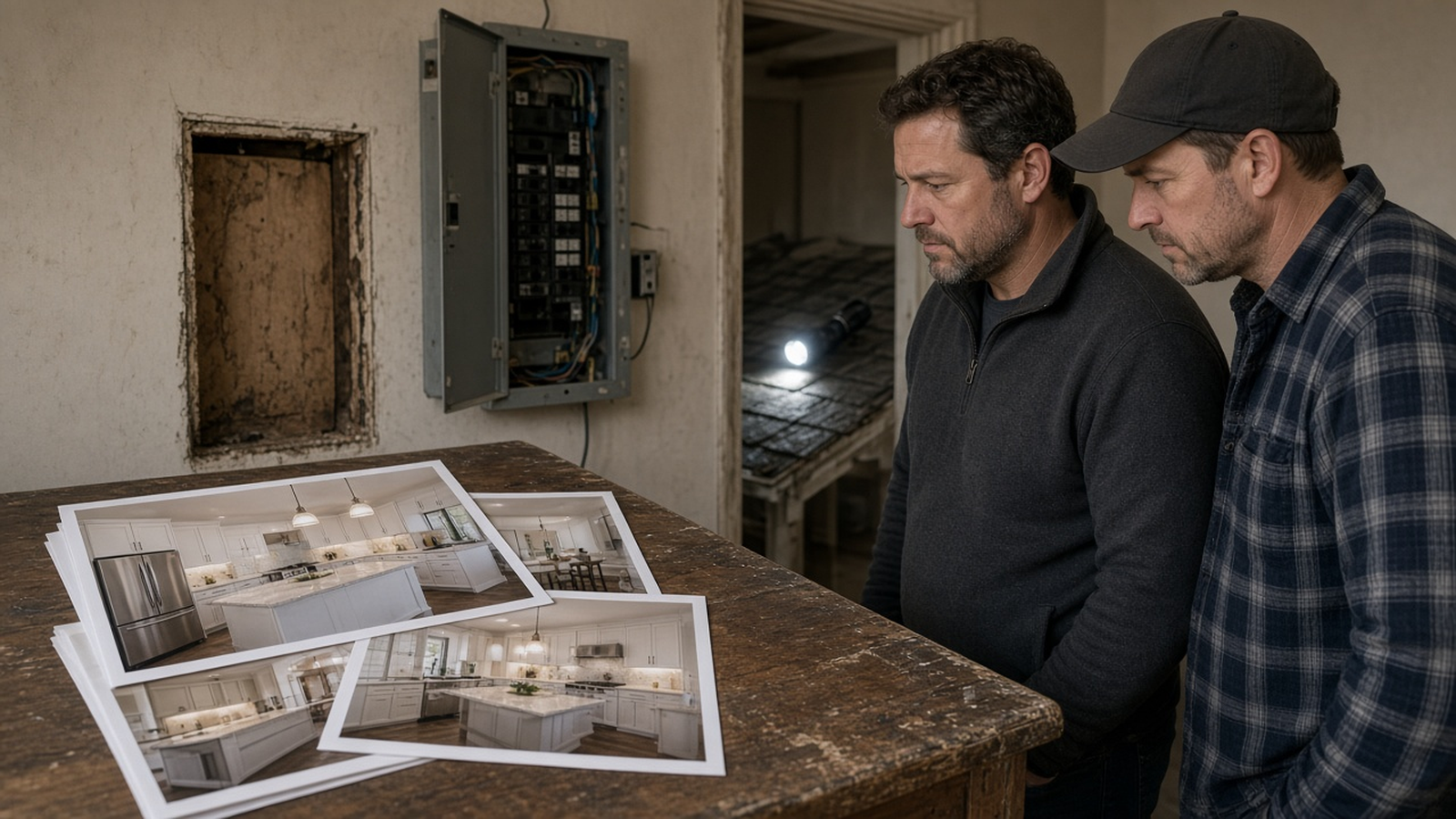
The U.S. Environmental Protection Agency states that in 1978 the federal government banned the sale of lead-based paint for use in homes, childcare facilities, and preschools, and that approximately three-quarters of U.S. homes built before 1978 still contain some lead-based paint. Intact paint in a listing photo does not tell you whether lead is present. Peeling paint does not, by itself, prove the lead content either. A photo is not a paint inspection.
EPA's Lead Renovation, Repair and Painting program requires that anyone paid to disturb painted surfaces in homes, childcare facilities, and preschools built before 1978 be certified, and that workers be trained in lead-safe practices. EPA also says the rule generally does not apply to homeowners working on their own pre-1978 homes, and that it does apply if you buy, renovate, and sell homes for profit. Some states and one tribe run authorized programs instead of the federal program. The EPA page lists them. Check that list for the job site rather than assuming every certificate looks the same.
For the photo screen, the correct lead line on a pre-1978 house is often a sentence, not a fake dollar amount: "Paid work that disturbs paint may require a certified firm. Photos do not determine lead content. Confirm before demo." If you drop $2,000 into the cosmetic total and call it lead, you have invented a price and hidden a compliance step. A real lead inspection, a certified renovator, or a different scope can replace that sentence later. The photo pack cannot.
The separate lead-based paint disclosure rule requires sellers, landlords, agents, and property managers to give known lead information before most pre-1978 sales or leases are signed. That disclosure is about what the seller knows. It is not a rehab estimate, and a missing disclosure is not something you can see in a kitchen photo. Put the disclosure packet on the due diligence list in the inspection-window checklist.
Access limits belong in the same honesty pass. A tenant-occupied house may block the panel, the attic, and the garage. A winter photo set may hide the roof under snow. Write those limits at the top of the screen so a partner does not read your paint number as a whole-house price. Code and permit cost also stay out of the photo total until you know the scope a local building department will actually review.
6. Use a photo-scope checklist with no account
Copy this list onto paper or into a spreadsheet before you create any login. The point is to finish a screen you can defend, then decide whether the house earns a visit.
- Write the address, the photo source, and the date of the pack.
- List every room and system in your fixed order, including ones with zero photos.
- For each group, note what is visible, what furniture or cropping blocks, and what quantity you can measure.
- Mark each row photo-supported, allowance, or unknown. Do not leave the mark blank.
- Price labor and materials only on photo-supported rows. State the finish level in words.
- Add a named unknown row for roof, structure and moisture, electrical, plumbing, HVAC, and pre-1978 paint disturbance when those photos are missing or useless.
- If you need a screen total, show two figures: the photo-supported subtotal, and the unknown reserve. Do not add them and erase the labels.
- Compare that pair with your walk-away repair limit from the offer math. If the visible work alone already fails, you can decline without a trip.
- If the screen still fits, book access. Take the missing photos yourself, then replace rows. Do not edit history. Keep the first log.
- When bids arrive, retire the photo prices they replace. The surviving document is the scope and the budget, not the gallery.
That checklist is the worked tool in this guide. You can run it on the next pack you receive. Software can store the same rows later. It is not required to do the thinking.
7. Work three named investor scenarios
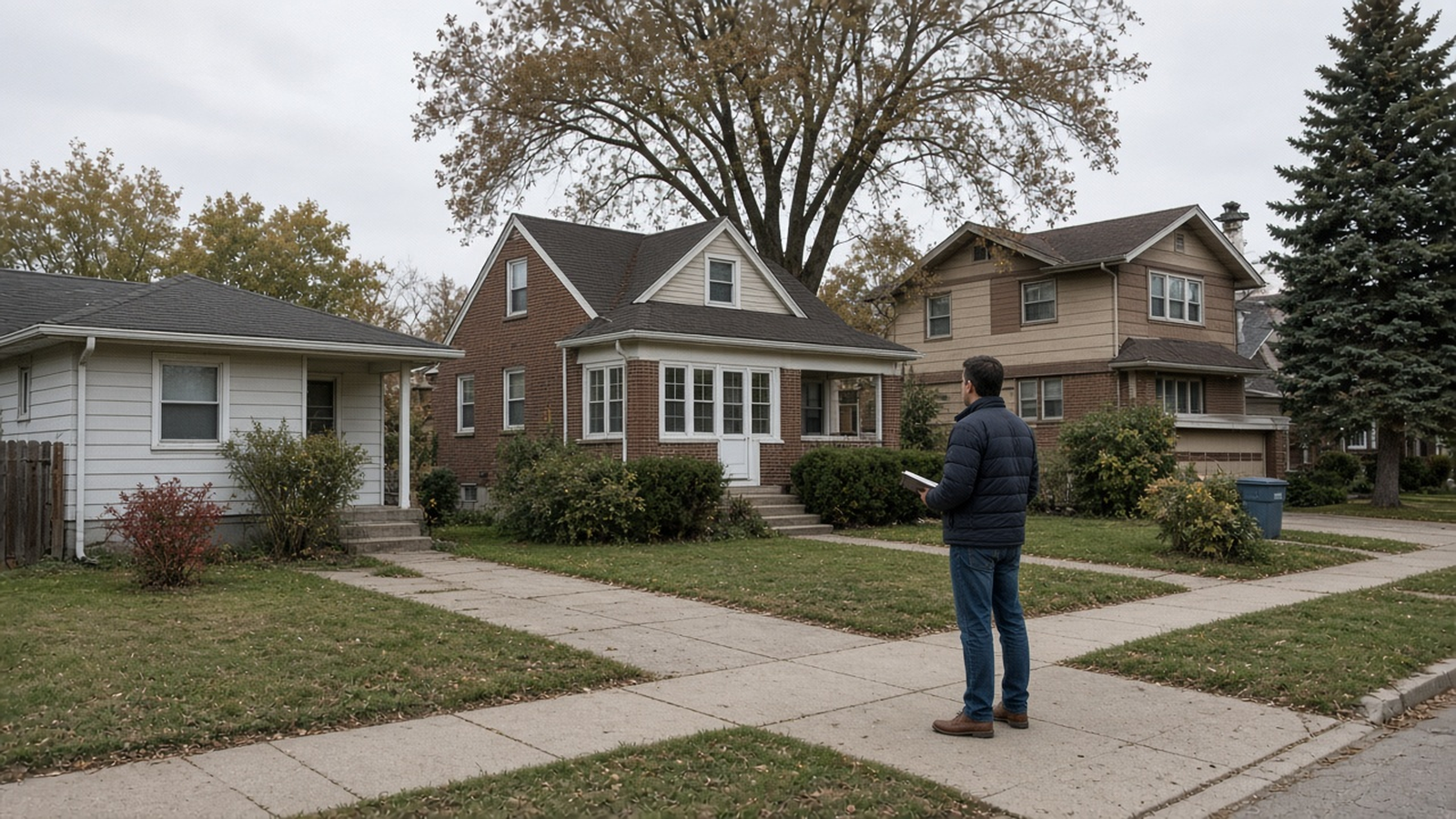
These three houses are fictional composites. Names, cities, and prices are teaching choices. They are not case studies, testimonials, or quotes you should reuse.
Maya Chen screens a Dayton ranch and refuses a single repair number
Maya is looking at a 1956 one-story ranch in Dayton, Ohio, about 1,140 square feet, three bedrooms and one bath. A wholesaler sends 22 photos and talks about a contract near $148,000. She wants a retail flip, but she will not book a flight until the pictures survive a screen.
The pack shows worn kitchen cabinets, a stained bath, carpet in the bedrooms, vinyl in the kitchen, scuffed paint, and a porch with peeling paint and one cracked step. There is no panel photo, no furnace photo, no crawl photo, and only a distant roof. She prices the visible work as allowances she expects to replace: interior paint $4,400, flooring at an installed allowance of $6 per square foot for 1,140 square feet ($6,840), a cosmetic kitchen package $11,800, a cosmetic bath $6,500, and cleaning plus a dumpster $1,150. The photo-supported subtotal is $30,690.
She does not call $30,690 the rehab. Beside it she parks a $15,000 unknown reserve for roof, electrical, HVAC, and the crawl, labeled "not a bid." A blended $45,690 would look tidy in a text message. She refuses to send that blend. She sends the two figures and the missing-photo list. The decision: visit only if the purchase math still works when the unknown reserve is treated as possible, not as optional. The 70% screen lives in the maximum offer guide, using her after-repair value, not this photo page.
Andre Brooks almost trusts a renovated-looking kitchen
Andre reviews a 1948 brick bungalow in Richmond, Virginia. The listing photos are bright. The kitchen looks recently finished. From the pictures he drafts a light cosmetic screen: paint $3,600, floors $5,200, one bath $4,800, exterior paint $3,200, and appliances $2,600. That photo-supported subtotal is $19,400. He is about to tell a partner the house is a "$20,000 rehab."
He stops because the fridge sits tight to a side wall and no photo shows the wall behind it. On the walkthrough that wall is open from an old leak, and the subfloor is soft. A plumber and a carpenter bid $7,750 for the leak and the floor repair, work the gallery never showed. Andre does not average $19,400 and $27,150. He replaces the silent zero behind the fridge with the $7,750 bid and keeps the cosmetic lines that the walk still supports. The working repair figure before contingency is $27,150. The decision: the photo screen was a reason to visit, and the visit retired the idea that the kitchen photos were the whole story.
Elena Vasquez will not invent a lead price from intact paint
Elena is screening a 1972 split-level in Omaha, Nebraska. The photos show intact paint, a tidy basement corner, and ordinary wear. Her photo-supported finish work is paint $3,900, floors $5,800, a light kitchen refresh $8,200, a bath $4,600, exterior touch-up $2,200, and cleaning $1,500. That subtotal is $26,200.
The house is pre-1978. She does not add a made-up lead-abatement line to the $26,200. She writes that paid paint disturbance may require a certified firm, that the photos do not test the paint, and that the basement photo is cropped above the rim joist. The decision: she will not waive inspection to "keep the number clean." If access shows a wet rim joist or a scope that disturbs painted surfaces, those facts become new lines. They do not become a percentage of $26,200.
8. Follow one photo pack through inspection
Stay with Maya's Dayton ranch. The photo-supported subtotal is $30,690. The unknown reserve of $15,000 was only a parking spot so she would not treat blanks as free. She gets access. The walk and the trade visits replace the reserve. They do not get averaged with it.
- Roof: two layers, roofer bid $8,900, including tear-off. The street photo had not shown the second layer.
- Electrical: a 60-amp fuse box with no spare capacity. Electrician bid $4,200 to replace the panel, including the permit in that bid.
- Furnace: 24 years old and still running. HVAC bid to replace it is $6,400. Maya writes both "replace now" and "disclose and defer" so the choice stays visible.
- Crawl space: dry on the day of the visit. No repair line. She notes that one dry day is not a moisture history.
- Bath supply leak at the shutoff, absent from the photos: plumber bid $1,800.
If she replaces the furnace, the resolved system work is $8,900 + $4,200 + $6,400 + $1,800 = $21,300. Added to the $30,690 of finish work that the walk still supports, the repair stack is $51,990 before contingency, holding costs, and selling costs. The old $15,000 reserve is deleted, not added on top. It did its job by keeping the blanks visible.
If she defers the furnace, she does not delete the risk. The stack without that bid is $8,900 + $4,200 + $1,800 = $14,900 of resolved systems, plus $30,690 of finishes, which is $45,590. The $6,400 furnace bid stays on the scope as a named choice. A buyer, an inspector, or a lender may force the replacement later. Deferring it is a decision. It is not a zero.
What she does not do. She does not add 10 percent to $30,690 and call the photo pack "close enough." She does not paste $51,990 into an offer calculator without a contingency policy and a holding-cost estimate. She does not ask a model to smooth the two totals into one confident sentence. The opinion that the ranch "feels like a cosmetic deal" was a reaction to the gallery. The fact set is the line list above.
Elena's Omaha inspection, in the same spirit, finds a stained rim joist the cropped basement photo missed. A carpenter bids $5,400. Her photo-supported $26,200 becomes $31,600 before contingency, and only for the lines the new evidence still supports. She returns to the due diligence checklist and either renegotiates or walks. The photo total is not a number she defends at the closing table.
9. A repeatable Rehabfolio photo-to-scope workflow
- Store the pack with a date. Keep the listing or wholesaler photos as received, before anyone crops them for a brochure.
- Build the room log. One row per room and per hidden system, including rows with no photo.
- Draft lines from the pictures. A person, or a model assisting that person, may draft finish items. Each line stays photo-supported, allowance, or unknown.
- Block the offer. Do not copy a blended repair total into the maximum-offer math while unknowns are still unlabeled.
- Replace rows after access. Inspection notes and bids overwrite the rows they disprove. The first log stays in the file as the screen you used that day.
- Hand the survivor to the scope. When the lines are specific enough to bid, they belong in the scope of work and then in the renovation budget.
- Price the rest of the deal elsewhere. Holding costs, financing, and selling costs are not rehab lines just because they showed up in the same spreadsheet.
Rehabfolio can keep those photos, notes, and scope lines on the property record, and it can draft a repair list from walkthrough photos. The product page for rehab estimating states the limit in plain language: a draft from photos cannot see concealed conditions and does not replace an inspection or a contractor check. Plan limits, including how many photo scopes a free workspace can run, are published on pricing. Read the AI disclosure before you treat any draft as yours. You still accept or reject each line.
AI help on this workflow should stay provider-neutral. The useful test is whether the source photo is still attached, whether unknowns are labeled, and whether a person can refuse a line. The brand of the model does not make a dark crawl photo into a foundation bid.
Frequently asked questions
Can I estimate rehab costs from listing photos alone?
You can build a preliminary scope from listing photos, a wholesaler photo pack, or your own walkthrough pictures. That draft can screen a deal. It cannot see inside walls, under floors, above ceilings, or behind staged furniture. Price only the work the pictures actually support, and keep roof, structure, moisture, electrical, plumbing, and HVAC as named unknowns until someone qualified looks at them.
What should a photo-based rehab estimate include?
Include the photo set and the date you received it, a room or system label for each group of pictures, a short description of the visible condition, a quantity you can defend from the photos, a labor and material allowance only where the work is visible, and a separate list of missing photos. Do not hide missing systems inside a round cosmetic number.
How accurate is a rehab estimate made from photos?
A photo estimate is a screen, not a bid and not a budget. It is often useful for obvious finish work such as paint, flooring, and a clearly dated kitchen. It is weak for anything concealed. Treat a later inspection or contractor bid as a replacement for the affected lines, not as a percentage you average back into the photo total.
Can AI estimate repairs from photos?
A model can draft a room-by-room list from the images you give it. That draft still misses concealed conditions, local code, permit rules, and current contractor pricing. Keep the source photos attached, label each line as photo-supported or unknown, and have a person accept or reject every line before it touches an offer or a project budget.
Which repairs should stay as named unknowns?
Leave a line unnamed in dollars when you have no photo, a photo that is too dark or too far away, or a photo that shows only a finished surface over a system. Typical unknowns are the roof deck, the electrical service, supply and drain lines, the furnace and water heater, crawl space or slab moisture, and lead-safe work practices in pre-1978 housing.
When should I stop using the photo estimate?
Stop using it as soon as you have access, an inspection, or a bid that contradicts a line. Replace that line. Do not keep the photo number because it made the deal look better. The photo pack remains evidence of what you knew on that date. It is not the working budget.
Does Rehabfolio price local contractor work from photos?
No. Rehabfolio can organize a photo log and help draft a scope from walkthrough photos. It does not know your local labor rate, does not see behind finishes, and does not replace an inspector, a certified renovator, or a contractor bid. You review every draft. Current plan limits, including any monthly photo-scope allowance, are on the pricing page.
Editorial methodology, limitations, and sources
The Rehabfolio editorial team chose this topic because investors search for a way to price rehab from photos, and the library did not yet have a page for that narrower job. The renovation budget guide remains the home for a walkthrough estimate, bids, and a frozen project budget. The scope of work guide remains the home for a bid-ready description. The AI underwriting guide remains the home for rejecting unsupported model output. The contingency, due diligence, permits, and maximum-offer guides stay in place for reserves, the inspection window, approvals, and walk-away price. This page is only the photo screen that happens before those documents.
Key sources include the EPA Lead Renovation, Repair and Painting program, including the 1978 lead-paint ban, the statement that approximately three-quarters of U.S. homes built before 1978 still contain some lead-based paint, the certification duty for paid work that disturbs paint in pre-1978 housing, and the note that the rule applies when you buy, renovate, and sell for profit. The EPA real estate disclosure page describes the duty to provide known lead information before most pre-1978 contracts or leases are signed. InterNACHI's Home Inspection Standards of Practice state that an inspection is not technically exhaustive, will not identify concealed or latent defects, and does not require repair cost estimates. Those pages support the limits in this guide. They do not set your contractor price.
Public guidance cannot tell you what a Dayton roof costs this month, whether a particular panel is safe, or whether paint in one house contains lead. Examples are original composites. Names, addresses, and figures are illustrative. They are not testimonials or performance claims. Replace every allowance with local evidence before you rely on it.
Editorial standard. We identify the audience, author, review date, topic boundary, assumptions, calculations, product limits, and sources. We do not invent credentials, licenses, testimonials, market statistics, or guaranteed savings. AI may help organize research and draft, and a person reviews the claims, calculations, links, examples, and limitations before publication. We revise the guide when a cited rule, a product workflow, or a material estimating practice changes. See the editorial methodology.
Keep the photo log, the unknowns, and the later bids on one property record.
Start a free workspace when you want the listing pack, the room list, and the replacement bids in the same file. The draft is not the budget until you accept it.
Create free account