House flip scope of work: how to write a bid-ready SOW
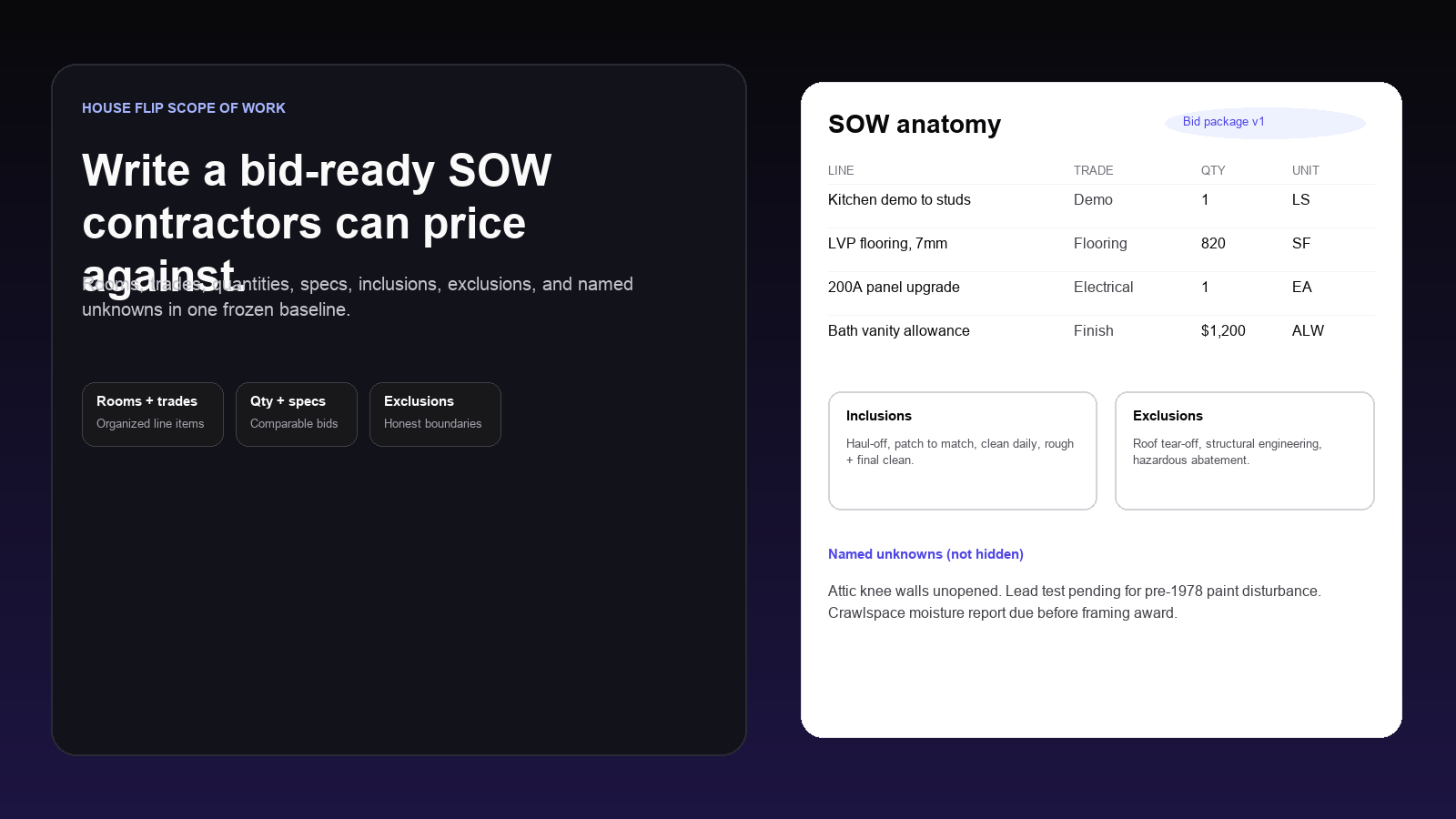
A scope of work protects a flip only when contractors can price the same rooms, trades, quantities, and exclusions, and when you freeze that baseline before demolition. This guide shows how to write a bid-ready SOW, separate it from estimates and change orders, run three named investor scenarios, and keep the frozen package connected to draws, permits, and schedule.
Published and last reviewed September 11, 2026 · Written and reviewed by the Rehabfolio editorial team.
Who this guide is for. This guide is for United States residential investors who can list major repairs and now need a written scope contractors can bid against without guessing. It starts after walkthrough notes exist, and it ends when the SOW is versioned, awarded, and frozen before work. If you are still estimating dollars without line items, begin with how to build your first repair budget. If you are still verifying the purchase, begin with the due diligence checklist. If work has already started and something changed, also read house flip change orders.
The Rehabfolio editorial team builds and reviews product workflows that connect property analyses, repair scopes, contractor bids, budgets, schedules, tasks, photos, files, change orders, expenses, lender draws, contingency balances, and project reports. That gives the team first-hand product experience tracing a line item from underwriting assumption through field evidence, award, and freeze. It does not make the team a contractor, construction manager, architect, engineer, attorney, lender, title professional, inspector, insurer, accountant, or tax adviser.
Building codes, permitting, hazardous-material rules, consumer-protection law, lending draw rules, insurance, and tax treatment differ by state, locality, property type, occupancy plan, and loan. This guide is educational information, not legal, construction, lending, insurance, accounting, tax, or investment advice. Use local licensed professionals for the house in front of you.
Tip: Keep this SOW guide beside the live workflows for repair budgeting, contractor vetting, payment schedules, permits and inspections, project schedules, and contingency budgets so the written baseline stays connected to estimating, award, cash, compliance, time, and reserve.
1. Define the SOW versus estimate, bid, and change order
Beginners often use "scope," "budget," and "bid" as if they were the same document. They are not. Mixing them is how two contractors return numbers that look comparable on a summary line and describe totally different houses.
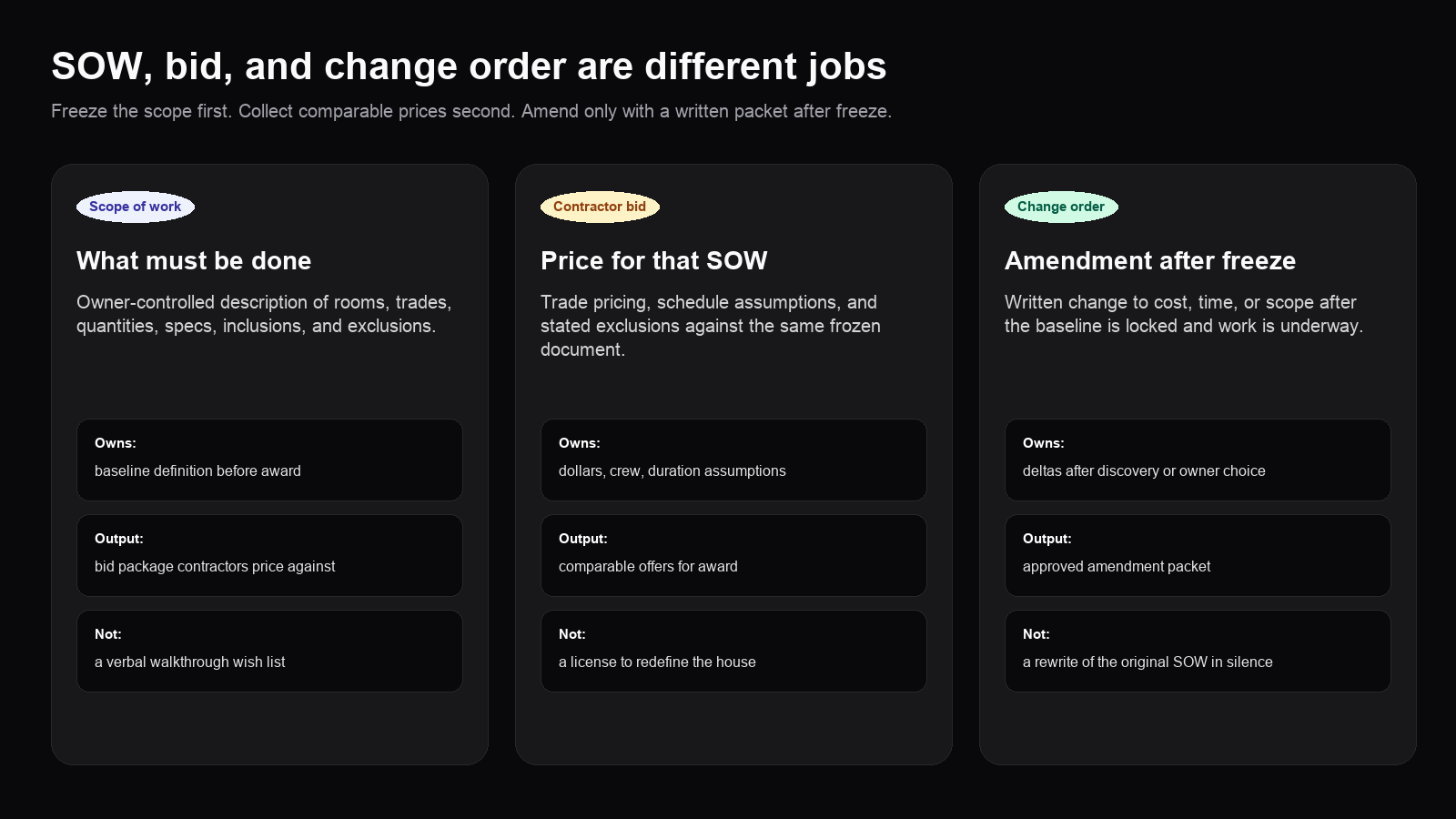
- Estimate is your underwriting forecast of likely cost. The repair budget guide owns how to assemble that forecast from walkthrough evidence.
- Scope of work is the owner-controlled description of what must be done: rooms, trades, quantities, specs, inclusions, exclusions, and named unknowns. This guide owns that document.
- Bid is a contractor's price and duration assumptions against that SOW. Vetting who may bid belongs in contractor vetting.
- Change order is a written amendment after the SOW is frozen. See house flip change orders.
- Contingency is the reserve for true unknowns after freeze, kept separate from allowances and upgrades. See the contingency budget guide.
Keep four evidence types separate while you write. Observed facts are photos, measurements, inspection notes, and permit research. Calculations convert quantities into estimated dollars and schedule days. Assumptions cover what sits behind unfinished walls or how long a specialty trade will take. Opinions describe comfort with a finish level or contractor personality. "Hall bath is 5 by 8 feet and the tub surround is cracked" is fact. "We will figure out the bathrooms later" is an opinion that destroys bid quality.
2. Build room and trade line items that can be priced
A bid-ready line item answers six questions without a phone call: Where is the work? What trade owns it? What action happens? How much quantity? What material or finish standard applies? What is explicitly out of scope for that line?
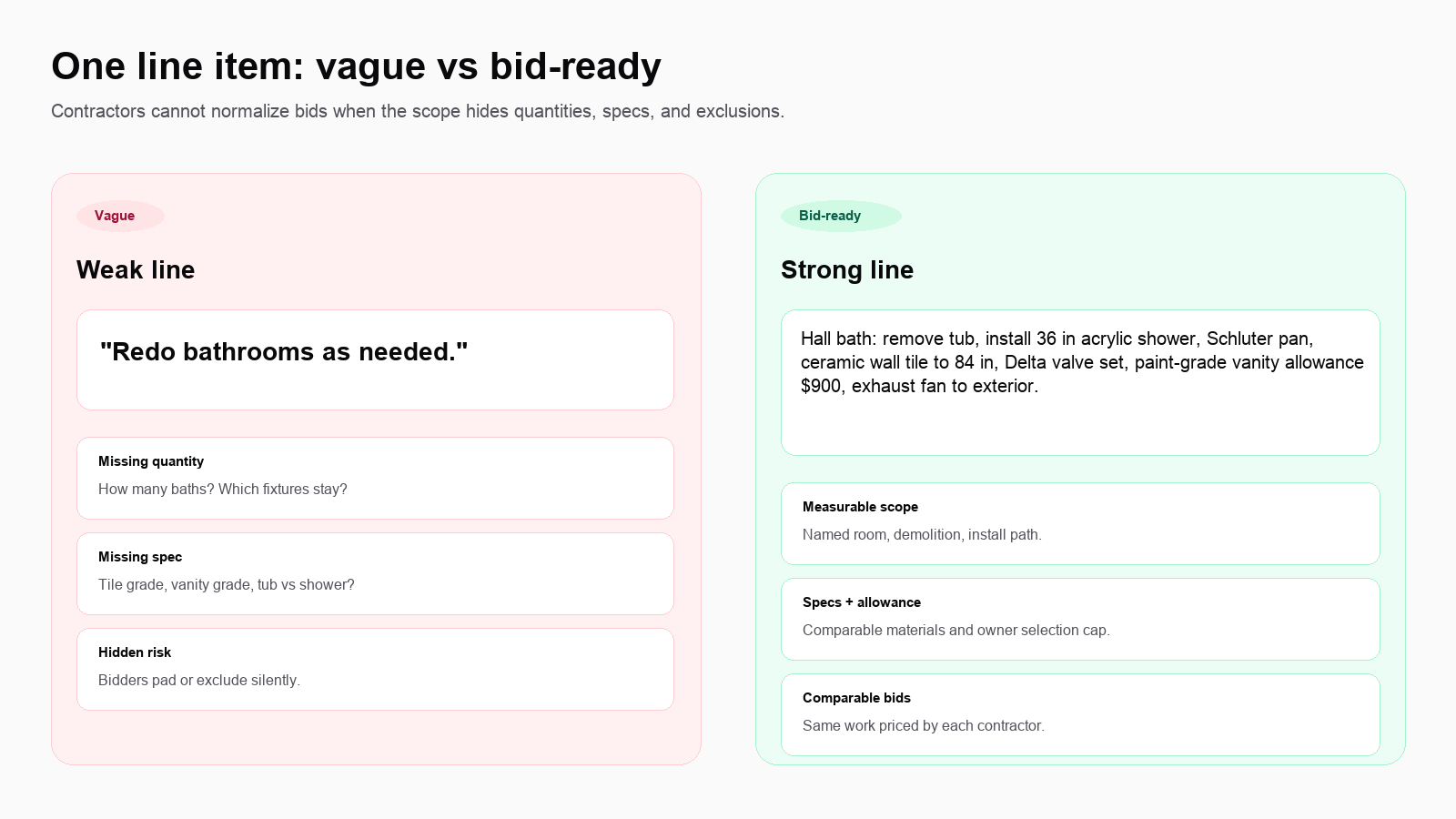
Organize the package by room or area first, then by trade inside each area, or by trade with room tags if your team prefers trade packages. Either pattern works when every line is complete. Incomplete patterns look like this: "kitchen remodel," "update electrical," "floors throughout." Complete patterns look like this: "Kitchen: demo cabinets, sink, and resilient flooring to subfloor; haul-off included. Install 18 linear feet paint-grade shaker cabinets per plan, laminate counters allowance $42 per SF, LVP 7mm waterproof plank 220 SF including underlayment, plumbing rough for existing sink location only."
Quantities deserve units that bidders recognize: SF, LF, EA, LS, SQ, and clear allowance dollars. Specs deserve brand-or-equal language only when you mean it, and equal substitutions should require written approval. If you care about a specific shower pan system, valve trim, flooring wear layer, or paint sheen, write it. If you only care about a price band, write an allowance with a cap and a selection deadline tied to the material procurement plan.
Photos and measurements belong with the SOW, not in a separate text thread. Attach annotated room photos, a simple floor sketch, fixture counts, and any inspection excerpts that justify the line. Bidders price what they can see. When evidence is thin, they either pad or exclude.
3. Write inclusions, exclusions, and allowances on purpose
Most scope fights are boundary fights. One contractor assumes dumpster and daily clean are included. Another assumes owner haul-off. One includes paint of all touched trim. Another paints only new work. Put the boundaries in writing once so every bid rests on the same ground.
- Inclusions often cover protection of finished spaces, daily clean, final clean, haul-off, patch-to-match for opened walls, temporary toilets if needed, and basic hardware that makes a room usable at turnover.
- Exclusions often cover structural engineering, hazardous material abatement, roofing if not in package, landscaping, window replacement outside listed openings, and owner-supplied materials delayed past the install window.
- Allowances are owner-selection budgets with a documented cap, such as lighting packages, appliances, or vanity sets. Keep allowances out of contingency. Contingency is for unknowns, not for nicer fixtures.
Consumer-facing renovation guidance consistently stresses clear written project terms before work starts. That is not only a scam-avoidance tip. It is also how you make bids comparable and how you reduce mid-job reinterpretation. Pair the written SOW with contractor verification from the vetting guide and payment controls from the payment schedule guide.
4. Name unknowns without hiding them in every line
An honest SOW does not pretend every cavity was opened. It lists what you could not verify and how those items will be handled after freeze. Hiding uncertainty as five percent padding on every trade makes bids harder to compare and makes later discoveries look like contractor failure instead of planned risk.
Typical named unknowns include attic knee walls not opened, crawlspace moisture pending a specialist visit, roof sheathing not visible from the attic hatch, lead-safe work practices pending confirmation for pre-1978 paint disturbance, and cast-iron stacks observed only at cleanouts. Write the unknown, the verification step, the decision owner, and whether a contingency reserve or a change packet will fund the lasting fix.
Hazardous-material and older-home renovation rules are local and fact-specific. National materials from the EPA Lead Renovation, Repair and Painting Program and related safety agencies explain why older finishes and dust controls matter. They do not replace local testing, certified firms where required, or your own written exclusions. Put the compliance path beside the SOW instead of hoping a low bidder absorbs it silently.
5. Match the SOW to draws, schedule, and permits
A beautiful SOW that ignores cash and time still fails in the field. Before award, map SOW sections to milestone draws, inspection gates, and the activity network that will run the job.
- Draws: Group completion evidence so a payment request cites finished SOW lines, photos, and any required waivers. See the payment schedule and lien waiver guides.
- Schedule: Convert major SOW packages into activities with predecessors, including ordering long-lead materials. See the project schedule guide.
- Permits: Tag lines that need plan review, rough inspection, or final signoff so nobody starts covered work without a path. See permits and inspections.
If a lender funds construction, confirm whether the draw schedule expects trade packages, percentage complete, or milestone photos tied to your SOW headings. Misaligned documents create rejected draws even when the physical work is fine.
6. Freeze the baseline before work starts
Freezing means the awarded SOW version stops changing without a written amendment. It is the moment verbal "while you are here" requests lose their power unless they survive a change packet and deal math.
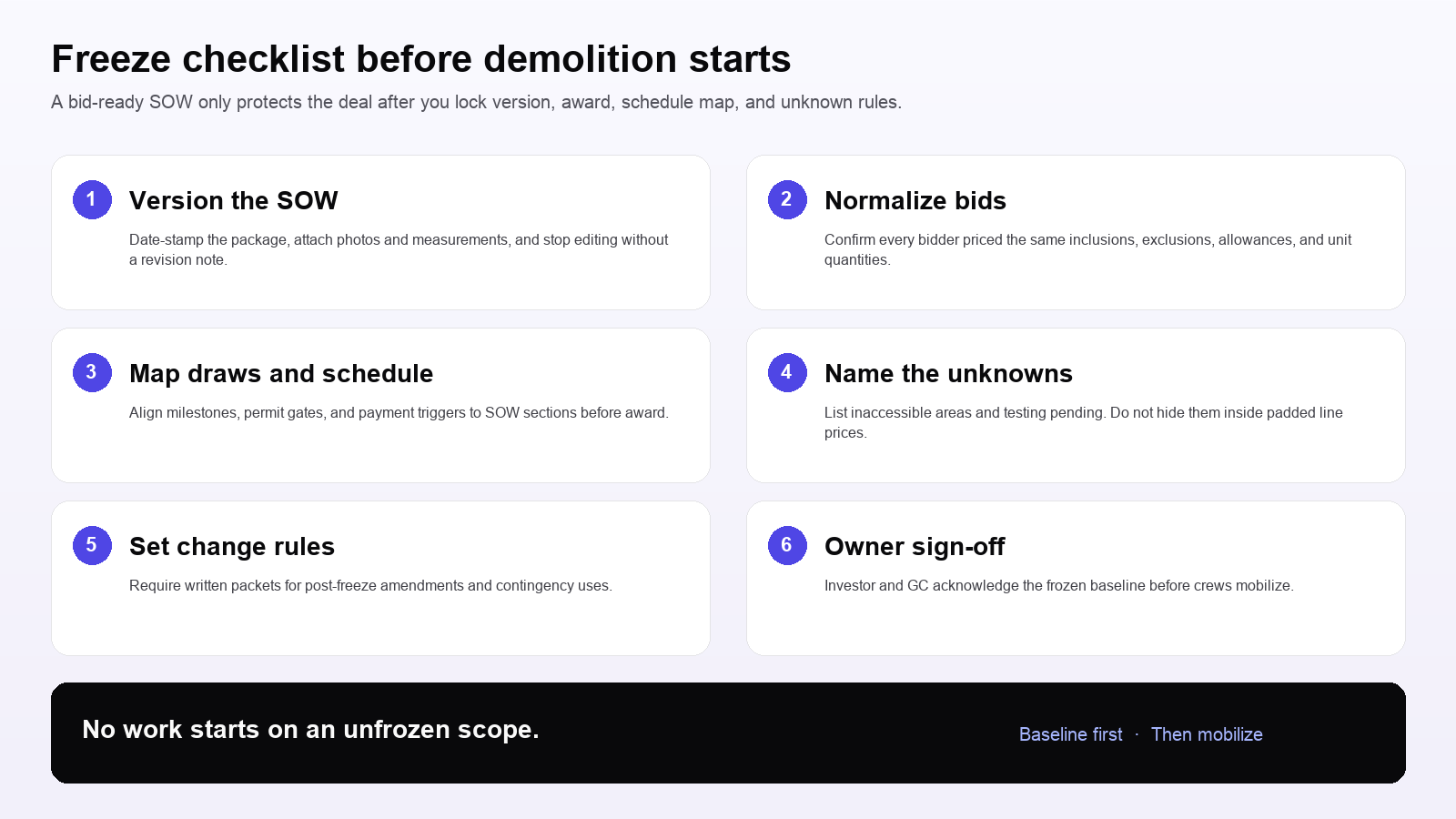
- Version the SOW. Date-stamp the package, attach photos and measurements, and require a revision note for any edit.
- Normalize bids. Confirm every bidder priced the same inclusions, exclusions, allowances, and quantities.
- Map draws and schedule. Align milestones, permit gates, and payment triggers to SOW sections.
- Name the unknowns. List inaccessible areas and pending tests instead of burying risk in padded prices.
- Set change rules. Require written packets for post-freeze amendments and contingency uses.
- Owner and GC sign-off. Acknowledge the frozen baseline before crews mobilize.
After freeze, owner upgrades still happen sometimes. Fund them by reducing finishes elsewhere, adding cash, or rejecting the upgrade. Do not silently raid contingency for nicer tile. Contingency release belongs in the contingency guide, and amendments belong in the change-order guide.
AI tools may help turn inspection PDFs into draft line lists or highlight rooms missing from your package. A person still has to verify quantities, specs, local permit tags, and whether an exclusion is honest. Keep the language provider-neutral: organize evidence, label assumptions, and require human approval before freeze or award.
7. Work three named investor scenarios
Scenario A: Priya Nair freezes a cosmetic townhome SOW before award. Priya is flipping a 2004 townhome bought for $265,000. The work is paint, LVP, lighting, appliances, and hall-bath vanity refresh. After diligence she writes 42 line items with SF and EA quantities, a $1,800 lighting allowance, and exclusions for roofing, HVAC replacement, and exterior painting. Three vetted contractors bid the same package. Normalized prices land at $31,400, $33,100, and $36,800. Priya awards the middle bid after checking schedule assumptions and draw milestones, freezes SOW version 1.2, and rejects a same-week request to "just upgrade the primary shower" until a written change packet shows cost, days, and effect on her $22,000 walk-away profit target.
Holding cost runs about $1,860 per month, or $62 per day. Because the SOW is complete and access is good, she keeps contingency modest and separate at roughly 7 percent of priced work plus soft costs. The point of the scenario is not the percentage. The point is that comparable bids existed only because the SOW existed first.
Scenario B: Marcus Webb rebuilds a 1962 ranch SOW after opening one wall. Marcus underwrote a ranch with kitchen, both baths, panel upgrade, and roof surface in scope. Purchase is $198,000. His first SOW was thin: "remodel kitchen and baths," "update electric," "new roof." Bids ranged from $48,000 to $79,000 with incompatible exclusions. He stops, rewrites room-by-room lines with quantities, attaches photos, and names two unknowns: cast-iron stack condition and sheathing under the old shingles. Re-bid range compresses to $61,000 to $67,500 on the same package.
During selective demolition before full award freeze, the plumber confirms a failed stack section. Marcus does not pretend the original vague bid covered it. He prices the lasting repair at $3,200 and four days, runs change and contingency math against a $24,000 walk-away target and $55 per day hold, then freezes the expanded baseline as version 2.0 before the remaining trades mobilize. The SOW became usable only after it stopped hiding uncertainty.
Scenario C: Elena Vargas refuses to send an incomplete cottage package. Elena reviews a long-vacant pre-1978 cottage. Asking price implies a thin margin if rehab is "about $55,000." She can see water staining, suspect paint layers, and limited attic access. A contractor offers a one-page number with broad exclusions. Elena refuses to collect more bids until the SOW lists demolition limits, lead-safe work assumptions, moisture investigation steps, roof tear-off quantities, and explicit exclusions for structural engineering until a report exists.
The rebuilt package plus named testing allowances and a visible contingency reserve pushes total construction planning near $84,000 before sale friction. Holding assumptions rise because specialty sequencing adds time. The deal falls below her walk-away number. She offers lower, requests seller credits she can verify, and prepares to walk. The SOW did its job by making incomplete work expensive on paper before crews arrived.
8. Follow one complete SOW example
Baseline property. Theo Nakamura is renovating a 1959 ranch bought for $214,000. After diligence, the investor estimate for rehab and soft costs is about $63,000 before contingency. He needs a bid package, not another summary number. Holding cost is about $1,680 per month, or $56 per day. After-repair sale after selling costs supports about $332,000. Walk-away profit target is $25,000.
SOW construction. Theo writes 57 lines across kitchen, hall bath, primary bath, flooring, electrical, HVAC service, interior paint, and exterior entry. Examples: "Hall bath: remove tub and wet wall tile to studs; install 36-inch acrylic shower with Schluter pan system, ceramic wall tile to 84 inches, Delta Monitor valve or equal, paint-grade vanity allowance $900, mirror, exhaust fan ducted to exterior, toilet replace with comfort-height elongated." "Electrical: replace 100A panel with 200A service subject to utility approval; add AFCI/GFCI where required by inspection; smoke and CO detectors per code." Flooring is 1,050 SF LVP 7mm waterproof with underlayment and shoe molding. Exclusions list roofing, window replacement, landscaping, and hazardous abatement beyond painted surfaces disturbed by listed demolition. Named unknowns include attic knee-wall cavities and one soft plaster bay in the hall bath.
Bid normalization. Three contractors return $58,900, $61,400, and $69,200. Theo builds a variance sheet. The high bid excluded haul-off and assumed owner-supplied vanity. The low bid omitted shoe molding and assumed the existing panel could be reused if the utility delayed service upgrade. After aligning inclusions, the adjusted middle package is $62,100 with an eight-week on-site duration assumption. Soft costs and permits add $4,400. Contingency is set separately at 11 percent of priced-plus-soft work because of age and the named plaster bay, or about $7,315. Approved plan is roughly $73,815.
Freeze and early finding. Theo freezes SOW v1.4 with the awarded GC, maps draws to demo, rough, finishes, and final, and links permit tags for electrical and plumbing. In week two the soft plaster bay reveals wet framing. Temporary dry-out costs $420. Lasting framing, plumbing repair, and tile backer are bid at $2,750 and four working days. Extra hold is 4 × $56 = $224. Contingency use would leave about $4,145. Projected profit still clears $25,000 after the use. Theo approves the lasting repair through a written packet funded by contingency, rejects a simultaneous tile upgrade, updates the project schedule, and keeps the frozen SOW intact except for that numbered amendment.
Opinion versus fact. Theo likes the GC's communication. That opinion does not replace quantities, normalized exclusions, or the freeze rule. The same discipline applies on the next house whether the package is cosmetic or a partial gut.
9. A repeatable Rehabfolio SOW workflow
- Collect evidence. Photos, measures, inspection notes, and permit research before drafting lines.
- Draft room and trade lines. Require location, action, quantity, spec, inclusions, and exclusions.
- Separate allowances and unknowns. Cap owner selections. Name verification gaps beside contingency rules.
- Issue one bid package. Same document to every vetted bidder with a response deadline.
- Normalize and award. Adjust for mismatched exclusions, then select on price, schedule, and capacity.
- Align cash and time. Map draws, lien controls, schedule activities, and permit gates to SOW sections.
- Freeze before mobilize. Version the package and require written amendments afterward.
- Archive the chain. Keep SOW versions, bids, awards, change packets, and photos with the project record.
Connect the SOW record to the fix-and-flip workflow and rehab estimating. The goal is one chain from diligence evidence to bid-ready lines to frozen baseline to verified field progress.
Before the next purchase, reconnect scope writing to offer math in the 70 percent rule and maximum offer guide and to acquisition verification in the due diligence checklist. A precise SOW cannot save a bad purchase price, and a low purchase price cannot save an unwritten scope.
Frequently asked questions
What is a house flip scope of work?
A scope of work (SOW) is the written baseline that describes what renovation work will be performed, where it happens, the quantities and specs that matter, what is included, what is excluded, and which unknowns remain open. Contractors bid against that document. It is not the same as a rough estimate, a contractor proposal, or a later change order.
How is an SOW different from a repair estimate or a bid?
An estimate is your underwriting forecast of likely cost. An SOW is the owner-controlled description of the work those dollars buy. A bid is a contractor's price and schedule assumptions against that SOW. Keep the three separate so you can compare bidders on the same work, then freeze the winning baseline before demolition.
What belongs in every line item?
Name the room or area, the trade, the action, the quantity or unit, the material or finish standard, and any allowance cap. Add inclusions such as haul-off or patching, and state exclusions that a bidder might otherwise assume. Vague lines like 'redo bathrooms as needed' produce padded or incomplete bids.
When should I freeze the SOW?
Freeze after diligence rebuilds the scope, after bids are normalized to the same document, and before crews mobilize. Version the package, map draws and permit gates, name unknowns, and require written amendments for anything that changes after freeze. Work that starts on an unfrozen scope becomes a verbal dispute ledger.
How do unknowns belong in a bid-ready SOW?
Name them. List inaccessible cavities, pending lead or asbestos tests, roof decking you could not see, and specialty reports still outstanding. Do not hide uncertainty as silent padding on every trade. Pair named unknowns with contingency and change-order rules so later discoveries have a process.
Can AI write my scope of work for me?
AI tools may help organize inspection notes, draft line-item checklists, or flag missing rooms and trades. A person still has to verify measurements, specs, code-sensitive work, exclusions, and local permit requirements. Keep the process provider-neutral: evidence visible, assumptions labeled, and human approval before the SOW is frozen or awarded.
Can Rehabfolio create a legally binding SOW?
No. Rehabfolio can help you organize rooms, trades, quantities, photos, files, bids, schedules, draws, and change packets in one project record. It cannot inspect the house, price labor as a contractor, clear a permit, bind insurance, interpret your loan, give legal advice, or decide whether you should buy or walk. Use licensed and qualified local professionals for contracts and field work.
Editorial methodology, limitations, and sources
The Rehabfolio editorial team chose this topic as a distinct bid-ready scope writing and freeze workflow. It does not replace the estimating intent of the repair-budget guide, the amendment intent of the change-order guide, the reserve intent of the contingency guide, the award-screening intent of contractor vetting, or the cash-timing intent of payment schedules. Those guides remain the homes for dollars forecasting, post-freeze amendments, reserves, bidder qualification, and draw mechanics. This guide focuses on writing the SOW contractors price against and freezing it before work.
Key sources include the Federal Trade Commission’s how to avoid a home improvement scam guidance on written agreements and clear project terms; the U.S. Environmental Protection Agency’s Lead Renovation, Repair and Painting Program materials on older-home renovation risk; OSHA’s construction industry safety resources relevant to jobsite hazard awareness; the U.S. Consumer Product Safety Commission’s carbon monoxide information center on detector safety topics that often appear in turnover scopes; and IRS Publication 583 on starting a business and keeping records. Local building departments, lenders, insurers, and construction counsel remain necessary for one property. National sources cannot write your line items or approve your freeze.
Public guidance cannot tell you whether a particular wall contains rot, whether a bidder omitted an exclusion on purpose, or whether your lender will accept a draw package. Examples are original composites created for teaching. Names, addresses, figures, and outcomes are illustrative, not testimonials or performance claims. Quantity and cost figures are educational, not quotes.
Editorial standard. We identify the audience, author, review date, topic boundary, assumptions, calculations, product evidence, and limitations. We do not invent credentials, licenses, testimonials, market statistics, or guaranteed results. AI may help organize research and draft, and a person reviews the claims, calculations, links, examples, and limitations before publication. We revise the guide when a cited rule, product workflow, or material scope practice changes. See the editorial methodology on the company page.
Keep the SOW, bids, draws, and changes in one clear project record.
Turn diligence evidence into priced line items, award against one package, and refuse to start demolition on an unfrozen scope.
Create free account