House flip due diligence checklist
An accepted offer is not proof the house is buyable. This guide shows a house-flip buyer how to use the inspection window to verify condition, title, flood, insurance, occupancy, and a rebuilt repair budget before removing contingencies.
Published and last reviewed August 31, 2026 · Written and reviewed by the Rehabfolio editorial team.
Who this guide is for. This guide is for new and growing United States residential investors who have a written contract to buy a one-to-four-unit house they intend to renovate and resell or hold. It starts at contract execution and ends when the buyer either removes inspection and related contingencies, renegotiates in writing, or cancels under the contract. If you are still deciding what the property is worth, begin with how to analyze your first investment property.
The Rehabfolio editorial team builds and reviews product workflows that connect property facts, analyses, repair scopes, estimates, photos, files, expenses, financing, contacts, tasks, risks, reports, and sale outcomes. That gives the team first-hand product experience organizing the evidence a buyer needs from accepted contract through a keep-or-walk decision. It does not make the team a broker, real-estate licensee, attorney, title or escrow professional, inspector, appraiser, surveyor, lender, insurer, contractor, environmental consultant, accountant, tax professional, or investment adviser.
Inspection rules, licensing, lead disclosure, flood insurance, title practice, occupancy, attorney involvement, and contract remedies differ by state, locality, contract form, property type, and loan. Use a licensed local real-estate professional and real-estate attorney, plus qualified inspectors, title, survey, insurance, lending, and renovation professionals. This guide is educational information, not legal, tax, accounting, inspection, title, brokerage, lending, or investment advice.
1. Define what due diligence must prove
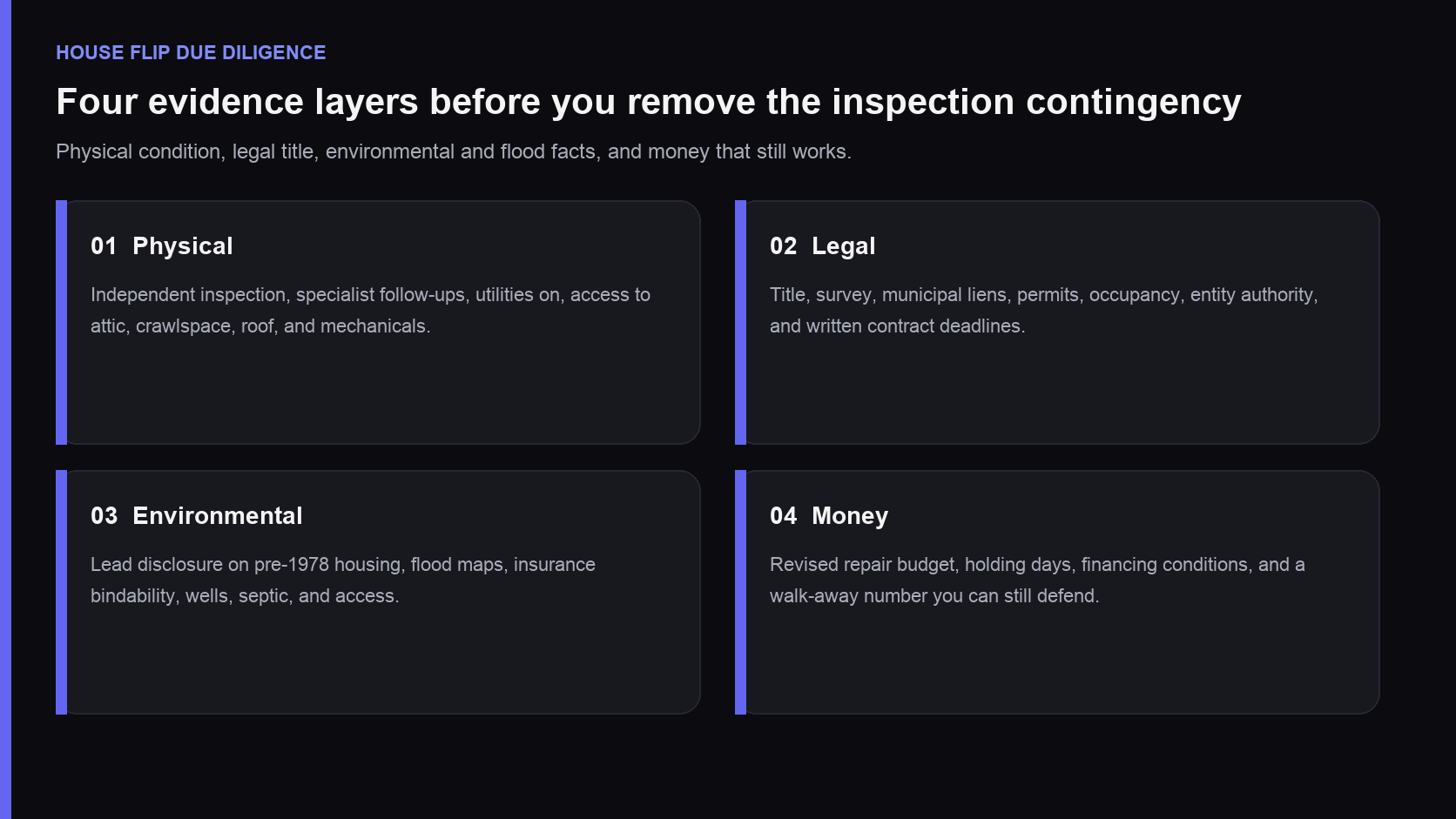
Pre-offer analysis answers whether the deal can work on the facts you have. Due diligence answers whether those facts survive contact with the house, the title plant, the city, the insurer, and the calendar in the contract. You are not trying to confirm a hopeful story. You are trying to prove, or disprove, four things before you remove a contingency.
Keep four evidence types separate. Observed facts are signed terms, inspection notes, photographs, issued documents, and confirmed events.Calculations apply visible arithmetic to those facts.Assumptions estimate a cost, duration, or unresolved item.Opinions describe a person’s judgment about risk or readiness. “The inspector photographed a rusted heat exchanger and recommended a specialist” is a fact. “HVAC should be fine” is an opinion.
The four proof questions are practical. Can you see and price the physical work? Can the seller convey what the contract promises, with occupancy and authority that match the deed? Can you insure and occupy the property under the intended plan? Does the rebuilt cost stack still clear your walk-away number? If any answer is still a guess when the deadline arrives, the remaining guess is a decision, not an unknown you can ignore.
Scenario: Lena Okonkwo separates appraisal from inspection.Lena is under contract on a 1958 Cape in Akron with a financed purchase. The lender orders an as-is appraisal. The appraiser’s job is a value opinion for the loan, not a complete condition report. Lena still hires an independent inspector who is accountable to her. The inspection finds a cracked heat exchanger that the appraisal photo set never isolated. She does not treat lender value as physical clearance. She books a licensed HVAC specialist inside the remaining window before anyone talks about removing contingencies.
2. Build one buyer control sheet on day one
Start with the fully executed contract and every addendum. Extract each date, deposit, inspection right, lead period, title objection period, financing condition, access term, occupancy term, included item, excluded item, and notice method. Assign one owner and one evidence requirement to each line. Preserve the original files. Do not rely on a text-message summary of “ten days to inspect.”
Put the people on the sheet the same day: buyer, entity signer, real-estate professional, real-estate attorney, title or escrow professional, general inspector, likely specialists, insurance broker, lender or hard-money contact, and the contractor who will later bid the work. The four-stage pipeline already moved the opportunity into Contract. Due diligence is the project that Contract creates, not a side conversation.
Lock access immediately. Confirm who has keys, how utilities are kept on, whether the attic, crawlspace, roof, electrical panel, and mechanical rooms are reachable, and whether occupants must receive notice. A dark house with no water is not inspectable. If utilities cannot be on in time, that is a contract and calendar problem, not a reason to guess at plumbing.
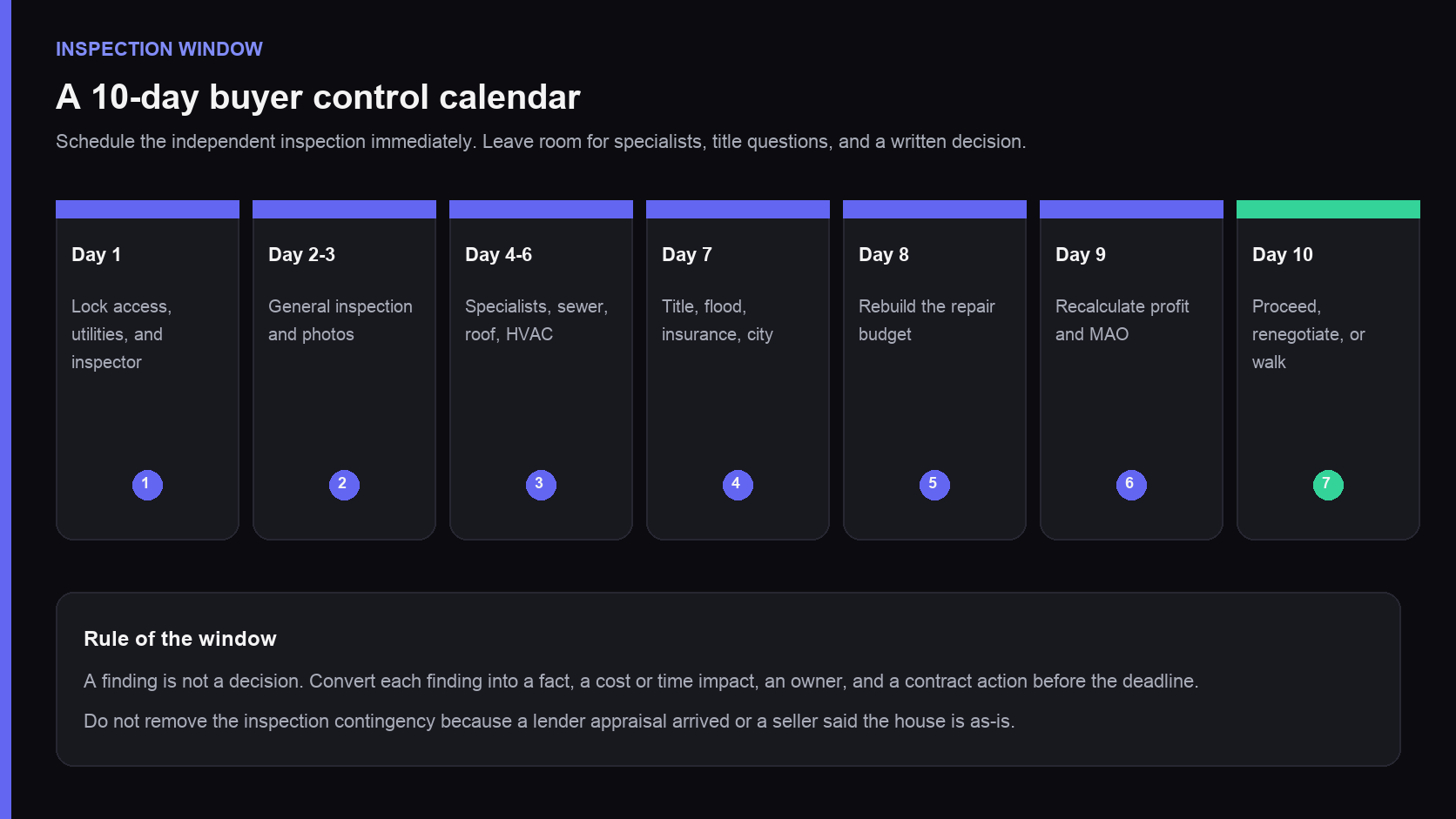
Work backward from the earliest hard deadline. A 10-day inspection window is not ten working days of thinking. It is enough time to schedule, inspect, receive the report, hire a specialist, rebuild the budget, and send a written notice. The CFPB’s home-inspection guidance is blunt: schedule the independent inspection as soon as possible so you have time to resolve problems or walk.
3. Separate inspection, appraisal, and contractor walkthroughs
Hire an independent inspector who works for you. The CFPB says you want someone who gives a complete and honest assessment of physical condition, and it warns that an inspector paid by someone else or unpaid until closing may underemphasize problems. Ask how the inspector is licensed or certified in that state, what standard of practice they follow, what is excluded, whether you may attend, and when the written report arrives. ASHI’s Standard of Practice describes a home inspection as a limited visual survey of readily accessible systems and components as they exist at the time of the inspection. It is not a code inspection, a permit review, or a renovation bid.
Attend if you can. Being present makes it easier to interpret the report, see what was inaccessible, and ask what a specialist should see next. Photograph the same rooms, roof edges, mechanical labels, panel, attic, crawlspace, and exterior grades. Your later repair estimate will need those images, not a memory of “it looked tired.”
A general inspection often creates specialist work: sewer scope, roof, HVAC, electrical, structural, chimney, well, septic, or mold. Those visits consume calendar. Book them as soon as the general inspector names a system that can change the budget. Do not wait for a pretty PDF if the verbal finding is already a roof or a sewer.
A contractor walkthrough is a third job. The inspector reports condition. The contractor prices means and methods against a written scope. Use the same room-by-room list you will later put in a repair budget. If you already have a candidate contractor, this is also a live check of capacity and communication, not a substitute for contractor vetting.
An appraisal does not close this section. When you borrow, the lender generally requires an appraisal and must send you a copy. That document can still miss a failed furnace, a collapsed lateral, or an unpermitted bathroom. Keep value evidence in the research file and condition evidence in the inspection file.Property research can organize comps. It cannot see behind a water heater.
4. Turn inspection findings into a revised repair budget
A finding is not a line item until you translate it. For each material issue, record the location, the observed condition, the inspector’s limitation, the specialist follow-up, a quantity, a unit cost or bid, a permit flag, a schedule impact, and whether the item was already in your original scope. Then sort items into work you already planned, work you missed, work that is optional finish, and work that is still unknown.
Unknowns need a named next action, not a round contingency that hides them. “Possible foundation issue, structural engineer visit Tuesday, no number yet” is usable. “Add 10 percent” is not a description of a cracked wall. Contingency still belongs in the budget for what you cannot see, especially behind finishes. It does not replace a sewer scope you had time to order.
Rebuild the scope in the same structure as your first estimate: demolition, structure, roof and exterior, mechanicals, electrical, plumbing, insulation, drywall, finish, and site. Attach the inspection page and photo to the line. If AI helps you group notes into rooms or draft a punch-style list, keep the source report visible and approve every quantity yourself. An assistant can organize text. It cannot see the crawlspace or sign the contract.
Price schedule, not only materials. A failed electrical service that needs a permit can add a week of holding cost even when the panel itself is a known number. Connect those extra days to your holding-cost estimate and to later permit and inspection planning. Due diligence is where those future controls get their first honest dates.
5. Clear title, survey, municipal, and occupancy issues
Physical condition can be excellent and the purchase can still fail. Ask the title or closing professional what is open: prior mortgages, tax liens, judgment liens, municipal assessments, easements, access, legal description, entity authority, marital or probate issues, and unreleased construction claims. Give them the contract, entity documents, and any known name variations early. A title commitment or abstract is evidence. A verbal “it should be fine” is not.
Check what the city and county actually know about the house. Unpermitted additions, open building permits, zoning mismatches, rental registrations, sidewalk assessments, and utility liens often show up outside the listing remarks. If the plan depends on adding a bedroom, a unit, parking, or a short-term rental use, confirm that the use is lawful before you treat it as value. The listing’s room count is marketing copy until the assessor, permit office, and your inspector agree.
Occupancy has its own file. If anyone lives in the property, collect the leases, addenda, deposits, notices, rent roll, and local landlord-tenant constraints. A vacant-looking house can still have a tenant with rights. A tenant-occupied flip is not automatically a bad deal. It is a different diligence job: access for inspection, utility control, lead pamphlet delivery if you will later lease pre-1978 housing, and a lawful path to possession that matches your renovation calendar.
Scenario: Rafael Soto will not waive occupancy documents.Rafael is under contract on a 1972 two-family in Toledo. The seller says both units are “month to month” and that one tenant “might be moving.” No leases, no lead pamphlet, and no access to the upstairs mechanical closet appear in the first document drop. Rafael’s attorney treats missing occupancy evidence as an open contingency item, not a personality issue. He notices in writing that upstairs access and lease files are required before any inspection waiver, and he keeps the lead inspection opportunity open. If the files and access do not arrive with enough time to inspect, his plan is to cancel under the contract rather than guess at who has the right to stay.
6. Check lead, flood, insurance, and access constraints
Most housing built before 1978 is subject to the EPA and HUD lead-based paint disclosure rule. Before a buyer is obligated, sellers and their agents generally must give the Protect Your Family From Lead in Your Home pamphlet, disclose known lead-based paint and hazards, provide available records and reports, and include a lead warning statement. Buyers usually receive a 10-day period to conduct a paint inspection or risk assessment unless the parties change or waive that period in writing. A signed disclosure that the seller knows of no lead-based paint is not the same as a certified inspection. If you will disturb paint later, the EPA renovation, repair, and painting rule can also require certified renovators. Put that cost and scheduling constraint in the rehab plan instead of discovering it on demolition day.
Look up the official flood map. The FEMA Flood Map Service Center is the public source for National Flood Insurance Program flood hazard maps. Federally regulated lenders generally must require flood insurance when a building is in a Special Flood Hazard Area in a participating community. A cash purchase does not erase flood risk. It only removes that particular federal purchase mandate. Price bindable coverage, elevation issues, and renovation rules in the floodplain as project costs. A zone X printout from last year is not current if a new map has gone effective.
Call the insurance question while you still have a walk-away right. Vacant renovation coverage is not the same as an owner-occupied homeowners policy. Ask whether the property is bindable for the intended vacant or rehab use, what the insurer needs for photos or claims history, and whether flood, sewer backup, or liability has to be placed separately. Connect the answer to yourhouse flip insurance plan before you treat closing as inevitable.
Access includes more than keys. Confirm legal driveway and alley use, shared walls, association rules, gate codes, well and septic locations, overhead utilities, and whether a survey is needed to locate fences or additions. When that survey is in the file, read it before any waiver. The property survey guide is the page for that reading. If you cannot get a ladder to the roof or water to the fixtures, write that limitation on the inspection report and the control sheet. A limitation is a remaining risk, not a completed check.
7. Recalculate the offer with the new evidence
Return to the original analysis instead of inventing a new one. Keep the first ARV range, repair budget, buying costs, holding costs, selling costs, financing costs, and target profit on the page. Then create a second version that uses only inspection-backed changes. The point of the second version is to show what moved, not to hide a thinner deal under a new file name.
Recalculate in this order. Update repairs from the translated findings. Update hold months if permits, occupancy, or long-lead work added time. Update insurance and flood if the binder quote changed. Update buying or selling costs only if the contract or loan terms actually changed. Then recompute projected profit or cash-to-close. If you used a 70 percent screen before offering, do not go back to that shortcut now. The inspection window is where the full cost stack earns its keep.
Stress the ugly case on purpose. If HVAC, sewer, and roof all land as the specialists described, does the deal still clear the walk-away number? If the lender later requires repairs before closing, do you have cash and calendar for that path? The CFPB notes that some loan programs can require repairs before closing or funds set aside after closing. That is a financing condition, and it belongs on the same sheet as the inspection findings.
Keep ARV honest. New condition evidence can change finish level, bedroom count, or marketability, but it does not automatically raise value. A rebuilt kitchen you now know you must do is a cost. It becomes value only if comparable sold homes support that finished house. Use the samedeal analysis discipline you used before the offer: sources next to numbers, range instead of a single magic ARV, and no silent edits to money fields.
8. Proceed, renegotiate, or walk
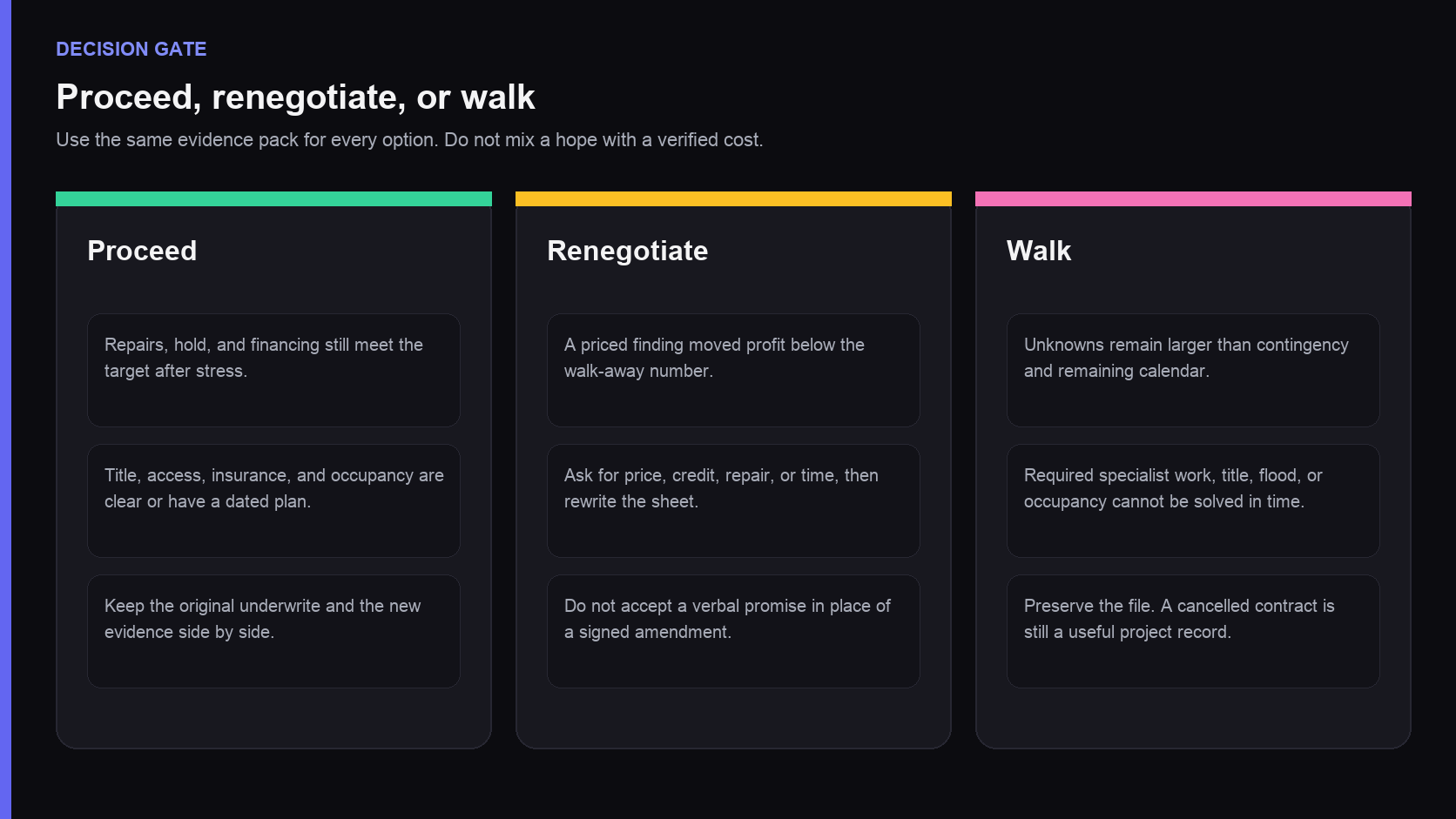
Convert the rebuilt sheet into one of three written actions before the deadline. Proceed if repairs, hold, title, insurance, and occupancy still meet the target after a documented stress case. Renegotiate if a priced finding moved the result below your walk-away number and a price cut, credit, repair, or extra time could restore it. Walk if the remaining unknowns are larger than contingency and calendar, or if required access, title, flood, or occupancy issues cannot be solved in time.
If the contract is contingent on a satisfactory inspection, the CFPB says you should be able to cancel without penalty when you are not satisfied with the results. That right lives in the written contract, local law, and notice rules. Send notices the way the contract requires. Do not rely on a phone call. If you ask the seller to repair or credit, specify the work, the evidence of completion, who pays, and whether you retain a re-inspection right. A verbal “we will take care of it” is not an amendment.
Do not remove the inspection contingency because you like the house, because another buyer is circling, or because the appraisal came in. Removing the contingency is a legal decision that you can complete the purchase on the remaining terms. If you need more time, ask for a written extension while you still have rights. If you walk, archive the contract, inspection, photos, specialist reports, title notes, and the rebuilt analysis. A cancelled house is still a useful project record for the next offer.
9. Worked example: Marcus Hale underwrites 19 Birch Court
Marcus Hale, buying through an LLC, is under contract to purchase a vacant 1964 three-bedroom ranch at a teaching address we will call 19 Birch Court. The written contract price is $155,000. Inspection contingency: 10 days. Possession at closing. Refrigerator included. Staging furniture excluded. Cash-like hard-money financing is planned, so there is a lender, but Marcus does not treat the lender’s appraisal as his condition report. Names, the street, and the figures below are original composites created for teaching. They are not a result from a live Rehabfolio customer.
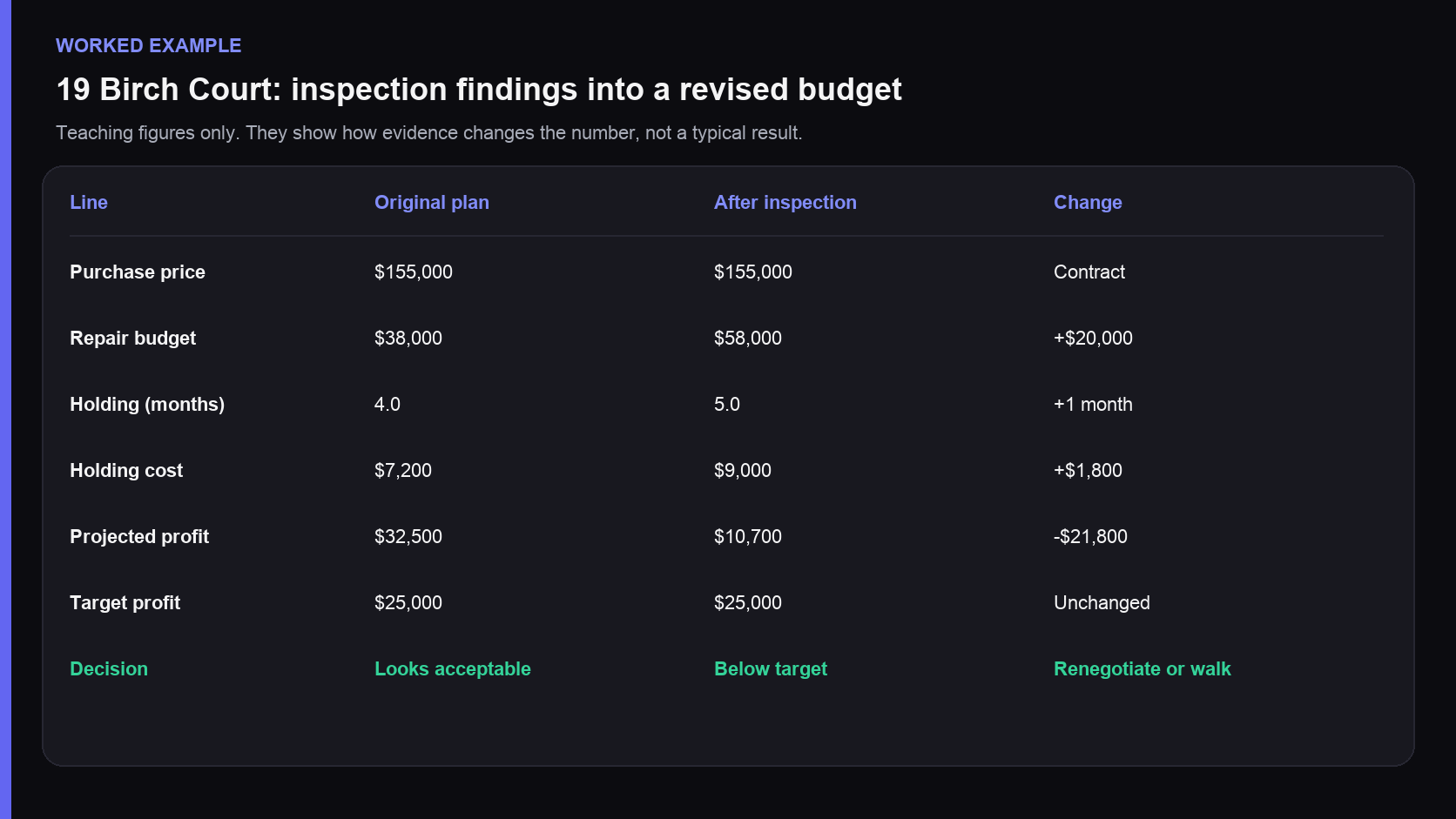
Original underwrite, before inspection. Supported renovated after-repair value $265,000. Repair budget $38,000. Buying costs $3,100. Holding 4 months at $1,800 per month, or $7,200. Selling costs 8 percent of ARV, or $21,200. Financing costs $8,000. Projected profit: $265,000 minus $155,000 minus $38,000 minus $3,100 minus $7,200 minus $21,200 minus $8,000 equals $32,500. Target profit is $25,000, so the first sheet looks acceptable with a modest cushion.
Observed facts during the window. Utilities are on. Marcus attends a three-hour independent inspection. The inspector photographs a rusted heat exchanger and calls for a specialist. A sewer scope the next morning shows a collapsed clay lateral at the property line. The roof is near the end of its remaining life on the south slope. The electrical service is an ungrounded panel that a contractor says will need a permitted upgrade before other rough-in. Title has one open municipal sidewalk assessment. FEMA’s current map shows the structure outside a Special Flood Hazard Area. The seller provides the federal lead pamphlet and a disclosure of no known lead-based paint. Marcus does not waive the lead inspection opportunity because the house is pre-1978 and he plans to disturb interior paint.
Translated costs. HVAC replacement is $8,400 instead of the original $1,200 allowance, a $7,200 miss. The sewer lateral is $6,500 and was not in the original scope. Roof work rises from $2,000 to $4,800, a $2,800 miss. The electrical service upgrade is $3,500 plus an estimated extra month of hold for permit and inspection. New repair budget: $38,000 plus $7,200 plus $6,500 plus $2,800 plus $3,500 equals $58,000. Holding becomes 5 months, or $9,000. Projected profit: $32,500 minus $20,000 of extra repairs minus $1,800 of extra hold equals $10,700. That is $14,300 below the $25,000 target.
Assumptions still open. Closing still occurs on the contract date if they proceed. No new title exception appears. The hard-money lender will fund the extra electrical and sewer work through draws after closing, not as a pre-closing repair escrow. Lead-safe renovation adds procedure, not a second full abatement number in this teaching case. Opinion:Marcus considers the house still buyable only if the price or credit restores the target. That opinion is not a reason to remove the contingency today.
Decision. Marcus sends a written request, in the form the contract requires, for an $18,000 price reduction to $137,000, keeps the inspection rights until the amendment is signed, and schedules the lead assessment. If the seller signs, projected profit returns to about $28,700 before any later surprise, which is back above target. If the seller refuses, Marcus cancels under the inspection contingency, archives the reports, and keeps the rebuilt budget as the starting file for the next similar ranch. He does not “meet in the middle” at a number that still sits below his walk-away line.
10. A repeatable Rehabfolio due diligence workflow
- Preserve the contract record. Store the signed contract, addenda, disclosures, lead pamphlet, access instructions, and the original property analysis.
- Create the window plan. Add inspection, specialists, title, flood, insurance, occupancy, budget rebuild, and decision tasks with owners and dates.
- Register evidence, not reassurance. Attach reports, photos, sewer video stills, flood-map prints, insurance emails, municipal searches, and written notices.
- Separate financial layers. Keep original underwriting, inspection-revised forecast, requested amendment, and final accepted terms as distinct versions.
- Log risks and limitations. Record inaccessible areas, delayed utilities, missing leases, open title items, and specialist appointments without storing unnecessary secrets.
- Decide in writing. Proceed, amend, extend, or cancel through the contract’s notice method before the deadline.
- Hand off the survivors. If you buy, the same file becomes the renovation scope, permit plan, insurance binder, and later seller closing record. If you walk, keep the lesson attached to the pipeline card.
Link the diligence record back to the fix-and-flip workflow, repair-budget method, insurance plan, and reviewable AI underwriting controls. The point is not more paperwork. It is one traceable chain from the first offer math to the inspection evidence, and from that evidence to a contract action you can still explain.
Frequently asked questions
What is due diligence when buying a house to flip?
Due diligence is the buyer’s time-boxed investigation after a written contract is in place and before inspection, title, financing, or other contingencies are removed. It covers independent physical inspection, specialist follow-ups, title and survey, municipal and occupancy issues, flood and insurance bindability, access, and a rebuilt repair and holding-cost estimate. It is not the same as the first underwrite you ran before you offered.
Is a home inspection the same as an appraisal?
No. A home inspection reports observed condition of accessible systems and components for the buyer. An appraisal estimates market value for a lender and is not a substitute for an independent inspection. The CFPB treats them as different jobs and says you generally need both when you borrow. A cash buyer still needs condition evidence even if no lender requires an appraisal.
How long is the inspection period on a house flip?
The inspection period is the number of days written in the purchase contract, not a national default. Federal lead-based paint rules give most buyers of pre-1978 housing a 10-day opportunity to inspect or assess for lead unless the parties change or waive that period in writing. A general home-inspection window may be shorter or longer than that lead period. Count backward from the written deadline and leave time for specialists, reports, and a written decision.
Do seller disclosures replace a house flip inspection?
No. Seller disclosures report what the seller knows and is required to disclose. They do not inspect hidden systems, confirm permit history, or price the work. Treat disclosures as one evidence source, then verify with independent inspection, title work, municipal records, and your own repair estimate. Missing or incomplete disclosures are a reason to slow down, not a reason to skip the rest of the file.
What extra checks apply if the house was built before 1978?
Most pre-1978 housing is covered by the EPA and HUD lead-based paint disclosure rule. Before a buyer is obligated, the seller generally must provide the federal pamphlet, disclose known lead-based paint and hazards, share available records, and include a lead warning statement. Buyers usually receive a 10-day opportunity to inspect or assess for lead unless they waive it. Disclosure is not the same as a certified inspection, and renovation work may later require certified renovators under the EPA renovation, repair, and painting rule.
Should a cash as-is buyer skip inspections to move faster?
Speed is not the same as evidence. An as-is clause describes who pays for repairs, not the condition of the house. The CFPB still advises an independent inspection before you are finally committed. If you shorten the window, you still need access, utilities, a qualified inspector, and time to convert findings into a cost and a contract action. Walking away with a documented file is cheaper than discovering a failed sewer or an unpermitted addition after you own it.
Can Rehabfolio replace an inspector, title company, or attorney?
No. Rehabfolio can organize property facts, contract dates, contacts, inspection notes, photos, repair estimates, title questions, flood and insurance flags, risks, and the rebuilt offer math. It cannot inspect a house, clear title, issue a survey, bind insurance, interpret a deed or lease, give legal advice, or decide a contract. Use licensed and qualified local professionals.
Editorial methodology, limitations, and sources
The Rehabfolio editorial team chose this topic as a distinct accepted-contract-to-contingency-decision workflow. It does not repeat the pre-offer valuation intent of the first-property analysis guide, the contractor-selection intent of the vetting guide, the renovation-budget intent of the repair-cost guide, or the seller-side recording intent of the seller-closing guide. We reviewed current primary or authoritative sources for independent inspection, appraisal versus inspection, lead-based paint disclosure, flood-map lookup, and mandatory flood-insurance purchase. We then mapped those sources into a product workflow using tasks, owners, documents, facts, calculations, assumptions, risks, and written decisions.
Key sources are the CFPB’s schedule a home inspection page and home-buying toolkit materials, the EPA’s lead-based paint disclosure rule and renovation, repair, and painting program, FEMA’s Flood Map Service Center and mandatory purchase FAQ, and the American Society of Home Inspectors Standard of Practice. IRS Publication 583 remains useful for keeping the resulting inspection, closing, and cost records with the property file.
National sources cannot determine which contract form, inspection standard, license, lead requirement, flood zone, title product, occupancy rule, or financing condition applies to one property. They also cannot determine whether a particular finding is a walk-away event. Confirm local requirements with licensed and qualified professionals. Examples are original composites created for teaching. Names, addresses, figures, and outcomes are illustrative, not testimonials or performance claims.
Editorial standard. We identify the audience, author, review date, source boundary, assumptions, calculations, product evidence, and limitations. We do not invent credentials, licenses, testimonials, market statistics, or guaranteed results. AI may help organize research and draft, and a person reviews the claims, calculations, links, examples, and limitations before publication. We revise the guide when a cited rule, product workflow, or material due-diligence practice changes. See the editorial methodology on the company page.
Run the contract-to-decision window in one workspace.
Track dates, files, contacts, inspection findings, rebuilt costs, risks, and the keep-or-walk decision.
Create free account