House flip AS-IS offer credits: seller credits versus price cuts
An AS-IS purchase is not a reason to skip the money. This guide shows house-flip buyers how to negotiate seller credits, repair credits, and closing credits, when a price reduction is the cleaner tool, which lender and title limits can shrink a promised credit, and how to document the number so it survives closing across three named investor scenarios.
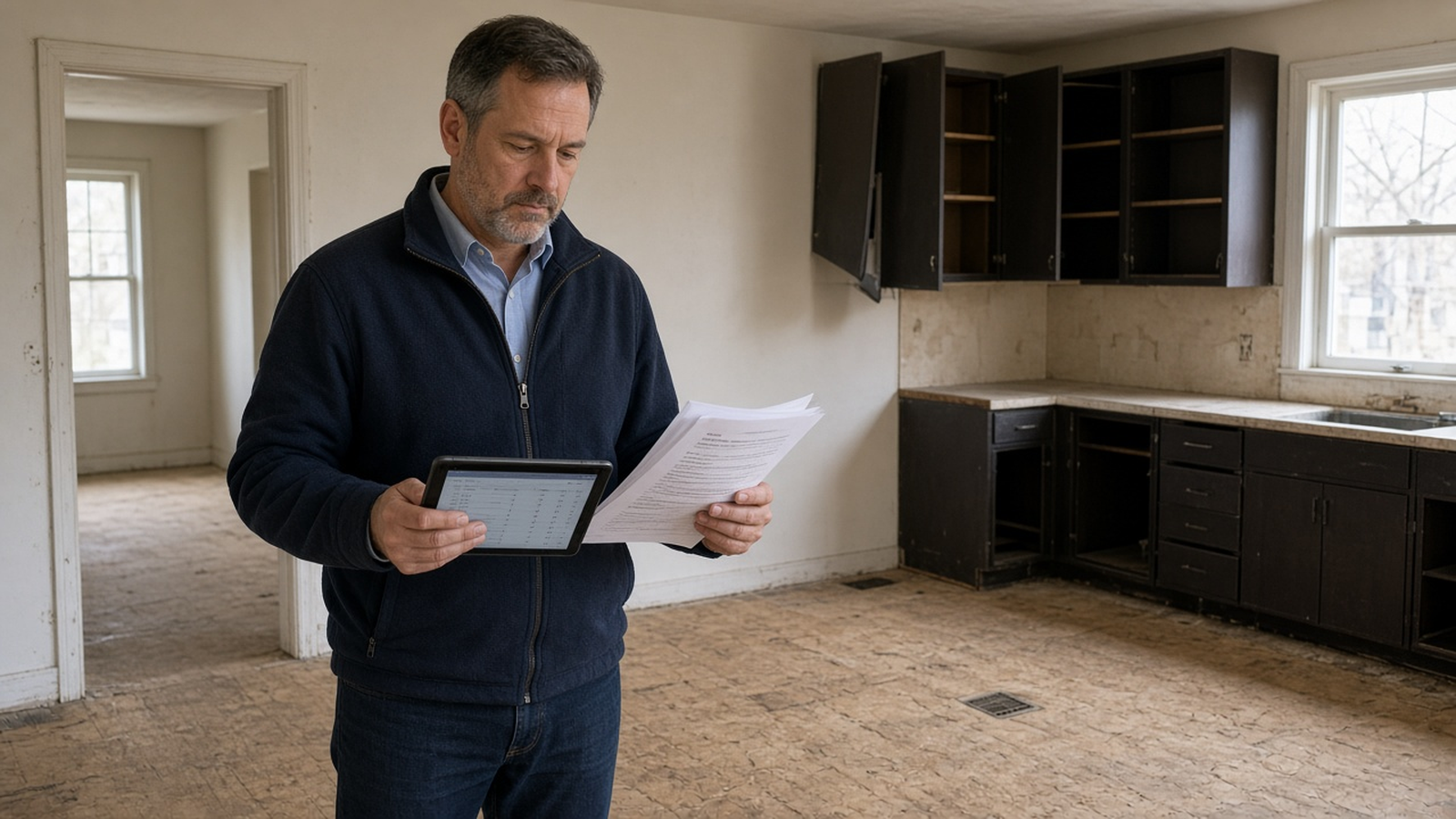
Published and last reviewed September 18, 2026 · Written and reviewed by the Rehabfolio editorial team.
Who this guide is for. This guide is for United States residential investors who are buying a one-to-four-unit house to renovate and resell (or hold) and who are negotiating an AS-IS purchase. It starts when the listing or contract says the seller will not make repairs, and it ends when a written credit, price cut, or walk decision is reflected on the contract and the closing figures. If you still need the walk-away formula, begin with the 70% rule and maximum offer guide. If you still need the inspection-window checklist, begin with house flip due diligence. If you are later selling the finished flip and comparing buyer offers, use how to compare sale offers instead. That sale-side guide is a different search intent.
The Rehabfolio editorial team builds and reviews product workflows that connect property analyses, repair scopes, estimates, offer versions, photos, files, expenses, financing assumptions, tasks, and project reports. That gives the team first-hand product experience tracing a credit request from inspection notes through rebuilt offer math and a closing-figure check. It does not make the team a broker, real-estate licensee, attorney, title or escrow professional, lender, appraiser, inspector, contractor, insurer, accountant, or tax adviser.
Contract forms, concession limits, title practice, transfer taxes, consumer disclosures, and tax basis rules differ by state, locality, occupancy plan, and loan type. This guide is educational information, not legal, lending, title, accounting, tax, or investment advice. Use the written contract, the loan documents, and licensed local professionals for the house in front of you.
Tip: Keep this AS-IS credit guide beside the live workflows for first-property analysis, repair budgets, maximum offer math, due diligence, hard money comparisons, holding costs, and seller closing checklists so a purchase credit stays connected to value, repairs, walk-away price, inspection evidence, financing, carry, and the later sale file. Post-close scope changes belong in change orders. Reserves after you own the house belong in the contingency budget guide.
1. Define AS-IS, seller credits, repair credits, and price cuts
Beginners often hear "AS-IS" and think two false things at once: that the house cannot be inspected, and that any later credit is free money. Neither is true. AS-IS is a risk-allocation phrase. It says the seller is not promising to perform repairs. It does not certify condition, hide defects, or freeze your right to investigate if the contract still gives you an inspection window.
- AS-IS purchase term. The seller offers the property in its present condition. You still rebuild the repair budget from what you can see, measure, and bid. The due diligence checklist owns the inspection-window process. This guide owns what you do with money when the seller will not swing a hammer.
- Seller credit or closing credit. The contract keeps a purchase price and the seller agrees to apply a stated dollar amount to eligible buyer costs at closing. On many mortgage closings that amount appears as a Seller Credit, or as seller-paid lines, on the Closing Disclosure.
- Repair credit. Informal talk for a credit the buyer wants because the house needs work. The label is dangerous if it is written as an open repair allowance. Some loan files treat repair allowances as inducements that reduce the value used to size the loan. A cleaner written form is either a closing-cost credit with a dollar cap or a price reduction.
- Price reduction. The parties amend the contract price itself. Cash to close usually falls. Loan-to-value math, transfer-tax bases, and the number that later sits on the recorded deed can all move with it.
Keep four evidence types separate while you negotiate. Observed facts are inspection photos, invoices, permit notes, and written contract lines. Calculations convert those facts into a rebuilt repair total, a 70% screen, cash to close, and seller net. Assumptions cover whether a lender will count a credit, whether title has proceeds to fund it, and how long hold will last. Opinions describe how motivated the seller sounds. "The sewer camera shows a collapsed clay line and the plumber bid $16,800" is fact. "They will definitely credit us at the table" is an opinion that does not close a deal.
The Consumer Financial Protection Bureau notes that buyers sometimes negotiate a credit toward closing costs, and that the seller will often require a higher purchase price to cover that credit. You are still paying the cost. The credit changes when the cash leaves your pocket (at closing versus through a higher loan or a higher price), not whether the work and the fees exist.
2. Choose a credit or a price cut with the same cash math
Run every request as two versions of the same deal. Version A keeps the contract price and adds a credit. Version B lowers the price by the same dollars and uses no credit (or a smaller credit). If you only stare at the headline price, a seller can look generous while your cash, loan, and walk-away number get worse.

Use one planning stack for both versions, the same stack you use in first-property analysis:
- Contract price. The number on the purchase agreement after the amendment.
- Buyer closing costs and prepaids. Title, recording, transfer items you pay, lender fees if you borrow, prepaid taxes and insurance if required. Ask the closing professional for a current estimate. Do not invent a national average.
- Seller credit applied. Only the dollars the settlement statement can actually use. A credit larger than eligible costs often becomes leftover, a required price cut, or a loan-file problem. It does not become pocket cash.
- Repairs. The rebuilt scope after inspection, not the optimistic number you used to get the house under contract.
- Holding and financing. Extra days spent negotiating still cost interest, taxes, insurance, and utilities. Price those days with the holding-cost guide.
- Walk-away screen. Rehabfolio's 70% planning formula is after-repair value times 0.70 minus repairs. Recalculate it after the inspection, then decide whether a credit or a cut restores the screen. The 70% rule guide owns that formula. This guide owns which concession tool you ask for.
A credit is often useful when you are financed and short on cash to close, the eligible closing costs are real, and the loan program will accept the amount. A price cut is often cleaner when you are paying cash, the credit would exceed eligible costs, the loan file treats repair allowances as inducements, or you care about the recorded purchase price more than a settlement-line offset.
Example arithmetic you can reuse. Contract price $220,000. Estimated buyer closing costs $7,400. Seller offers either an $8,000 credit or an $8,000 price cut. If the credit can only apply to $7,400 of eligible costs, $600 is leftover, not a rebate. Cash toward the price and costs is about $220,000 + $7,400 − $7,400 = $220,000, plus any leftover handling the closer requires. The price-cut version is $212,000 + $7,400 = $219,400. The cut saved more cash and lowered the recorded price. The credit looked equal in conversation and was not equal on paper.
3. Check lender, title, and occupancy constraints before you ask
A seller can agree to a number the loan and the closing file cannot carry. That is how investors celebrate a $20,000 "repair credit" on Tuesday and watch it shrink on the Closing Disclosure on Friday. Ask three offices the same week you write the addendum: the lender or private funder, the title or escrow company, and your real-estate professional.

Cash buyers do not have a mortgage interested-party contribution cap. They still have a title problem if the seller's net proceeds cannot cover payoffs, commissions, and the credit. A credit that pushes the seller negative will be rewritten or rejected at the table. Cash buyers also still have tax-basis work after closing. IRS Publication 551 explains that the basis of real property you buy starts from cost, that certain settlement fees can be included, and that some items (including certain tax prorations and loan-getting costs) are treated differently. A credit versus a price cut can change which number you later take to a tax professional. This guide does not compute your basis.
Financed owner-occupant purchases (less common on a flip, still relevant if you occupy or if you later help a retail buyer) sit inside published concession rules. HUD Handbook 4155.1 guidance on purchase transactions states that a seller or other third party may contribute up to six percent of the lesser of sales price or appraised value toward the buyer's closing costs, prepaid expenses, discount points, and other financing concessions. Contributions above that limit, contributions above actual eligible costs, decorating allowances, and repair allowances can be treated as inducements to purchase and can reduce the adjusted value dollar-for-dollar. That is a federal insurance-file rule for covered FHA loans, not a custom you should invent for every flip.
Financed investment purchases are often tighter. Agency selling guides for conventional loans treat interested-party contributions as money that cannot be used for the borrower's down payment, reserves, or minimum contribution, and they use a lower maximum financing concession on investment property than on many owner-occupant files (commonly 2 percent of the lesser of sales price or appraised value on published Fannie Mae tables). Excess financing concessions can be recast as sales concessions and deducted from the price used for loan-to-value. If your flip is funded by hard money instead, do not paste that 2 percent table onto the term sheet. Compare the actual draw, fee, and concession language with hard money loan offers. Private lenders vary. Some ignore consumer concession tables. Some still refuse credits that look like cash back or unpaid repairs.
Title and settlement remain the last gate even when the lender is comfortable. The closer must show the credit on the settlement statement, keep the seller from going negative, and (on covered mortgage closings) keep the Consumer Financial Protection Bureau Closing Disclosure consistent with the contract. The Bureau's Closing Disclosure explainer tells the buyer to check that the Seller Credit reflects the agreement, and that specific seller-paid items may appear as seller-paid lines on page 2 instead of one lump sum. If your addendum says $10,000 and the disclosure shows $4,200, you do not have a $10,000 credit.
4. Document the credit so it survives lender, title, and closing review
Verbal generosity dies in underwriting. Write the request the same way every time so your team, the listing agent, the lender, and the closer recognize the packet.
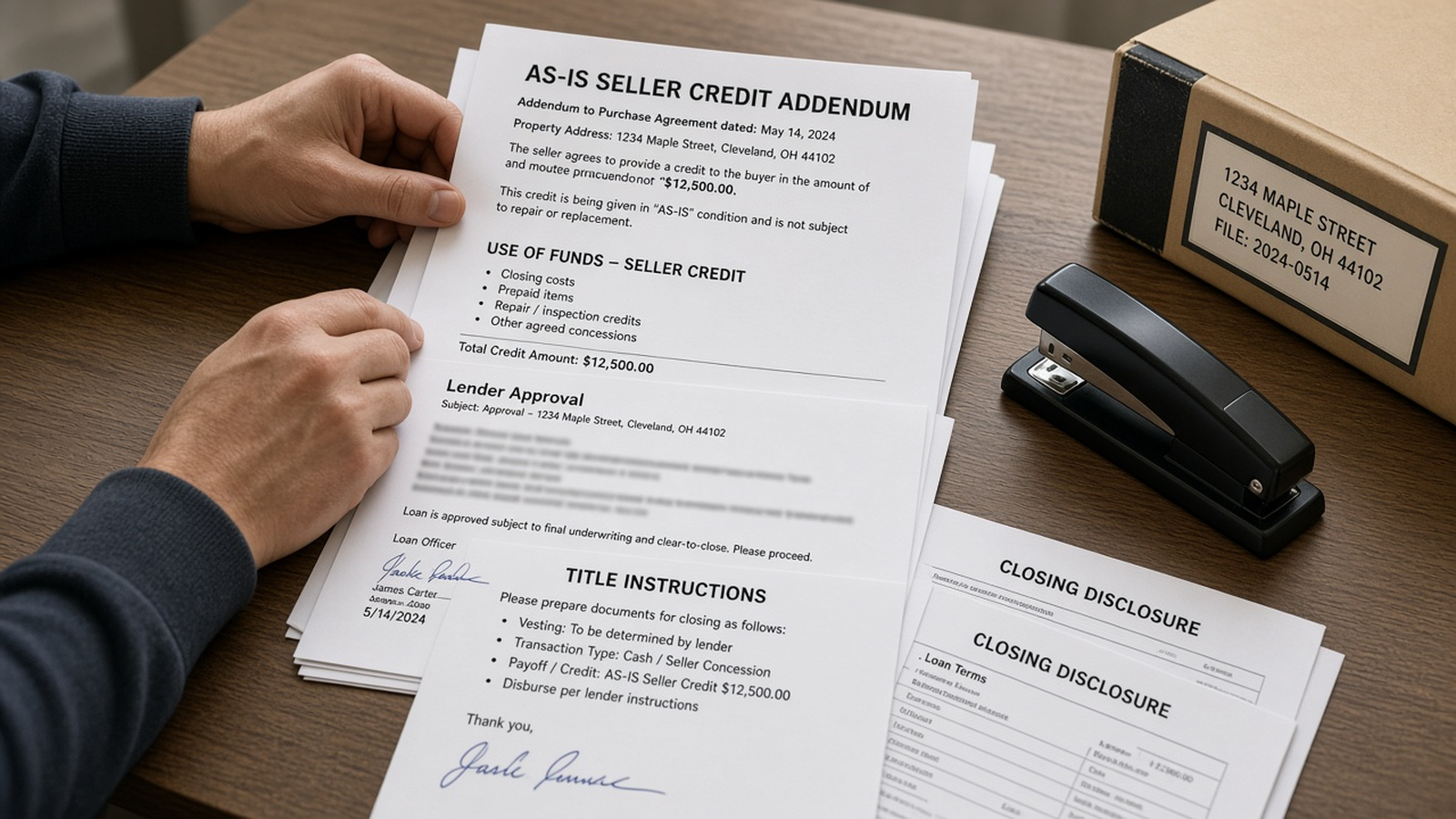
- Written addendum. Property address, contract date, exact dollar amount, whether the tool is a credit, a price reduction, or both, and the new totals. No "seller to help with repairs as needed."
- Use of funds. Closing costs, prepaids, discount points, or named seller-paid lines. If you mean a price cut, say price cut. If you mean a closing credit, say closing credit and list eligible uses.
- Price versus credit split. When the deal uses both tools, show the new price and the credit on the same page so nobody applies the dollars twice.
- Lender or private-funder confirmation. A short written note that the amount fits the program or term sheet. Hallway optimism is not confirmation.
- Title proceeds check. Ask whether the seller's estimated net can fund the credit after payoffs and commissions. A credit that bankrupts the seller file will be rewritten.
- Inspection evidence. Keep the report, photos, and rebuilt line-item budget with the request. The due diligence guide owns how those facts were gathered. This packet owns how they support a dollar amendment.
- Closing Disclosure or settlement match. Before you sign, compare the addendum to the closer's figures. On covered mortgage closings, check Seller Credit and seller-paid columns. On cash files, check the settlement statement the title company actually uses.
- Project archive. Store the addendum, emails, estimates, rebuilt offer math, and final statement with the property record so the later sale file (and any tax professional) can see what you paid.
Federal Trade Commission consumer guidance on home-improvement transactions stresses written terms and not paying for unfinished work as if it were done. That advice is written for homeowners hiring contractors, but the discipline transfers: do not treat a promised repair credit as completed work, and do not wire extra money because someone said the credit would "come out in escrow" without a matching statement line.
AI tools may help rename folders, draft an addendum checklist, or compare two offer versions side by side. A person still verifies that the sewer bid in the packet is the sewer bid used in the rebuilt MAO, and that the credit on the disclosure equals the addendum. Keep language provider-neutral: organize evidence, label assumptions, require human approval before send.
5. Work three named investor scenarios
Scenario A: Priya Nandakumar takes a price cut on a cash AS-IS bungalow. Priya is buying a 1954 bungalow listed at $228,000 AS-IS. After a complete walkthrough she models after-repair value of $360,000 and repairs of $38,000 (roof $11,500, HVAC $8,200, kitchen $12,400, baths $5,900). The 70% screen is $360,000 × 0.70 − $38,000 = $214,000. The seller will not drop below a $222,000 headline, but will do either an $8,000 closing credit at $222,000 or an $8,000 price cut to $214,000. Priya is paying cash, so she has no mortgage concession cap. Title confirms the seller can fund either structure. Buyer closing costs are about $6,100. The credit version can apply only $6,100, leaving $1,900 that is not cash back. The price-cut version is $214,000 + $6,100 = $220,100 cash outlay and a recorded price that matches her 70% screen. She takes the cut, updates the maximum offer sheet, and keeps the unused-credit lesson in the file. Holding cost is about $1,860 per month. The lesson is not that credits are bad. The lesson is that a cash AS-IS buyer often wants the lower contract price more than a settlement offset she cannot fully use.
Scenario B: Marcus Ellison splits a credit that would break an investment-loan cap. Marcus is buying a 1978 ranch at $280,000 AS-IS with a conventional investment-property loan while he completes a light interior rehab. He wants the seller to cover $11,200 of closing costs after the inspection finds a water heater and a panel the lender will require before closing. Two percent of $280,000 is $5,600, a published conventional investment-property interested-party contribution figure on Fannie Mae tables. An $11,200 lump-sum credit can exceed that cap and the actual remaining eligible costs after the lender-required items are seller-paid as specific lines. Marcus rewrites the ask: $5,600 as a closing credit, plus a $5,600 price reduction to $274,400, plus named seller-paid safety items the closer can put on seller lines. If the loan had been hard money instead, he would have read that term sheet rather than imported the 2 percent table. He still would have split a credit that looked like cash back. The rewrite keeps the lender file inside a published cap, lowers the price used for loan-to-value, and keeps the safety items visible instead of buried in a vague repair allowance. HUD-style files, if he had used one, would have been even more sensitive to a labeled repair allowance.
Scenario C: Elena Voss walks when a closing credit does not restore the rebuilt budget. Elena is under contract at $229,000 on an occupied 1968 Cape listed AS-IS, with a 10-day inspection window. She first underwrote after-repair value of $380,000 and repairs of $52,000. The 70% screen was $380,000 × 0.70 − $52,000 = $214,000, so she already knew the $229,000 price sat $15,000 above the screen and needed a clean inspection. The inspector and a sewer contractor then add $16,800 for a failed clay line and $5,600 to open and document an unpermitted porch, for $22,400 of new work. Rebuilt repairs are $74,400. The new screen is $380,000 × 0.70 − $74,400 = $191,600. The seller refuses repairs (the listing was AS-IS) and offers a $10,000 closing credit. Even if title can apply every dollar, effective price is $219,000, which is still $27,400 above the rebuilt screen. Extra hold to argue the point is modeled at 11 days × $64 per day = $704. Elena requests a $22,400 price reduction (to $206,600) or a walk under the inspection contingency. The seller holds at the $10,000 credit. She cancels in writing, keeps the inspection file, and does not convert a failed sewer into a hope that closing credits will "make it up." The scenario shows why this guide is not the due diligence process and not a contingency-budget lesson. It is the money tool you use after the facts change, including the tool called walking away.
6. Follow one complete AS-IS credit negotiation
Baseline property. Devon Hale is buying a 1962 ranch listed at $239,900 AS-IS. After the first walk he models after-repair value of $345,000 and repairs of $52,000. The 70% screen is $345,000 × 0.70 − $52,000 = $189,500. He offers $204,000 with a written inspection window, $4,000 earnest money, and no seller credit yet. He is paying cash. Holding cost runs about $1,740 per month, or $58 per day. Selling costs are modeled at 8 percent of after-repair value ($27,600) for the later exit, using the same planning stack as the first-property guide.
Inspection change. A sewer camera and a plumber bid add $9,500. Rebuilt repairs are $61,500. The new screen is $345,000 × 0.70 − $61,500 = $180,000. Devon now has three written options to send: (1) a $24,000 price cut to $180,000, (2) keep $204,000 and ask for a $24,000 closing credit, or (3) a split. Title informally says the seller's equity can support about $14,000 of concession before the file looks negative after commission and payoff. Buyer closing costs are about $6,800. A $24,000 credit cannot apply in full. Option 2 is theater.
Negotiated structure. The parties amend to a $190,000 purchase price and no credit. That is $10,000 above the rebuilt 70% screen and $14,000 below the original offer. Devon recalculates the full stack at the new price: purchase $190,000, buying costs $3,800 (2 percent planning figure), repairs $61,500, five months of hold $8,700, later selling costs $27,600. Total planned outlay before tax is $291,600. Planned sale at $345,000 leaves $53,400 if every assumption holds. He writes down the opinion ("I like the street") separately from the fact (the sewer bid is $9,500 and the price is $10,000 above the screen). He accepts the haircut against a $24,000 target only because the rebuilt profit still clears his written minimum of $40,000. If the seller had insisted on $204,000 plus a $6,000 credit, cash toward price and costs would have been about $204,000 + $6,800 − $6,000 = $204,800, or $8,000 worse than the $190,000 price plus the same $6,800 costs. The credit version looked friendly and was more expensive.
Closing check and archive. Devon compares the amendment to the cash settlement statement. There is no Seller Credit line, and the contract price is $190,000. He archives the inspection report, plumber bid, addendum, settlement statement, and the rebuilt offer sheet beside the project record. After he owns the house, any new scope surprise is a change order against contingency, not a second attempt to invent a purchase credit. When he later sells, he will use the seller closing checklist and, if several buyers appear, sale-offer comparison. Those are different jobs from the purchase-credit decision he just finished.
7. A repeatable Rehabfolio AS-IS credit workflow
- Separate the intents. Analysis and the 70% screen live in their guides. Inspection work lives in due diligence. This workflow only chooses and documents a purchase credit or price cut.
- Rebuild the repair total first. Do not negotiate a credit against the listing's cheerful "needs TLC" line. Use a line-item budget.
- Run two versions. Same dollars as a credit, then as a price cut. Include leftover credit, loan caps, and title proceeds.
- Ask lender and title before you fall in love with a structure. A promised credit that the file cannot carry is not a concession.
- Write one addendum. Amount, tool, new price, use of funds, and what happens if the credit cannot be applied in full.
- Human verify the closing figures. Match the addendum to the Closing Disclosure or cash settlement statement before you sign.
- Archive the chain. Keep bids, photos, amendments, and the final statement with the project so later sale and tax work have a trail.
- Stop using purchase credits after you own the house. New work is a change order and a contingency decision, not a reopened seller credit.
Connect the credit record to the fix-and-flip workflow and deal analysis. The goal is one chain from listing facts to rebuilt repairs to a written credit or price cut to a settlement line that matches the addendum.
Before the next AS-IS offer, reconnect credit reality to financing in hard money loan offers and to carry in holding costs. A beautiful credit clause cannot save a loan that forbids it, and a cheap purchase price cannot save a file that spends eleven extra days arguing a credit the seller cannot fund.
Frequently asked questions
What does AS-IS mean on a house flip purchase offer?
AS-IS describes who is expected to pay for repairs, not the true condition of the house. The seller is generally offering the property in its present state and is not promising to fix defects. You can still inspect, rebuild the repair budget, and decide to proceed, renegotiate in writing, or cancel if the contract gives you that right. An AS-IS clause is not a substitute for due diligence.
Is a seller credit the same as a price reduction?
No. A seller credit (also called a closing credit or concession) keeps the contract price and applies seller money to eligible buyer costs at closing. A price reduction lowers the contract price itself. The same dollar request can change cash to close, loan-to-value math, transfer-tax bases, and whether unused credit is leftover rather than cash back. Choose the tool after you run both versions against your walk-away number.
Can a seller credit cover repairs on an AS-IS house?
Sometimes, but not as a casual repair allowance you spend later like cash. Many lender and HUD-style files treat open-ended repair allowances as inducements that reduce the value used for the loan. A closing credit can offset eligible settlement costs so you keep more cash for the rehab. A price cut can restore purchase math without creating a leftover credit. Do not treat a promised credit as if the roof were already replaced.
Do lenders limit seller credits on investment property?
Often yes, when the loan is a consumer or agency program with interested-party contribution rules. Conventional investor files commonly use a tighter cap than owner-occupant files. FHA-style files commonly discuss a 6 percent contribution limit and treat excess or certain allowances as inducements. Hard-money and private flip loans use their own term sheets. Read the controlling loan documents instead of importing a consumer-program table onto a private loan.
How should a credit appear on the Closing Disclosure?
The Consumer Financial Protection Bureau tells buyers to check that the Seller Credit on the Closing Disclosure matches the agreement. A lump-sum credit may appear as Seller Credit. Specific seller-paid items may appear as seller-paid lines instead. If the number is missing, split, or renamed, stop and ask the lender and settlement professional before you sign. A handshake credit that never hits the settlement statement is not a credit.
Can AI decide my credit versus price-cut request?
AI tools may help organize inspection notes, draft a comparison table, or flag a credit that looks larger than typical closing costs. A person still has to verify the rebuilt repair budget, lender or private-loan rules, title proceeds, contract language, and walk-away math. Keep the process provider-neutral: evidence visible, assumptions labeled, and human approval before any addendum goes out.
Can Rehabfolio negotiate or approve my offer credit?
No. Rehabfolio can help you keep listing facts, inspection notes, repair budgets, offer versions, files, and closing figures in one project workspace. It cannot negotiate with a seller, bind a contract, interpret loan or title documents, approve a concession, give legal or tax advice, or decide whether you should buy. Use your real-estate professional, lender, title or escrow professional, and other qualified local advisers.
Editorial methodology, limitations, and sources
The Rehabfolio editorial team chose this topic as a distinct beginner workflow for house-flip buyers negotiating AS-IS purchase offers with seller credits, repair credits, and closing credits. It does not replace the walk-away formula in the 70% rule guide, the inspection-window process in the due diligence guide, the sale-side comparison of buyer offers, the seller-side closing checklist, the post-freeze amendment intent of change orders, or the reserve intent of the contingency budget guide. Those guides remain the homes for maximum offer math, investigation, choosing a buyer, completing a sale, construction amendments, and reserves. This guide focuses on choosing, constraining, documenting, and closing a purchase-side credit or price reduction on an AS-IS house.
Key sources include the Consumer Financial Protection Bureau's explainer on closing fees and seller credits, which notes that a negotiated credit toward closing costs is often paired with a higher price and is not free; the Bureau's Closing Disclosure explainer on checking that Seller Credit or seller-paid lines match the agreement; HUD Handbook 4155.1 Section A on the six percent interested-party contribution limit for covered FHA purchase files and on treating excess contributions, decorating allowances, and repair allowances as inducements that can reduce adjusted value; IRS Publication 551 on basis of assets, including which settlement costs may be included in the basis of real property; and the Federal Trade Commission's guidance on written home-improvement terms and not paying for unfinished work as if complete. Fannie Mae's published interested-party contribution tables are cited only to illustrate that conventional investment-property caps can be tighter than owner-occupant caps. Local lenders, title companies, counsel, and tax professionals remain necessary for one property. National sources cannot approve your addendum or interpret your private loan.
Public guidance cannot tell you whether a particular $12,000 request should be a credit or a cut, whether your hard-money lender will accept any credit, or whether the seller's equity will fund it. Examples are original composites created for teaching. Names, addresses, figures, and outcomes are illustrative, not testimonials or performance claims. Percentages and dollar figures are educational, not quotes or guaranteed negotiation results.
Editorial standard. We identify the audience, author, review date, topic boundary, assumptions, calculations, product evidence, and limitations. We do not invent credentials, licenses, testimonials, market statistics, or guaranteed results. AI may help organize research and draft, and a person reviews the claims, calculations, links, examples, and limitations before publication. We revise the guide when a cited rule, product workflow, or material concession practice changes. See the editorial methodology on the company page.
Keep AS-IS credits, price cuts, inspection bids, and closing figures in one clear project record.
Turn inspection findings into a written credit or price reduction, check lender and title limits, and close only when the statement matches the addendum.
Create free account