House flip draw inspection: how to pass lender progress draws
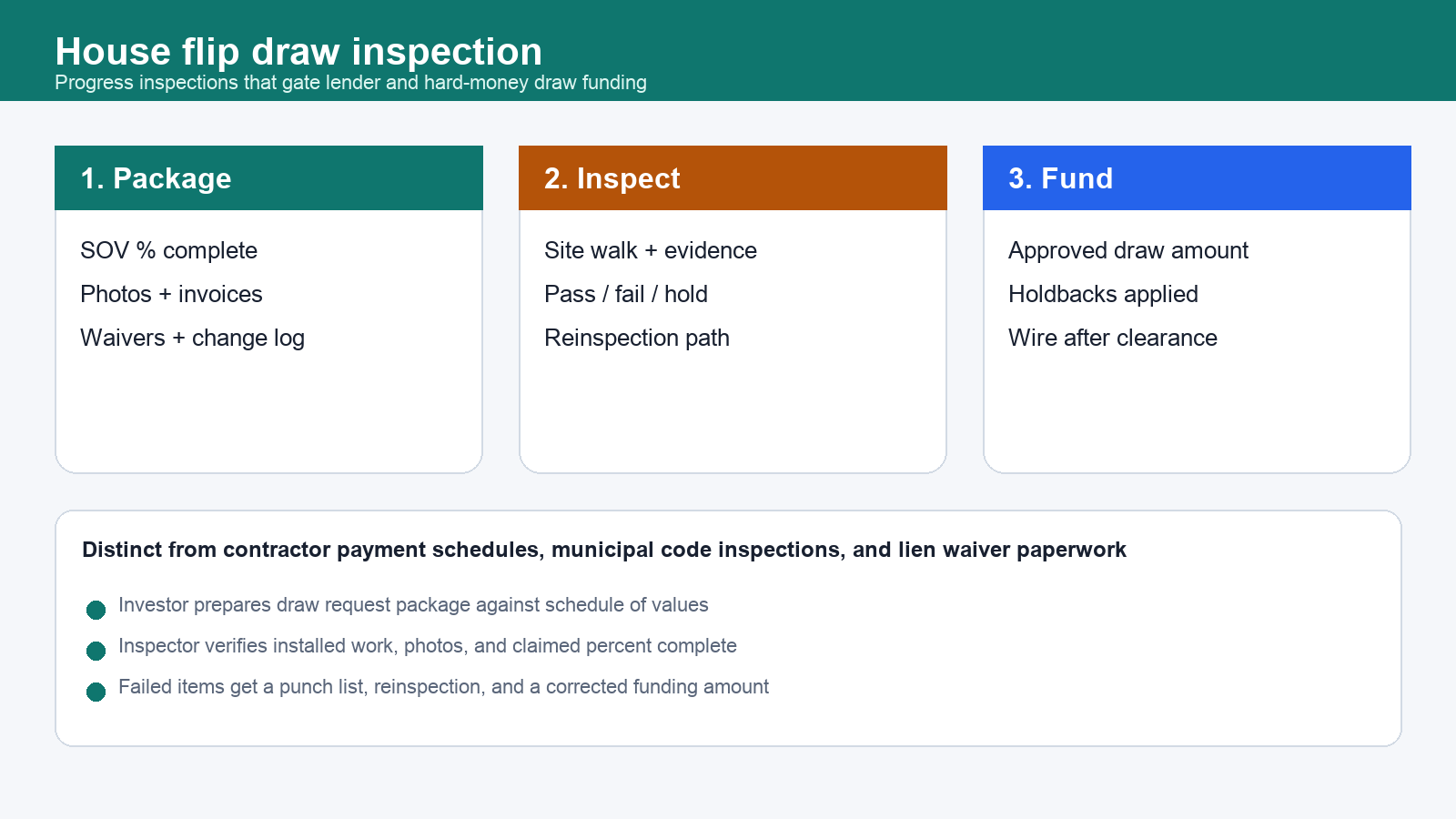
A draw inspection gates rehab funding. This guide shows how house flip investors prepare the request package, document percent complete against a schedule of values, run the site visit, remediate fails, match contractor invoices to lender draws, and keep holdbacks honest across three named investor scenarios.
Published and last reviewed September 14, 2026 · Written and reviewed by the Rehabfolio editorial team.
Who this guide is for. This guide is for United States residential investors using construction draws from hard-money lenders, private lenders, or other rehab funders who require a progress inspection before money wires. It starts after you have a written scope and a payment plan, and it ends when a draw is funded, partially funded, or corrected after reinspection. If you still need the contractor cash timing structure, begin with contractor payment schedules. If you still need municipal code gates, begin with permits and inspections. If you need release paperwork after payment, also read house flip lien waivers.
The Rehabfolio editorial team builds and reviews product workflows that connect property analyses, repair scopes, contractor bids, budgets, schedules, tasks, photos, files, change orders, expenses, lender draws, contingency balances, and project reports. That gives the team first-hand product experience tracing a claimed percent complete from schedule of values through photo evidence, invoice matching, and draw status. It does not make the team a contractor, construction manager, appraiser, draw inspector, attorney, lender, title professional, insurer, accountant, or tax adviser.
Lending draw rules, inspection vendors, holdback percentages, municipal permitting, consumer-protection law, insurance, and tax treatment differ by state, locality, property type, occupancy plan, and loan documents. This guide is educational information, not legal, construction, lending, insurance, accounting, tax, or investment advice. Use your loan documents and local licensed professionals for the house in front of you.
Tip: Keep this draw inspection guide beside the live workflows for scope of work, payment schedules, permits and inspections, lien waivers, change orders, contingency budgets, quality control plans, and project schedules so funding evidence stays connected to scope, cash, compliance, releases, amendments, reserves, workmanship, and time.
1. Define draw inspections versus payment schedules and code inspections
Beginners often treat every site visit as the same event. They are not. Mixing lender progress reviews with contractor payment rules and municipal code inspections is how investors show up with the wrong package and wait weeks for money that was never going to wire.
- Contractor payment schedule is the owner-to-GC cash plan: deposits, milestones, retainage, and final payment rules. See the payment schedule guide.
- Municipal permits and inspections are code compliance gates: plan review, roughs, finals, and corrections. See permits and inspections.
- Draw inspection is the lender or private funder progress check that decides whether claimed rehab work is complete enough to release escrowed construction funds. This guide owns that funding gate.
- Lien waivers are release documents tied to payments already made or about to clear. See lien waivers.
Keep four evidence types separate while you prepare. Observed facts are photos, measurements, inspector notes, and permit statuses. Calculations convert schedule-of-values percents into dollar requests after holdbacks. Assumptions cover how a lender treats materials on site or whether a partial trade is fundable. Opinions describe confidence in a contractor's pace. "Hall bath tile is set and the valve is pressure-tested" is fact. "We are basically done with the baths" is an opinion that fails inspections.
2. Build the draw request package before anyone arrives
A clean package does not guarantee a pass, but a messy package almost guarantees delay. Assemble the packet in the same order every time so your team and your lender recognize the pattern.
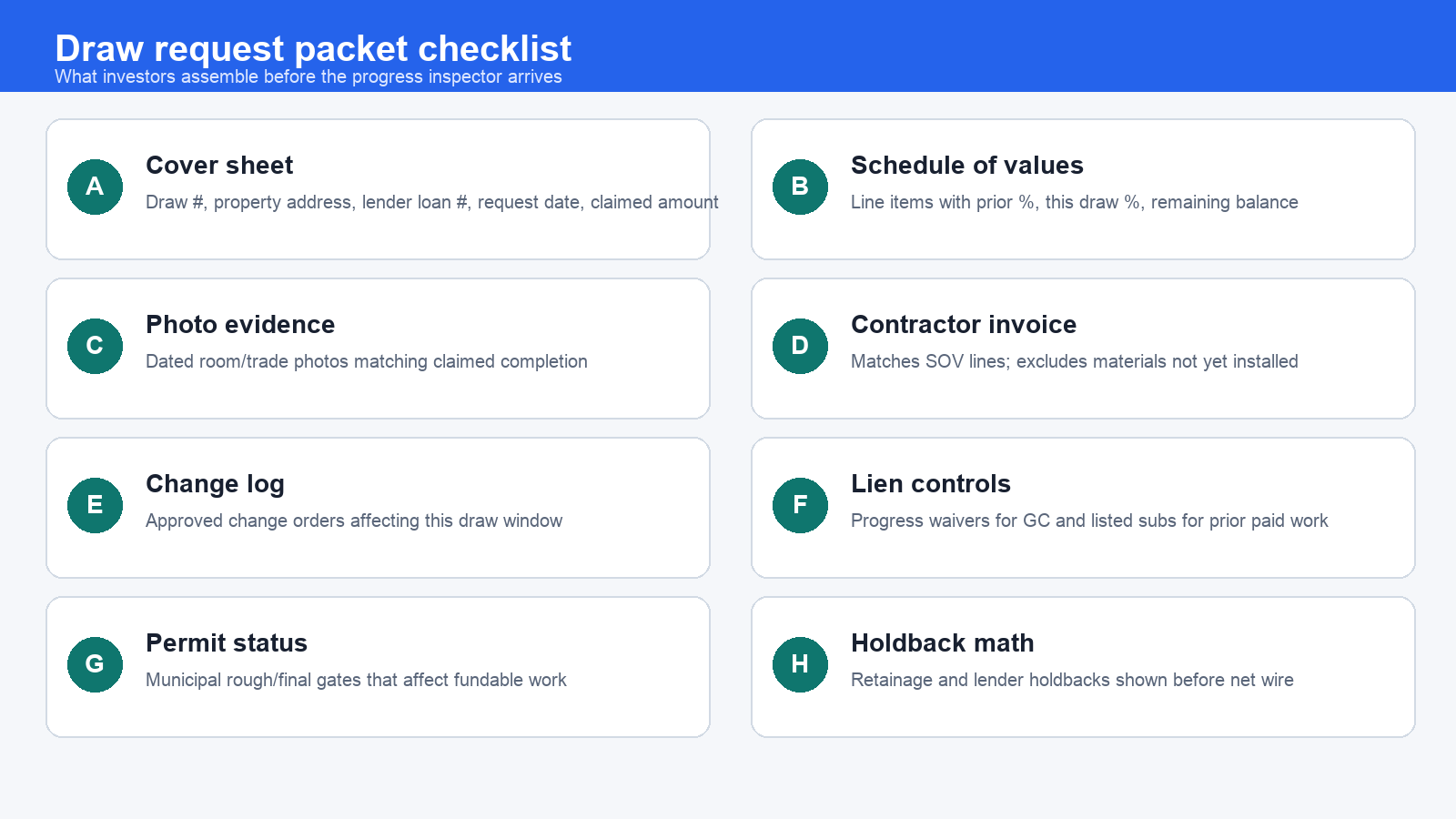
- Cover sheet. Draw number, property address, loan or account number, request date, claimed gross amount, holdbacks, and net amount.
- Schedule of values (SOV). Every fundable line with prior percent, this-draw percent, remaining balance, and short field notes.
- Photo set. Dated, labeled photos for each claimed room or trade. Wide shots plus detail shots for concealed work that will soon close up.
- Contractor invoice. Line items that mirror the SOV, not a single lump sum that hides unfinished rooms.
- Change log. Approved change orders that affect this window, with cost and schedule impact. Unapproved extras do not belong in the draw. See change orders.
- Lien controls. Progress waivers for the GC and listed subcontractors covering prior funded work, prepared according to your state practice and lender checklist.
- Permit and municipal status. Note which code inspections passed, failed, or are still required before related trades are truly fundable.
- Holdback math. Show retainage, lender holdbacks, inspection fees if deducted, and the net wire you expect.
Consumer guidance from the Federal Trade Commission stresses written project terms, careful contracts, and not paying for unfinished work as if it were done. That consumer advice is not a lending rulebook, but it aligns with draw discipline: pay and request funding against documented completion, not pressure or vague promises.
3. Map percent complete to the schedule of values honestly
The schedule of values is the shared scoreboard. If your SOW, bid, and draw schedule do not share the same line structure, percent complete becomes a debate instead of a measurement. Rebuild alignment before the first draw, not during a failed visit. The scope of work guide owns how those lines get written and frozen.
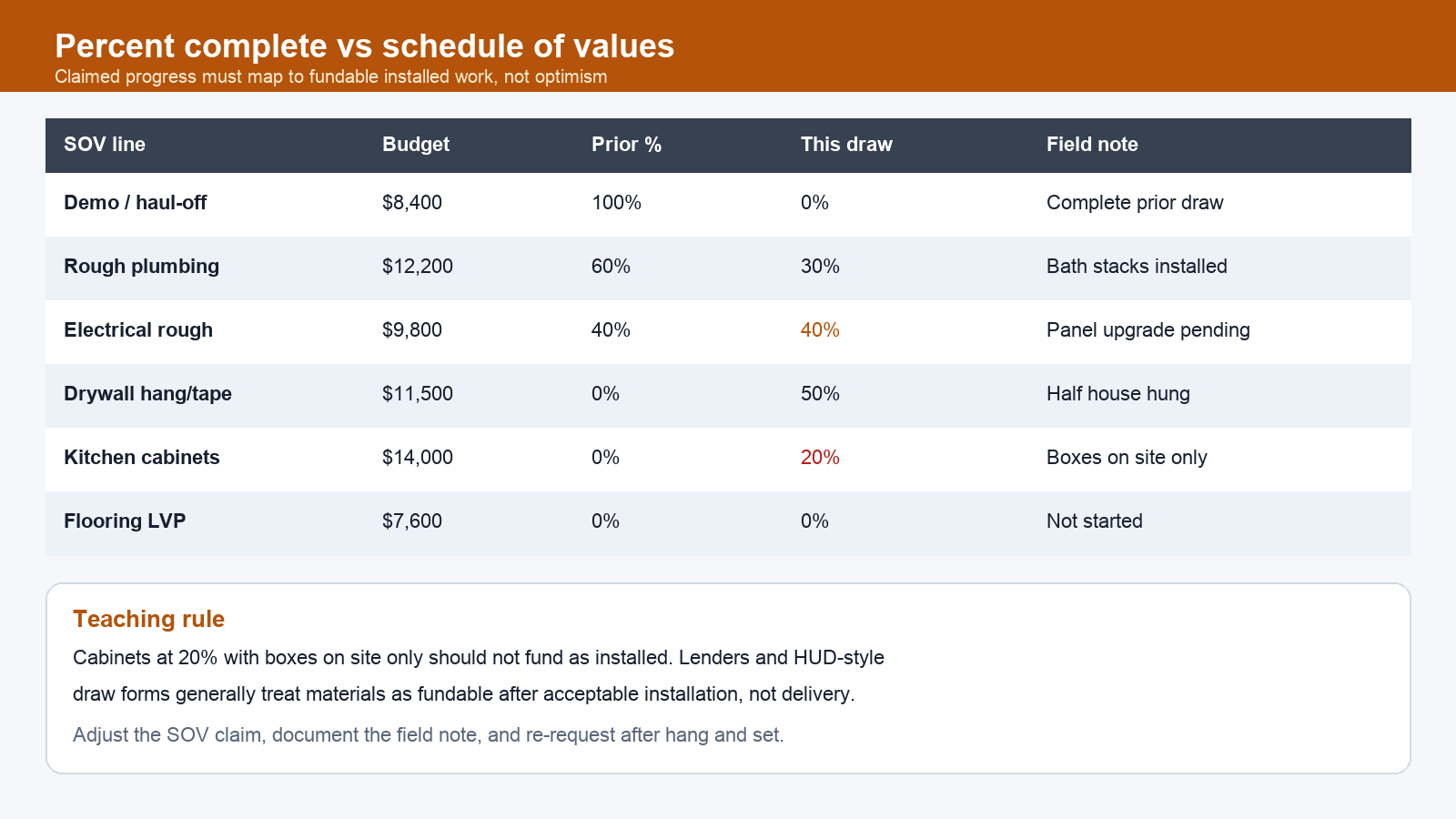
Practical rules that keep claims defensible:
- Installed beats delivered. Cabinets on site are not cabinets hung. Flooring in the garage is not flooring installed. Many lender and HUD-style draw workflows emphasize that materials are generally not funded until acceptably installed.
- Incremental percent, not cumulative storytelling. Show prior accepted percent and the new increment. Do not rewrite history on every draw.
- Partial lines are normal. Fifty percent drywall hang with clear photos is stronger than a round 100 percent claim on an unfinished floor.
- Field notes prevent arguments. One sentence per contested line ("panel upgrade pending utility", "primary bath waterproofing complete, tile not set") saves inspection time.
Hard-money term sheets and private loan agreements vary widely. Some fund by trade package, some by percentage complete across the SOV, and some by milestone photos tied to your hard money comparison assumptions. Read the controlling loan exhibits before you invent a percent method the inspector will not accept.
4. Run the inspection day and document what the inspector can verify
Treat inspection day like a controlled walkthrough, not a social visit. Unlock the property early. Provide power and light where safe. Have the packet printed or loaded on a tablet. Walk room by room in SOV order so claimed percentages appear in the same sequence as the paperwork.
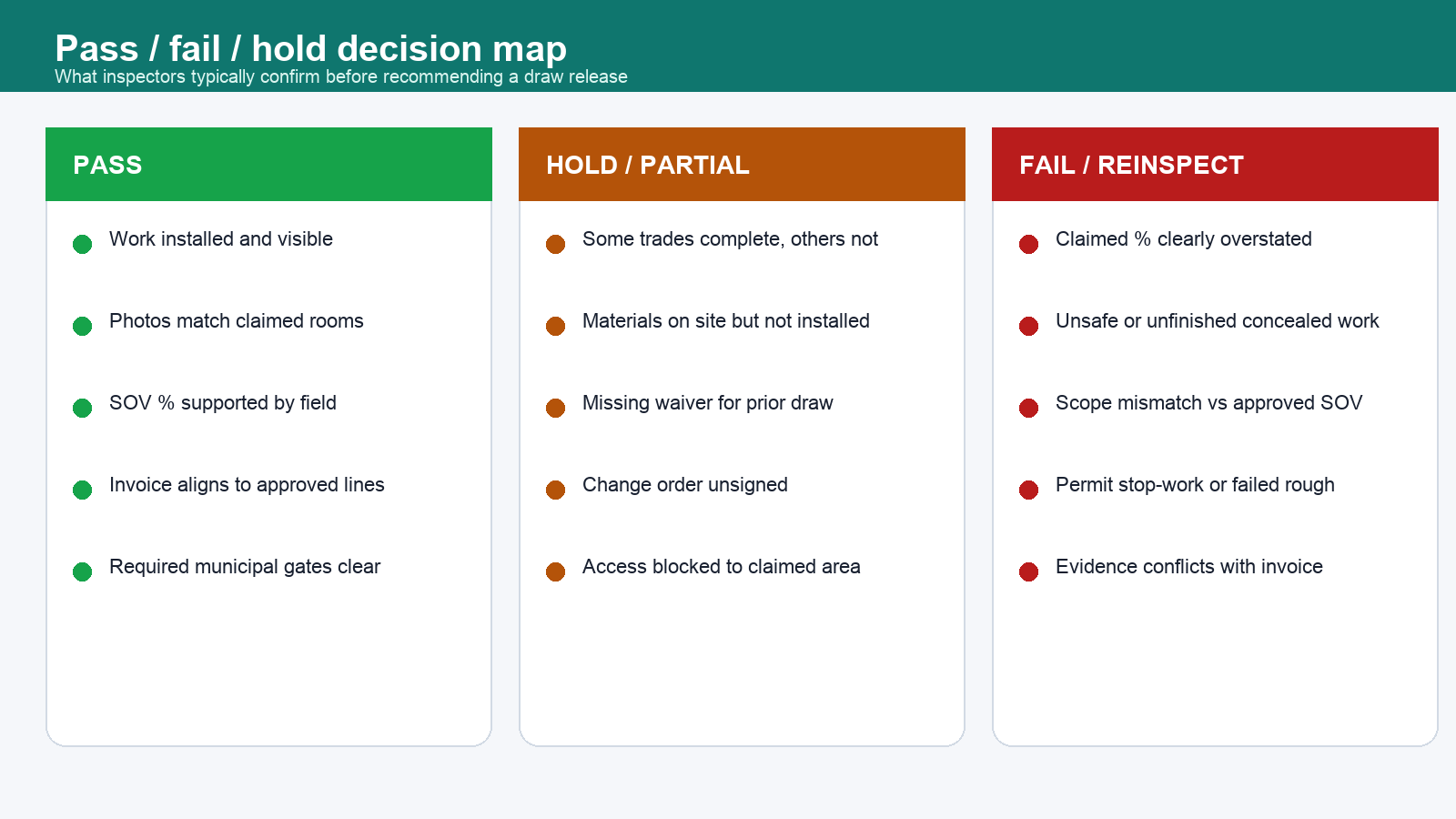
Inspectors typically look for:
- Whether claimed work is present, installed, and consistent with photos.
- Whether percent complete is plausible for each SOV line.
- Whether open safety or workmanship issues block funding for related trades.
- Whether municipal roughs or stop-work conditions affect the claimed scope.
- Whether invoices and change paperwork match the physical house.
Pair the lender visit with your own quality control plan. A draw pass funds progress. It does not automatically mean finish quality is listing-ready. Keep punch items and concealed-work photos in the project record even when the lender funds.
AI tools may help rename photo folders by room or draft a cover sheet from your SOV export. A person still verifies that the bathroom in the photo is the bathroom claimed at 80 percent, and that the invoice did not silently add an unapproved tile upgrade. Keep language provider-neutral: organize evidence, label assumptions, require human approval before submit.
5. Handle fails, partials, holdbacks, and reinspections without panic
A failed or reduced draw is a process event, not a personal verdict. Your job is to capture the punch list, separate fundable work from blocked work, and schedule the smallest reinspection that restores cash flow without lying about completion.
- Full pass. Inspector recommends the requested amount subject to contractual holdbacks. Wire timing still depends on lender processing.
- Partial / hold. Some lines fund, others are cut to a lower percent or zero until evidence improves. Update the SOV and contractor invoice to the accepted amounts before you pay anyone.
- Fail / reinspect. Material overstatement, missing access, or conflicting paperwork triggers a new visit after corrections. Do not argue percentages without new photos and a revised claim sheet.
Holdbacks deserve their own line in your cash plan. Lender holdbacks and contractor retainage both reduce cash today even when work is accepted. Model them beside holding costs so a delayed reinspection is priced in days of interest, taxes, insurance, and utilities, not only in inspection fees.
If the fail reveals a true scope change, stop using draw theater to paper over it. Write a change packet, check contingency, and update the schedule. See change orders and the contingency budget guide.
6. Match contractor invoices to lender draws without double-paying
Two cash streams often move on different clocks: what the lender funds into your project, and what you owe the GC under the payment schedule. When those streams drift apart, investors either overpay the contractor before funding arrives or starve the job after a partial draw.
- Mirror the lines. Contractor invoices should use the same SOV headings the lender reviews.
- Pay against accepted amounts. If the inspector cuts drywall from 50 percent to 35 percent, do not pay the contractor the original 50 percent claim out of pocket and hope the next draw catches up without a written plan.
- Separate owner-funded extras. Upgrades you approve outside the lender SOV need a labeled owner invoice path, not a silent padding of the draw.
- Attach waiver timing. Progress waivers should match cleared payments for the prior window before you ask for the next one.
- Reconcile fees. Inspection fees, wire fees, and draw handling fees may reduce net proceeds. Track them as project soft costs.
For consumer-purpose construction financing, federal disclosures can treat construction inspection and handling fees (including draw fees) as loan costs that must be disclosed under the TILA-RESPA integrated disclosure framework. That is a disclosure topic for covered consumer loans, not a guarantee that your hard-money flip loan uses the same forms. Still, it is a reminder to read fee exhibits before underwriting cash.
7. Work three named investor scenarios
Scenario A: Jordan Hale passes a cosmetic townhome draw with photo discipline. Jordan is flipping a 2011 townhome bought for $289,000 with a hard-money rehab budget of $38,000. Draw 2 claims paint complete, LVP 70 percent, lighting allowance fixtures installed in kitchen and baths, and hall bath vanity set. Jordan builds an SOV packet with 36 photos labeled by room, a GC invoice that matches each line, and progress waivers for Draw 1 trades already paid. The inspector confirms installed work, trims LVP from 70 percent to 65 percent where two bedrooms remain unfinished, and recommends funding on the adjusted amount after a 10 percent lender holdback. Jordan pays the GC only the accepted lines, updates the project schedule, and books Draw 3 after the remaining flooring and punch paint. Holding cost is about $2,100 per month. The lesson is not the percentage. The lesson is that labeled evidence made a partial cut small and fast instead of a full fail.
Scenario B: Samira Ortiz fails a ranch draw by claiming materials as installed. Samira underwrote a 1968 ranch with kitchen, both baths, electrical panel, and roof in a $72,000 rehab plan. On Draw 3 she claims kitchen cabinets at 80 percent because boxes and counters are on site. Photos show stacked cartons in the garage and an unfinished floor. The inspector marks cabinets at 0 percent installed, reduces related plumbing finish lines, and requires reinspection after hang and set. Samira's contractor still wants payment based on the delivery invoice. She refuses, cites the loan rule that materials are not fundable until installed, revises the SOV, and uses a short owner cash bridge only for labor already accepted on other lines. Extra hold from the reinspection delay is five days at $58 per day. The draw later passes at a honest 55 percent on cabinets after install photos. Claiming delivery as completion cost time and trust.
Scenario C: Diego Alvarez remediates a partial after a municipal rough fail. Diego's duplex flip has a private lender who funds against SOV percent complete but will not fund electrical finish while the municipal rough is open. Draw 4 paperwork claimed electrical at 90 percent based on contractor optimism. The city failed the rough for grounding and box fill issues the same morning the lender inspector arrived. The lender inspector issues a partial: carpentry and insulation lines fund, electrical drops to the last accepted rough-ready percent, and a reinspection is required after the city pass. Diego treats the municipal fail as the controlling gate, updates permit status in the packet, runs corrections through his quality control hold points, and only then re-requests the electrical increment. The scenario shows why draw inspections and code inspections must be tracked as related but separate systems.
8. Follow one complete draw cycle example
Baseline property. Nora Kim is renovating a 1955 ranch bought for $205,000. Hard-money total loan is structured with acquisition and a $64,000 rehab escrow released through draws. Holding cost runs about $1,740 per month, or $58 per day. After-repair sale after selling costs supports about $318,000. Walk-away profit target is $24,000.
SOV and Draw 2 claim. Nora's frozen SOW maps to a 12-line SOV. Draw 2 claims: demo 100 percent (already accepted prior), rough plumbing +40 percent to 100 percent, electrical rough +35 percent to 75 percent, HVAC rough +50 percent to 50 percent, and drywall +25 percent to 25 percent. Gross claim before holdback is $18,600. Packet includes 48 photos, GC invoice mirrored to SOV, two approved change orders totaling $1,100 already reflected in the SOV, progress waivers for Draw 1, and notes that the electrical municipal rough is scheduled for the next week.
Inspection outcome. The lender inspector accepts plumbing at 100 percent, cuts electrical from 75 percent to 60 percent because the panel upgrade is incomplete, accepts HVAC at 50 percent, and accepts drywall at 20 percent where one side of the house is still undhung. Adjusted gross becomes $16,050. After a 10 percent holdback, net recommended release is $14,445. Inspection fee of $350 is deducted per the loan fee schedule, so Nora models $14,095 hitting the project account.
Cash matching and next actions. Nora revises the contractor payment for Draw 2 to the accepted SOV amounts, not the original claim. She schedules electrical completion and the municipal rough before Draw 3, updates the project schedule by four days, and recalculates hold at 4 × $58 = $232. No contingency raid is needed because the cut was evidence timing, not a new scope discovery. She archives the inspector punch notes, the revised SOV PDF, wire confirmation, and waivers in the project record beside expenses and the payment schedule.
Opinion versus fact. Nora likes the GC's communication. That opinion does not restore the 15 electrical points the inspector removed. Only installed work, photos, and a later pass do.
9. A repeatable Rehabfolio draw inspection workflow
- Align documents. Freeze SOW lines, SOV, payment schedule, and lender draw rules to the same headings.
- Collect evidence early. Photos, invoices, waiver status, permit gates, and approved changes before you claim percentages.
- Draft the packet. Cover sheet, SOV percents, photos, invoice, change log, lien controls, holdback math.
- Human verify. Walk the house against the claim sheet. Cut optimistic lines yourself before the inspector does.
- Host the visit. Access, light, packet order, and room sequence that matches the SOV.
- Record the outcome. Pass, partial, or fail with line-level notes and any reinspection date.
- Match cash. Pay the GC against accepted amounts. Reconcile fees, retainage, and owner-funded extras separately.
- Archive the chain. Keep packets, photos, inspector notes, wires, and waivers with the project record.
Connect the draw record to the fix-and-flip workflow and rehab estimating. The goal is one chain from frozen scope to claimed percent complete to verified inspection to funded draw to matched contractor payment.
Before the next purchase, reconnect draw reality to financing comparisons in hard money loan offers and to contractor screening in contractor vetting. A beautiful SOV cannot save a loan that funds too slowly for your hold, and a cheap GC cannot save a draw package that overclaims every month.
Frequently asked questions
What is a house flip draw inspection?
A draw inspection is a progress inspection that verifies how much renovation work is complete so a lender, hard-money lender, or private construction funder can release the next tranche of rehab money. It is not a municipal code inspection and it is not the same as deciding how you structure contractor deposits, milestones, and retainage.
Who performs the draw inspection?
It depends on the loan. Hard-money and private lenders often use their own inspectors, third-party field reviewers, or appraisers familiar with rehab progress. Some programs, including certain FHA 203(k) workflows, use approved consultants or inspectors and formal draw request forms. Ask your lender who will visit, what evidence they require, and how long funding takes after a pass.
What should be in a draw request package?
At minimum: a cover sheet with draw number and claimed amount, a schedule of values with prior and current percent complete, dated photos matched to claimed lines, a contractor invoice that mirrors those lines, approved change orders affecting the window, lien waiver status for prior paid work, permit or municipal gate notes that affect fundable trades, and holdback or retainage math showing the net request.
Why do draw inspections fail?
Common reasons include overstated percent complete, materials on site claimed as installed, missing photos, invoice lines that do not match the approved schedule of values, unsigned change work, blocked access, failed municipal roughs that stop related trades, and missing progress waivers from a prior funded draw. A fail usually produces a punch list and a reinspection path rather than permanent denial.
How is percent complete calculated against a schedule of values?
Each SOV line has a budgeted amount. You claim a percent complete for that line based on installed work, not optimism. The draw amount for the line is roughly budget times the incremental percent in this window, subject to lender rules, holdbacks, and any inspector adjustments. Partial lines are normal. Claiming 100 percent for unfinished rooms is how packages get cut.
Can AI prepare my draw package?
AI tools may help organize photo filenames, draft cover sheets, or flag SOV lines that lack matching evidence. A person still has to verify field conditions, percent complete, invoice accuracy, waiver status, and lender rules. Keep the process provider-neutral: evidence visible, assumptions labeled, and human approval before the package is submitted.
Can Rehabfolio approve or fund my draw?
No. Rehabfolio can help you organize schedules of values, photos, files, invoices, change packets, expenses, contractor payments, lien controls, and lender draw records in one project workspace. It cannot inspect the house, authorize funding, clear a municipal inspection, bind insurance, interpret your loan documents, give legal advice, or decide whether you should draw or wait. Use your lender and qualified local professionals for funding decisions.
Editorial methodology, limitations, and sources
The Rehabfolio editorial team chose this topic as a distinct lender and hard-money progress inspection and draw-funding workflow. It does not replace the cash-timing intent of the contractor payment schedule guide, the municipal compliance intent of the permits and inspections guide, the release-paperwork intent of the lien waiver guide, the amendment intent of the change-order guide, or the bid-baseline intent of the scope of work guide. Those guides remain the homes for owner-to-GC payment structure, code gates, waivers, post-freeze amendments, and SOW writing. This guide focuses on preparing for, documenting, passing or failing, and remediating construction draw inspections that gate funding.
Key sources include the Federal Trade Commission's how to avoid a home improvement scam guidance on written terms and not paying for unfinished work as if complete; the Consumer Financial Protection Bureau's TRID construction loan guide discussing disclosure of construction inspection and handling fees (including draw fees) for covered consumer construction financing; HUD form HUD-9746-A (Draw Request Section 203(k)) and related 203(k) draw request instructions illustrating percent-complete columns, installer certification, inspector adjustment, and the general rule that materials are not paid until acceptably installed; and IRS Publication 583 on starting a business and keeping records. Local lenders, building departments, insurers, and construction counsel remain necessary for one property. National sources cannot approve your draw or interpret your private loan exhibits.
Public guidance cannot tell you whether a particular bathroom is 60 percent or 80 percent complete, whether your hard-money lender accepts materials on site, or whether a municipal rough will clear this week. Examples are original composites created for teaching. Names, addresses, figures, and outcomes are illustrative, not testimonials or performance claims. Percentages and dollar figures are educational, not quotes or guaranteed funding results.
Editorial standard. We identify the audience, author, review date, topic boundary, assumptions, calculations, product evidence, and limitations. We do not invent credentials, licenses, testimonials, market statistics, or guaranteed results. AI may help organize research and draft, and a person reviews the claims, calculations, links, examples, and limitations before publication. We revise the guide when a cited rule, product workflow, or material draw practice changes. See the editorial methodology on the company page.
Keep SOV percents, photos, invoices, and draw outcomes in one clear project record.
Turn frozen scope into honest percent-complete claims, host a clean inspection, and match contractor payments to what the lender actually funded.
Create free account