House flipping cost breakdown: how acquisition, rehab, holding, and selling costs become profit
A flip makes money only after every bucket is on the page. This guide shows beginners how to stack purchase and buyer closing, rehabilitation, holding, selling costs, and contingency, then turn that stack into a maximum offer and an illustrative net profit. The numbers below are teaching examples. They are illustrations, not quotes, appraisals, or results from a real project.

Field Journal · Rehabfolio editorial team · September 25, 2026
Published and last reviewed September 25, 2026 · Written and reviewed by the Rehabfolio editorial team.
Who this guide is for. This guide is for new and growing United States residential investors who can already name a purchase price and a repair guess, and who now need the rest of the profit picture before they write an offer. It covers single-family houses and small residential properties, such as a duplex you plan to renovate and sell. It starts when you have a listing or a contract draft. It ends when acquisition, rehab, holding, selling, and contingency each have a number, and those numbers produce a walk-away purchase price. If you are still pricing the finished house from comparable sales, start with how to estimate after-repair value. If you are still building the physical work list, start with how to build your first repair budget.
The Rehabfolio editorial team builds and reviews product workflows that organize property analyses, repair estimates, expense records, holding assumptions, and project reports. That work is experience with how a number moves from an early screen into a budget line and later into a recorded cost. The team is not a broker, appraiser, attorney, lender, tax professional, insurer, contractor, inspector, or accountant. We do not hold those licenses, and this guide does not create them.
Loan documents, closing customs, transfer taxes, building codes, insurance forms, and tax treatment differ by state, city, property, occupancy, and entity. This page is educational information. It is not legal, tax, lending, insurance, appraisal, construction, or investment advice. Use licensed local professionals when the decision depends on their field.
How this page sits next to the other guides. The holding-cost guide owns the daily carrying burn from purchase close to sale close. The repair-budget guide owns the walkthrough, quantities, and bids that become the rehab total. The contingency-budget guide owns how to size a reserve for unknowns and when to release it. This page owns the stack: where each finished total sits, which costs people leave out, and how the sum changes the most you can pay and the profit you might keep.
1. Define the full flip cost stack
A house flipping cost breakdown is a profit and loss sketch for one property. List what you pay to buy it, what you pay to change it, what you pay to own it while the work and the sale take time, what you pay to transfer it to the next buyer, and what you hold back for surprises. Illustrative net profit is the sale price you are willing to underwrite, minus that sum. If you want a minimum profit, solve backward. The remainder is your maximum purchase price. Six honest lines are enough for a first pass: purchase price, buyer closing, rehabilitation, contingency, holding, and selling. A percentage can screen a long list of houses. Freeze the offer from the itemized stack, because a single percentage cannot see your insurance quote, a permit fee, or a commission you plan to pay.

Keep facts, calculations, assumptions, and opinions in separate notes. A bid that lists labor, materials, and a permit allowance is a fact plus a document. A feeling that the house will sell fast is an opinion. In this guide, rehab means labor, materials, and the permits that belong to the work. Acquisition, holding, and selling are separate calculations. Your after-repair value, often shortened to ARV, is the sale price in the sketch. It is your planning memo. An appraisal is a professional opinion of value prepared under appraisal standards for an intended user. Choosing comps is the job of the after-repair value guide. This page starts from a sale figure you can explain. The source notes below say what USPAP and Fannie Mae's market-value definition actually cover.
2. Count acquisition and buyer closing
Acquisition starts with the price you agree to pay the seller. Earnest money is usually a deposit toward that price and a credit at closing, so put the full contract price on the purchase line and leave the deposit out of the stack. The earnest money guide covers who holds it and when it comes back. Buyer closing costs are the charges to take title and, when you borrow, to open the loan: lender points or origination, title insurance, escrow or settlement fees, recording, and buyer-side transfer taxes. The Consumer Financial Protection Bureau's Closing Disclosure explainer describes closing costs as the upfront charges to get the loan and transfer ownership, and it separates those charges from cash to close. A cost you finance is still a cost. A seller credit reduces cost only when it is real.
Write down what sits inside the closing number. Points paid once at purchase belong in acquisition. Monthly interest during the hold belongs in holding. An insurance premium belongs in one place, either the closing line or the holding line. Cash buyers still pay title, transfer, and recording. Replace a round percentage with a written estimate from the title company or closing attorney before you freeze the offer.
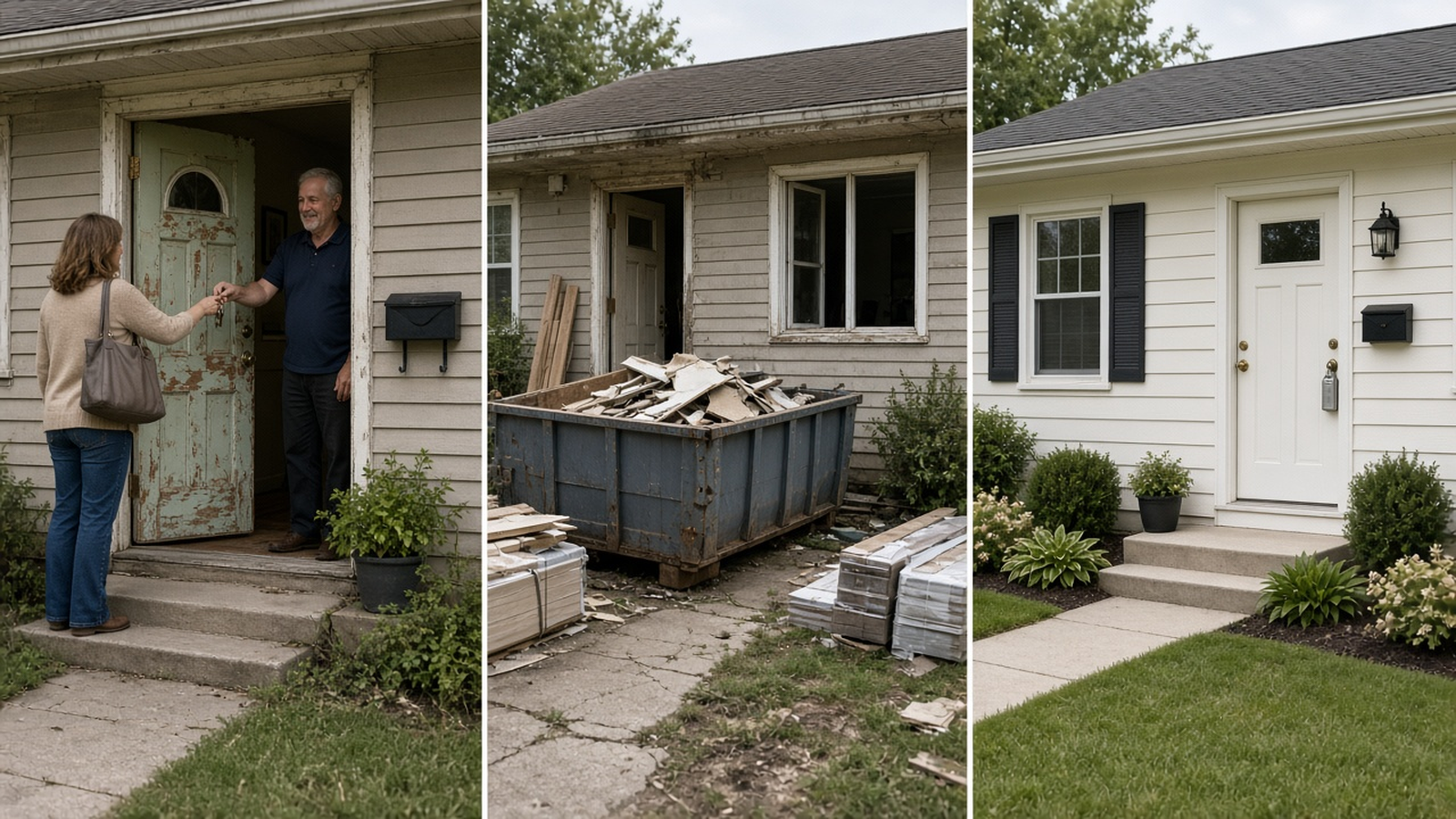
The same house has three cash moments: you pay to receive the keys, you pay to change the building, and you pay to hand the keys to the next owner. The months between those moments have a cost too. Selling costs belong in the offer math so they are visible on the day you buy.
3. Place rehab labor, materials, and permits
The rehab bucket is the cost to make the house match the scope behind your sale price. If the ARV assumes a new kitchen, a repaired roof, and finished floors, those items belong in this bucket, or a written exclusion has to lower the sale price too. Split labor, materials, and permits even when the contractor bids a lump sum. Labor is the trade work. Materials are the goods you or the contractor buy for the job. Permits, plan review, and required inspection fees sit with the work they authorize. A dumpster that serves the renovation stays here so it does not also appear under holding.
Measuring rooms and comparing bids is the repair budget guide. Permit sequence, and the days those steps add, is the permits and inspections guide. The fee belongs in rehab. The extra days belong in holding. Until a written scope and a price are attached, mark the rehab line as an assumption. Prefer a written contract over a texted range. If you fund the work with draws, the economic cost is still the bid plus approved changes. A construction loan is usually short-term money, often advanced as the work progresses. Put any draw fees on a line you can find. The sources section cites the public pages behind those points.
4. Drop holding costs into the stack
Holding costs are the price of time between purchase closing and sale closing: interest, property taxes, insurance, utilities, and basic property care. The holding-cost guide builds that list from a calendar and turns it into a daily burn. The holding-cost calculator checks the arithmetic once you have monthly inputs. This page only needs the period total inside the offer.
Scale an annual interest rate to the months you will actually carry the balance, and read the term sheet before you treat the math as final. Points paid up front stay in acquisition. Principal you pay down is cash, and in this simple profit sketch it is part of the loan payoff at sale, not a second purchase price. Ask an accountant how your books should record it. Place the renovation insurance premium once. Coverage questions belong in the house flip insurance guide. Match utilities to the building. Two meters are a different number from one house. When the schedule slips, update this bucket before you approve more work. If a hard-money note creates the interest, compare offers in the hard-money comparison guide and bring the dollar result back here.
5. Add selling costs before you offer
Selling costs transfer the renovated house to the next owner: commission or another selling fee, seller-side title and settlement charges, seller transfer taxes, recording, and concessions you expect to give. Staging or a last repair that exists only to sell can sit here when it is outside the rehab scope. Commission is usually a percentage of the sale price, so the dollars move when the ARV moves. Use a smaller investor-to-investor fee only when you can describe a real path to that buyer.
The offer comparison guide tests which contract nets more after credits and financing risk. The seller closing checklist controls the settlement statement on the day you sell. Reserve the cost on the day you buy. Tax prorations can overlap the holding tax line. On a first pass, holding carries the tax for the months you own the house, and seller closing carries the transactional fees. Update both lines when a draft settlement statement arrives so the same dollar appears once.
6. Keep contingency as its own line
Contingency is money reserved for conditions you could not verify when you froze the scope. Rotten sheathing is a rehab surprise. An extra month of interest is a holding surprise. They can arrive together, and they stay on different lines. A cosmetic project with open access is a different uncertainty problem from a partial gut of an older house. There is no universal percentage that makes the unknown safe. The contingency guide sizes the reserve and decides when a written change may spend it. Here, you subtract the reserve you already justified before you call the profit real.
Conservative offer math treats contingency as a cost. If the reserve is untouched at the end, profit is higher by what you did not spend. If you leave it out and then spend it, the profit you described was never available. Keep one rehab total and one reserve. When a change order spends the reserve, update the balance and recalculate. The paperwork for that change is the change-order guide.
7. Turn the stack into a maximum offer
Illustrative net profit equals the sale price you are underwriting, minus purchase price, buyer closing, rehab, contingency, holding, and selling costs. Maximum purchase price equals that same sale price, minus every cost except the purchase, minus the minimum profit you will accept. One answer is what you might keep at a given price. The other is the price that still leaves the profit you named.
The 70 percent rule guide is a screen: ARV times 0.70, minus repairs. The 0.30 remainder stands in for closing, holding, selling, contingency, and profit all at once. It cannot see your rate, your transfer tax, or your commission. Freeze the offer only after the itemized stack still clears your target. Then stress the sketch. Lower the sale price to a figure you could defend if the best comp falls out, and lengthen the hold by a delay you think is plausible. Recalculate interest, taxes, insurance, utilities, and commission. You can pay more than the maximum only by cutting a cost you can document, accepting less profit on purpose, or supporting a higher sale price with comps. Cutting scope also cuts the right to use the finished-house price. Those two edits travel together.
8. Work three named investor scenarios
Aisha Grant, Luis Ortega, and Priya Shah are fictional investors. The street addresses, prices, rates, and results are original illustrations for this article. They are not case studies, testimonials, or performance claims. Each person uses the same six buckets. The houses are different, so the stacks are different. None of these figures is a bid, a tax determination, or an appraisal.
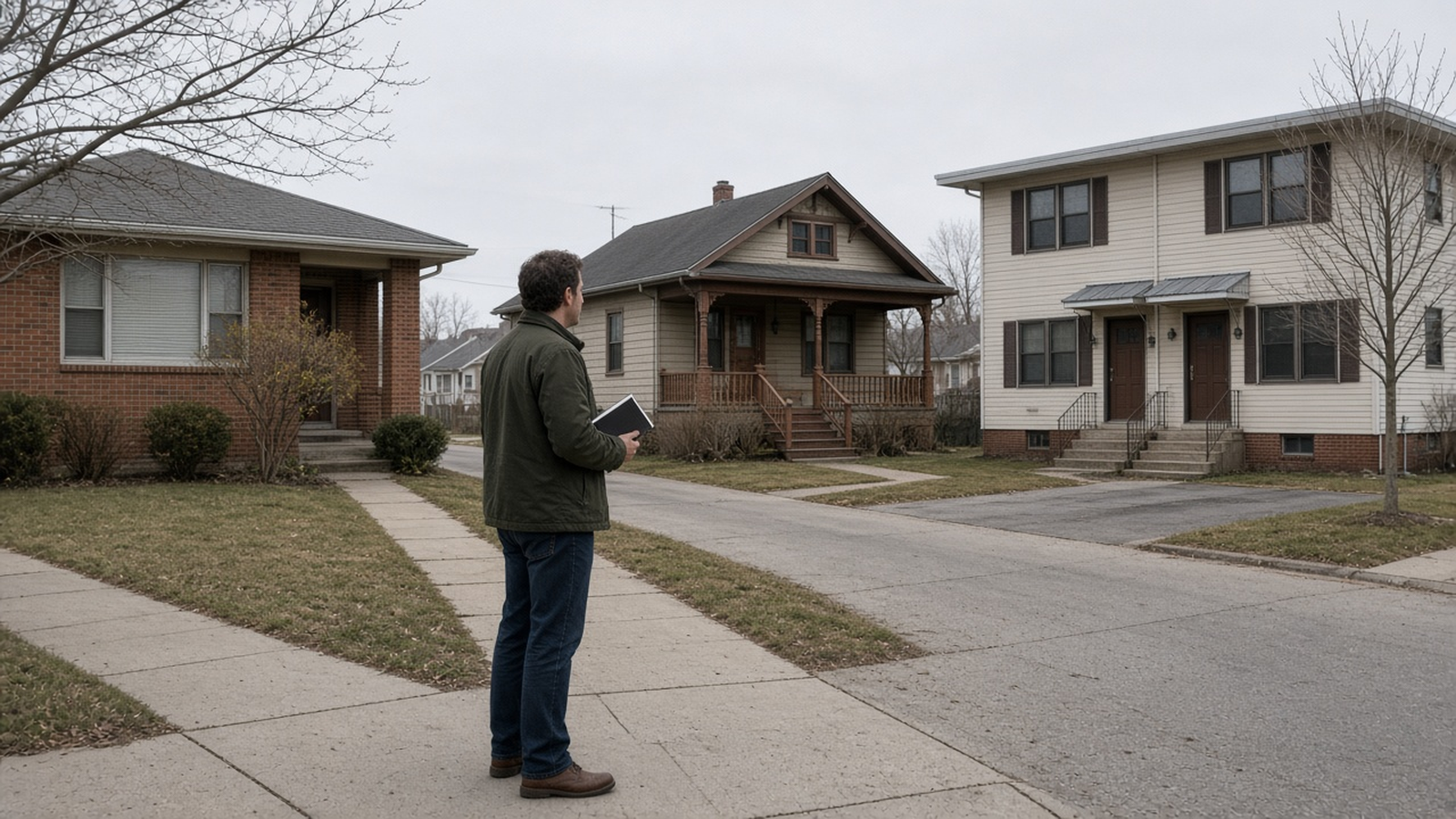
Scenario A: Aisha Grant and a 1968 ranch. Aisha is looking at a one-story ranch, about 1,140 square feet, with three bedrooms and one bathroom. The fictional setting is 418 Linden Avenue in Columbus, Ohio. The contract draft is $185,000. She believes a finished cosmetic scope, a kitchen and bath refresh plus floors and paint, supports a planning ARV of $268,000. She is keeping that figure in her own comp memo, not calling it an appraisal. Her buyer closing estimate is $6,400: $2,200 in lender points and origination, $3,150 in title and recording, and $1,050 in transfer and small settlement items. Insurance and monthly interest are outside that $6,400. Written rehab bids total $43,550: $28,500 labor, $14,200 materials, and $850 in permits. After a walkthrough with open access, she reserves $4,355 of contingency and treats it as spent for offer math. She plans a five-month hold. Interest on $148,000 at 11 percent annual for five months is $6,783, rounded to the nearest dollar. Insurance at $180 a month is $900. Taxes of $2,640 a year for five months are $1,100. Utilities at $160 a month are $800. Holding is $9,583. Selling on a $268,000 price is a 5 percent commission of $13,400, seller closing of $2,680, and a $2,000 allowance for concessions or staging, which is $18,080. Costs other than the purchase are $81,968. All-in at $185,000 is $266,968. Illustrative profit if it sells at $268,000 is $1,032. She wants $25,000. The purchase price that leaves $25,000, with every other line held still, is $161,032. The draft contract is $23,968 above her walk-away number.
A quick 70 percent screen on her figures is 0.70 times $268,000, which is $187,600, minus $43,550 of repairs, which is $144,050. That screen is stricter than her $161,032 walk-away price because the 30 percent remainder is a blended allowance, not her actual closing, hold, commission, contingency, and $25,000 target. She still itemizes. The screen does not replace the stack.
Scenario B: Luis Ortega and a 1924 bungalow. Luis is underwriting a partial gut of a bungalow, about 1,620 square feet, with three bedrooms and two bathrooms. The fictional setting is 907 Prospect Avenue in Kansas City, Missouri. The purchase price in his draft is $142,000. He is paying cash at acquisition, so buyer closing is title and transfer only, estimated at $5,100. The rehab he is willing to underwrite is $96,900: $62,000 labor, $31,500 materials, and $3,400 in permits and plan review. Because walls will open in an older house, he reserves $14,500 of contingency and counts it as a cost. His private loan illustration is $180,000 at 12 percent for eight months, which is $14,400 of interest. Insurance at $240 a month is $1,920. Taxes of $1,860 a year for eight months are $1,240. Utilities at $210 a month are $1,680. Holding is $19,240. His planning ARV is $340,000. Selling is a 5.5 percent commission of $18,700, seller closing of $3,400, and a $4,000 concession reserve, which is $26,100. Costs other than purchase are $161,840. All-in is $303,840. Illustrative profit at $340,000 is $36,160, and that figure assumes the contingency is spent. If the reserve is never used, the sketch would be $14,500 higher. He does not spend that hope in the offer.
Luis also runs the bad path. The sale figure falls to $315,000 and the hold grows by two months. Extra interest is $3,600. Extra insurance, taxes, and utilities are $480, $310, and $420, so extra holding is $4,810. Commission falls to 5.5 percent of $315,000, which is $17,325, so selling becomes $24,725 instead of $26,100. Costs other than purchase become $165,275. All-in becomes $307,275. Illustrative profit becomes $7,725, still assuming the original $14,500 reserve is used and that nothing beyond it appears. That is below a $25,000 profit target. Luis can still like the house. The first sketch did not survive. He needs a lower price, a shorter documented schedule, or a sale figure he can support before the contingency is his only remaining cushion.
Scenario C: Priya Shah and a 1979 duplex. Priya is buying a side-by-side duplex, about 2,040 square feet in total, with two two-bedroom units. The fictional setting is 2215 Oakdale Street in Springfield, Illinois. She plans to renovate and sell the building to another investor. The contract draft is $210,000. Buyer closing is $7,800 for lender fees, title, and recording, with insurance and interest kept out of that number. Rehab is $36,000 labor, $18,400 materials, and $1,200 in permits, which is $55,600. She reserves $6,700 of contingency after inspection and counts it as spent. Her loan illustration is $168,000 at 10.5 percent for six months, which is $8,820 of interest. A vacant duplex policy at $310 a month is $1,860. Taxes of $3,720 a year for six months are $1,860. Utilities on two meters at $280 a month are $1,680. Holding is $14,220. Her planning sale price is $325,000. She uses a 4 percent selling fee because she can describe a credible investor-buyer path, which is $13,000, plus $3,250 of seller closing, which is $16,250. If that buyer path disappears, she reprices the selling line before she trusts the profit. Costs other than purchase are $100,570. All-in at $210,000 is $310,570. Illustrative profit is $14,430. For a $30,000 profit target, the maximum purchase is $194,430. The draft contract is above her number. Two kitchens and two meters changed the rehab and utility lines. The equation stayed the same.
Read across the three sketches and the lesson is the mix. Aisha's rehab is the smallest, and her contract price still fails because acquisition plus selling consume the spread. Luis's rehab is the largest, and the base sketch still shows more profit, until a lower sale price and two extra months compress it. Priya's duplex changes utilities, insurance, and the selling fee, and her target profit produces a purchase cap below the ask. Same buckets. Different houses. Every bucket still has to be filled.
9. Follow one complete stack, line by line
Use Aisha's ranch as the worksheet you can copy. Every dollar below is illustrative. Replace each line with a quote, a bid, or a labeled assumption before you negotiate. The sale price is her planning ARV of $268,000, explained in her own comp notes. It is her memo, not an appraisal.
Check the addition in the open. Buyer closing $6,400 plus rehab $43,550 is $49,950. Add contingency $4,355 and the subtotal is $54,305. Add holding $9,583 and the subtotal is $63,888. Add selling $18,080 and the costs other than purchase are $81,968. Add the draft purchase of $185,000 and the all-in figure is $266,968. Subtract that from $268,000 and $1,032 remains. Subtract the $81,968 and the $25,000 target from $268,000 and the maximum purchase is $161,032. If your own page does not add back to the same profit, a line is in two buckets or a line is missing.
Holding detail for the $9,583: $6,783 interest, $900 insurance, $1,100 taxes, and $800 utilities. Selling detail: $13,400 commission, $2,680 seller closing, and $2,000 of concessions or staging. If a document is missing, that line stays an assumption. Aisha can offer at or below $161,032 and keep the rest of the stack. Paying more requires a documented cost cut or a smaller profit she accepts on purpose.
10. Keep the stack in a repeatable record
A cost breakdown dies when it lives in a message thread. Put the six buckets on one property record before you offer, and keep the same record after you own the house. Estimates and later expenses should land on the same lines so you can see drift. Rehabfolio's workflows for rehab estimating and budget and expense tracking are built to hold that kind of record. The flip analysis calculator is a way to test the arithmetic before you create an account. The product can store the lines you enter. It cannot inspect the roof, bind a policy, or decide the offer.
Once you close, the stack becomes the project budget. Scope, schedule, draws, and vendor documents belong with the house so a paid invoice can be matched to a bucket. That operating question is the rehab project management guide. The fix-and-flip workflow describes the path from an accepted deal into the rehab. Use those pages for the week-to-week system. Use this page so the week-to-week system still rolls up to profit.
An AI tool can group notes you already captured or flag a blank bucket. It cannot invent a sale price, a local transfer tax, or a contractor's price. Show the source note, label assumptions, and have a person accept any figure that changes the offer. The AI disclosure states that boundary. Before you send the offer, match purchase to the contract, closing to a written estimate, rehab to a scope, and selling fees to the sale price. If a line is still a guess, the offer is still a draft.
Frequently asked questions
What is a house flipping cost breakdown?
A house flipping cost breakdown is the full set of money you expect to spend from purchase through sale, grouped so profit is visible. The usual buckets are the purchase price, buyer closing costs, rehabilitation (labor, materials, and permits), holding costs, selling costs, and a contingency reserve. The purchase price is one line inside that larger stack.
What belongs in rehabilitation cost calculations?
Rehabilitation cost calculations cover the work that changes the house: labor, materials, permits, and fees that belong to that work, such as a dumpster or required plan review. Purchase price, loan interest, property taxes, insurance, utilities, and selling commission sit in other buckets. Build the scope and compare bids in the repair-budget guide, then bring the finished rehab total into this profit stack.
How do holding costs fit into the full flip budget?
Holding costs are the cost of owning the house between purchase closing and sale closing. Interest, property taxes, insurance, utilities, and basic property care belong here. A longer calendar makes the bucket larger even when the rehab bid stays the same. Calculate the period with the holding-cost guide, then drop that total into the stack before you set a maximum offer.
How do I turn a cost breakdown into a maximum offer?
Start with the sale price you are willing to underwrite. Subtract buyer closing, rehab, contingency, holding, and selling costs. Subtract the profit you require. What remains is the most you can pay for the house if every other assumption holds. If the seller wants more, another assumption has to change in your favor, and you need evidence for that change. Recalculate before you raise the offer.
Are house flipping costs tax deductible?
Deductibility is a tax question, and the answer depends on your facts. The IRS discontinued Publication 535, Business Expenses, after the 2022 edition and now points readers to the Tax Guide for Small Business for topics such as deducting expenses, interest, taxes, and insurance. Those pages explain categories for a trade or business. They do not decide whether your flip is a business, whether a cost is deducted now or added to the property, or how your entity is taxed. Keep records by bucket and ask a qualified tax professional before you file.
Is an investor cost memo the same as an appraisal?
Your memo is a planning worksheet for a purchase decision. An appraisal is a professional opinion of value prepared by an appraiser. The Appraisal Foundation describes USPAP as the generally recognized ethical and performance standards for the appraisal profession in the United States, and state-licensed or state-certified appraisers must follow USPAP when they appraise for federally related transactions. Fannie Mae's selling guide describes market value as the most probable price in an open market under conditions it lists. A lender uses an appraisal to judge collateral. Your after-repair value figure can be informed by comps, and it remains your assumption until a qualified appraiser produces a report for an intended use.
Can Rehabfolio or an AI tool set my maximum offer?
Rehabfolio can store the purchase, the rehab estimate, holding assumptions, selling assumptions, contingency, and the expenses you later record, so the stack stays on one property. An AI tool can sort notes you already captured or draft a checklist from those notes. You still inspect the house, compare the loan, accept the contractor price, and approve every number that changes the offer. Software can hold the record. It cannot make the purchase decision.
Editorial methodology, limitations, and sources
The Rehabfolio editorial team wrote this guide from product workflow experience organizing estimates, expense categories, and project records. The team is not a brokerage, appraisal firm, law firm, lender, tax practice, or insurance agency. We did not inspect the fictional houses in the examples, and we did not pull live quotes for those addresses. Dollar figures are rounded teaching arithmetic so a reader can audit the stack. They will not match your title bill, your note, or your bids.
The holding-cost, repair-budget, contingency, after-repair value, and 70 percent rule guides remain the homes for the method inside each topic. This page answers a different search: how those finished totals sit together when you compute a maximum offer and a net profit.
Key public sources, and the limited claim each one supports, are listed here. The Consumer Financial Protection Bureau explainer What is a construction loan? describes a construction loan as usually short-term financing to build or rehabilitate a home, often advanced as work progresses, often at a higher rate than a long-term mortgage. The CFPB Closing Disclosure explainer describes closing costs as upfront charges to get a loan and transfer ownership, distinguishes them from cash to close, and says the lender uses an appraisal, prepared by an independent appraiser, to help decide what the home is worth. The IRS guide to business expense resources states that Publication 535, Business Expenses, was discontinued after the 2022 revision, and it maps topics such as deducting business expenses, interest, taxes, and insurance to the Tax Guide for Small Business. That guide is IRS Publication 334. Those pages are category maps. They are not a determination of what you may deduct on a flip. Fannie Mae's selling-guide topic Definition of Market Value gives the market-value definition summarized above. The Appraisal Foundation's USPAP page describes USPAP as the generally recognized standards for the appraisal profession and explains when credentialed appraisers must follow them on federally related transactions. The Federal Trade Commission article How To Avoid a Home Improvement Scam is the reference for preferring written contracts and careful payment practices when you hire renovation work. Local closing customs, licensing boards, and your own professionals still control the transaction in front of you.
Editorial standard. We name the audience, the author, the review date, the topic boundary, and the product limit. We do not invent credentials, licenses, testimonials, market statistics, or guaranteed returns. AI may help organize research and draft, and a person reviews the claims, the links, the examples, and the limitations before publication. We revise the guide when a cited public page or a material product workflow changes. See the editorial methodology on the company page.
Keep the purchase, the rehab, the hold, and the sale on one record.
Use a workspace to store the stack you are willing to defend. You still decide what to pay.
Create free account