What an escrow holdback does to a house flip at closing
A beginner can finish the inside of a flip, accept an offer, and still wire home less than the settlement statement seemed to promise. The missing cash is often an escrow holdback: money held back until paint, a driveway, a roof, a payoff, or a title item is actually done. This guide shows what that hold is, how the amount is usually sized, who releases it, and how to price the gap before you sign.

Written and reviewed by the Rehabfolio editorial team. Published and last reviewed October 19, 2026.
Who this guide is for. This guide is for a beginner house flipper in the United States who is about to sell a one-to-four-unit property, or who is buying one and sees a holdback on the seller side of the file. You might sell to a buyer using a conventional loan, an FHA loan, or a VA loan, or to a cash buyer who still wants unfinished items covered. The guide starts when someone says part of your proceeds must stay in escrow. It ends when you can point to the amount, the holder, the release evidence, the cash you will actually receive on closing day, and the cash you expect after the release.
The Rehabfolio editorial team builds and reviews product workflows that connect a property record to documents, dates, photos, and the offer math. That is first-hand product experience with how a deal file is organized. It does not make the team a closer, a title agent, an attorney, a lender, an appraiser, or a tax adviser. We do not invent licenses, credentials, or customer results.
Holdback rules differ by loan program, lender overlay, state, contract, and the house in front of you. Published guidelines change. This page is educational. It is not legal, tax, title, or lending advice. Use the escrow agreement in your hand and a qualified closing professional for the house you are selling or buying.
Tip: Read this beside the seller closing checklist, the title commitment guide, the punch list and closeout guide, the holding cost guide, and the pre-listing checklist. Those pages are the homes for the closing day, the title file, the finished work, the daily carry, and the listing launch. This page is only the hold on your proceeds.
1. Define what an escrow holdback is
An escrow holdback is a slice of closing money that does not go to the seller on closing day. A neutral holder keeps it until a written condition is met. People also call the same pile a repair escrow, a completion escrow, a holdback for incomplete work, or, when the condition is a lien rather than a paint job, a payoff holdback or a title holdback. The name on the email matters less than three facts: the dollar amount, the condition, and the person who is allowed to release the money.
Escrow, in this narrow sense, means a third party holds money or documents until instructions say to let them go. It is not a gift, a fee, or a price cut, unless the agreement later lets the holder spend the money because the work was never finished. Until that happens, the cash is yours on paper and not yours in the bank.
On a flip, the painful version usually appears when you are the seller. The buyer's lender or appraiser looks at the house and says it is not finished in the way the loan requires. Exterior paint is still primer. Landscaping was waiting on frost. The roof or the driveway slipped because of weather. The loan can still close if someone holds back enough of your proceeds to pay for that list. You get the rest of the wire. You get the held part later, if the release conditions are met.
A smaller, easier-to-miss version is not about paint at all. The title company will not insure a clear sale until a seller mortgage payoff is confirmed, a per diem day is covered, or an old lien release is recorded. Per diem here means the daily interest or fee the payoff quote adds for each day the loan stays open. That hold is still an escrow holdback. It just has a title condition instead of a work list.
Beginners mix this up with two other escrows that belong in different guides. The earnest money deposit is money you post as a buyer so the seller knows the contract is real. The earnest money guide is the home for that deposit. A rehab draw is money your own construction lender releases while you renovate. That inspection is covered below only far enough to keep the two holds apart.
2. Separate it from the monthly tax and insurance escrow
The word escrow is already printed all over a normal mortgage file, and most of those lines are not your holdback. The Consumer Financial Protection Bureau says an escrow account, sometimes called an impound account, is set up by the mortgage lender to pay certain property-related expenses. The money comes from a portion of the monthly mortgage payment. The servicer then pays taxes and insurance, instead of the owner writing those large checks once or twice a year. Many lenders require that account. Sometimes the law requires it.
The bureau's Closing Disclosure explainer tells the borrower to check whether the loan has that kind of escrow account, which homeownership expenses are in it, and the estimated costs. Lenders are required to provide the Closing Disclosure three business days before the scheduled closing. Use those days. A repair holdback can be agreed in the same week, and it will not look like the monthly tax line.
HUD's Single Family Housing Policy Handbook 4000.1 puts the two ideas next to each other on purpose. In the closing chapter, section II.A.6.a.viii, Projected Escrow, subsection (A) is the monthly escrow for hazard insurance, real estate taxes, mortgage insurance premiums, and similar bills. Subsection (B) is Repair Completion Escrow Requirements. Same heading. Different money. The monthly account is the buyer's ongoing bill. The repair account is about work that is not done at closing.
If you are the seller, the buyer's monthly tax escrow is not deducted from your proceeds as a repair hold. Your property tax proration is a different line, and the property tax guide is the home for that split. Ask the closer to point at the holdback with a finger on the settlement statement. If nobody can point at it, you do not yet know what is being held.
3. See when a holdback shows up at closing
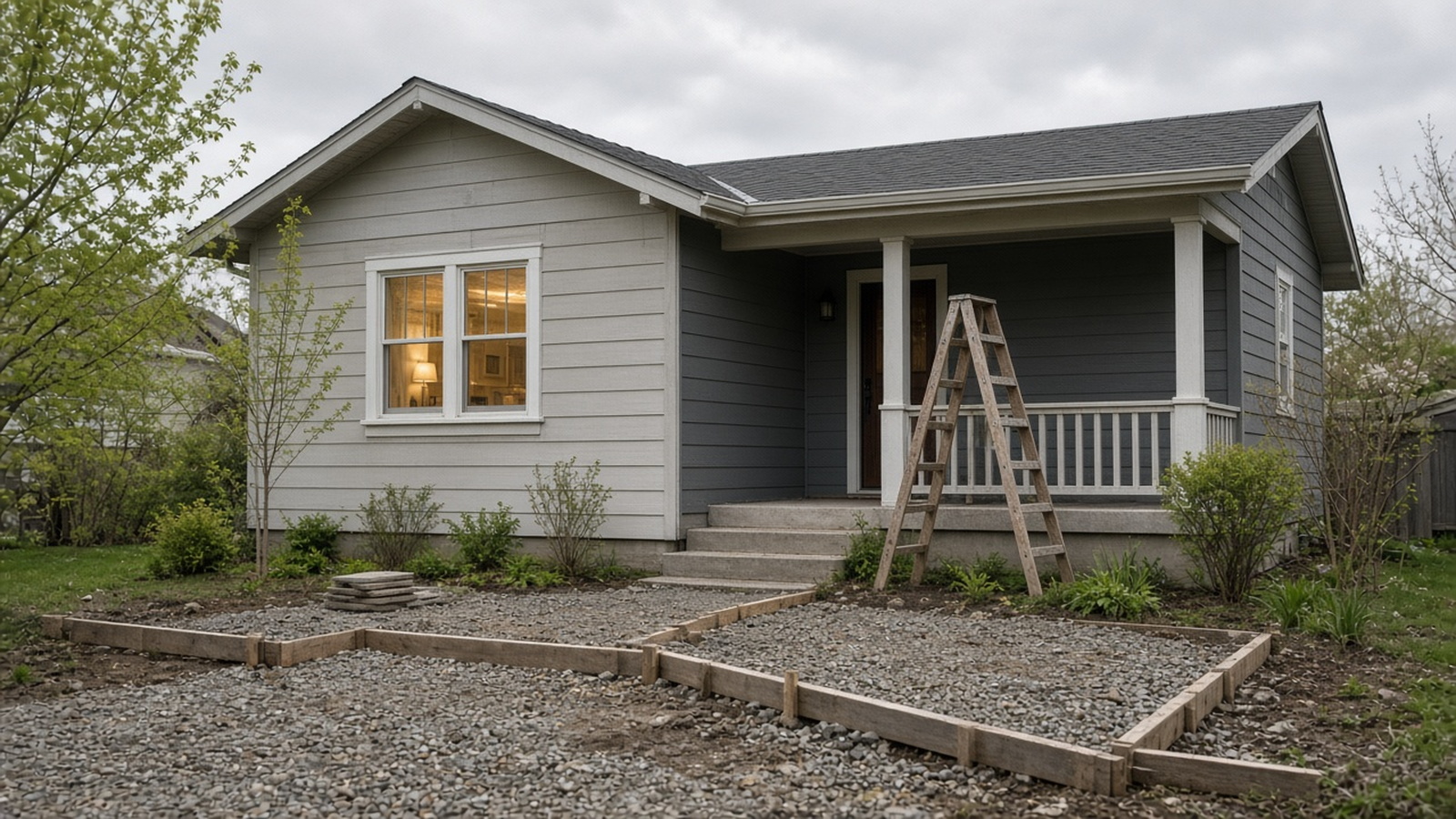
The common flip version shows up on the resale, not on the day you buy the wreck. You listed a house that looks done in the photos. The buyer's appraiser walks it and marks items "subject to" completion, or the underwriter reads the photos and will not clear the loan. The unfinished list is often outside, because that is what weather delays: exterior paint, landscaping, a driveway, a walk, or a roof that could not be finished in the rain. The buyer still wants to close. The lender will allow the close if the unfinished cost is held back from you.
Fannie Mae's Selling Guide draws a line you should be able to say out loud. Minor conditions or deferred maintenance that do not affect safety, soundness, or structural integrity are reflected in an "as-is" value. The guide's examples include worn floor finishes, minor plumbing leaks, holes in window screens, missing handrails, and cracked window glass. If those items will be fixed after closing, the lender may escrow for them at its own discretion, and it may still sell the loan to Fannie Mae before the escrow is released, as long as the items do not affect safety, soundness, or structural integrity.
Items that do affect safety, soundness, or structural integrity are a different box. The guide says the appraisal must be "subject to" completion of the specific repairs. Its examples include foundation settlement, water seepage, active roof leaks, worn roof shingles, and inadequate electrical service or plumbing fixtures. For those items, the lender must verify completion before the loan is sold to Fannie Mae. A holdback might still exist between your closing and that sale, but you should not treat a safety item like a shrub. Ask which box your item is in before you agree to close around it.
FHA's version, in Handbook 4000.1, says the lender may establish a repair escrow for incomplete construction, or for alterations and repairs that cannot be completed prior to loan closing, provided the housing is habitable and safe for occupancy at the time of loan closing. If the house is not habitable, this section is not your permission slip to close. The same handbook says that if repairs for existing construction cannot be completed prior to closing, the lender may establish an escrow in accordance with those repair completion escrow requirements. Habitable and safe is the gate.
A VA buyer brings a form made for this weather problem. VA Form 26-1849 is the Escrow Agreement for Postponed Exterior Onsite Improvements. The form's own recitals say the seller, because of conditions beyond the seller's control, cannot complete certain improvements now, and that the hold lets the veteran move in while those items are finished. VA's construction and permanent home loan circular, Circular 26-18-7, tells lenders that formal escrows are required, points them to this form for seasonal items, and says that if escrowed items are not completed, VA may adjust or cancel the guaranty. Read the circular as construction-loan guidance that sends you to Chapter 9 of the VA Lender's Handbook. Do not treat one sentence in a construction circular as the rule for every resale.
The other time a hold appears is the title file. A mortgage payoff quote expires, the per diem is still running, or a release of lien has not been recorded. The title company holds a stated amount until the payoff is confirmed or the exception is cleared. That hold can sit on the same settlement statement as a repair escrow. They are not the same condition, and you should not let one unlabeled "escrow" line cover both. The title commitment guide shows how a requirement becomes an exception if it is not cleared. A holdback is one way closers keep an exception from landing on the policy. It is not a substitute for reading the commitment.
Cash buyers and hard-money buyers can demand a holdback too. No agency handbook has to be involved. If the purchase contract says $8,000 stays with the closing attorney until the buyer signs a walkthrough, that sentence is the rule for that file. Agency guides tell you what a lender is allowed to do. Your contract tells you what you agreed to do.
4. Size the holdback from the rule in the file
People ask for "the" holdback percentage. The published rules do not share one. Write down which rule the lender or the title company is actually using, then do the arithmetic from the estimate they accepted. A round number with no bid under it is a negotiation, not a calculation.

| Path in the file | What the published page says about the amount | What that page does not say |
|---|---|---|
| FHA repair completion escrow, Handbook 4000.1 section II.A.6.a.viii(B) | Funds must be sufficient to cover the cost of the repairs or improvements. The cost of the borrower's own labor may not be included. | A national multiplier such as 110 percent or 150 percent for this section. |
| Fannie Mae postponed improvements on new or proposed construction, Selling Guide B4-1.2-05 | Withhold 120 percent of the estimated cost from the purchase proceeds. If the builder offers a guaranteed fixed-price contract, the escrow only needs to equal that contract price. The cost may not be more than 10 percent of the as-completed appraised value. Finish within 180 days of the note date. | That the same 120 percent is required for every minor item on an existing house. |
| Fannie Mae existing house, minor items that do not affect safety, soundness, or structural integrity | The lender may escrow at its own discretion. | A required percentage. The lender's agreement fills that blank. |
| VA Form 26-1849, postponed exterior onsite improvements | The schedule adds at least one-half of the postponed-item cost to that cost. The total escrowed is 1.5 times the estimate. A commercial letter of credit, if used instead of cash, follows the same form. | A dollar amount you may invent because a friend's VA sale used one. |
Read those rows as different doors, not as a menu you get to pick from. An FHA lender following the repair completion escrow section has to hold enough to cover the work. The handbook sentence is "sufficient to cover the cost." It does not say 1.5 times. If that lender still asks for 1.5 times, the extra is that lender's overlay or a different program. Ask which section they are citing.
The 120 percent figure is real, and it is easy to paste onto the wrong house. In B4-1.2-05, Fannie Mae allows a loan on new or proposed construction to be sold before postponed items are complete. Acceptable items are part of the sales contract, third-party contracts are not permissible, the delay needs a valid reason such as weather or a shortage of building materials, and the items may not block an occupancy permit. The completion cost must not represent more than 10 percent of the as-completed appraised value. The escrow is 120 percent of the estimate, unless a guaranteed fixed-price contract lets the escrow equal the contract price. The work must be completed within 180 days of the note date. That is a new-construction rule. On an existing flip, minor items are the discretion row above. Safety items have to be verified before the loan is sold to Fannie Mae. Do not tell a buyer's lender that 120 percent is "what Fannie always requires" on a resale.
VA Form 26-1849 makes the multiple visible on the form itself. Line 11 is the total cost of the postponed improvements. Line 12 is one-half of line 11, and the form marks that half as a minimum. Line 13 is the total amount escrowed, the sum of line 11 and line 12. A column note says the escrow is at least 1.5 times the amount in the cost column. If the accepted estimate is $8,000, the half is $4,000 and the escrow is $12,000. The form also says the deposit is paid to the seller without interest. The cushion is not a fee you planned to forfeit. It is still cash you do not have until release.
Handbook 4000.1 adds one limit that beginners miss. The cost for borrower labor may not be included in the repair escrow account. If you plan to paint the last elevation yourself, the FHA escrow is not a paycheck for your Saturday. Price materials and a contractor, or finish the work before closing. Sweat equity does not fill this account.
Every one of these figures can be tightened or enlarged by the lender in front of you. Guidelines change. A lender may refuse holdbacks that the guide would allow, or it may ask for more evidence than the guide's minimum. The number you underwrite is the number on the escrow agreement, after you have checked it against the bid and against the guide the lender claims to be using.
5. Name who controls the release
The holder and the releaser are often different people. The title company or closing attorney may hold the cash in a trust account. The buyer's lender, the appraiser, VA, or the buyer may be the one whose signature lets it out. If the agreement says the buyer must be "satisfied," you have given the release to a person who no longer needs the sale to happen. Prefer a condition you can meet with evidence: a named form, a named inspector, a photo set, and a title update.
On VA Form 26-1849, the escrow agent pays the seller the sum deposited, or a lesser sum the Loan Guaranty Officer approved, without interest, when the agent has advice from that officer that the improvements have been satisfactorily completed. If the seller does not finish, the lender, with the Loan Guaranty Officer's approval, may hire someone else and direct the escrow agent to pay that person from the deposit. The seller also agrees to put in more money if the deposit is not enough. Control sits with the lender and VA, not with a handshake.
On a Fannie Mae new or proposed construction postponed-improvements file, the lender must release the final draw after a satisfactory Form 1004D or an allowed completion alternative. The release should include any funds in excess of the amount needed to pay for the postponed items. The lender and the borrower sign an escrow agreement that states how the account is managed and how funds are disbursed. The account has to be a custodial account that meets Fannie Mae's custodial rules. The final title report must not show outstanding mechanic's liens, exceptions for the postponed improvements, or exceptions for the escrow agreement. If title was issued before the work was done, the lender needs an endorsement that keeps the lien in first position.
FHA's repair completion path names two forms. The lender executes form HUD-92300, Mortgagee's Assurance of Completion, to show the escrow exists. The lender certifies on form HUD-92051, Compliance Inspection Report, that the incomplete construction, alterations, and repairs have been satisfactorily completed. For case numbers assigned on or after October 31, 2016, the lender then completes the Escrow Closeout Certification screen in FHA Connection within 30 days after the escrow account is closed. You will not click that screen. You will be waiting on the person who does.
Ask one blunt question before you sign: if the work is done and the report is clean, can anyone other than you refuse the release? If the answer is yes, the agreement needs a deadline, a standard, and a path that does not depend on the buyer's mood. Write the answer into the agreement. A closer's "we always release these" is not a party to the contract.
6. Collect the paperwork and the reinspection
The release packet is short, and files stall because one page is missing. Build it while the crew is still on site, not after the inspector has already left.
- The escrow agreement. Amount, the list of items, the deadline, the holder, the release signer, what happens to extra money, and what happens if the work is late. If a fact is only in an email, it is not in the agreement yet.
- The estimate the amount was built on. A contractor bid or a third-party estimate, with the same items the appraiser or lender named. A round holdback with no bid is how cushions get large.
- The completion report the loan actually uses. HUD-92051 on the FHA repair path. Form 1004D, or a borrower attestation letter with photos and a paid invoice or a professional report, when Fannie Mae's existing-construction alternatives allow it. VA advice of satisfactory completion on Form 26-1849. Do not send a punch list photo set to a lender that asked for a form.
- Photos that match the list. Same elevations the appraisal complained about, after the work, with enough of the house in the frame that a reviewer can tell it is this property.
- Paid invoices and lien waivers. A mechanic's lien from the painter you hired to clear the holdback can become the next title exception. The lien waiver guide is the home for matching waivers to payments. Fannie Mae's postponed-improvements section wants a final title report with no outstanding mechanic's liens.
- The return wire instructions. The release is a second wire, often weeks after closing, and it is a common moment for a changed account number. Use the same callback habit the seller closing checklist uses for the first proceeds wire. Call a number you already had, not the number in the new email.
Reinspection is the visit, or the virtual review, that produces that completion evidence. It is not your city final inspection, and it is not the draw inspection from the rehab loan you already paid off. Book it as soon as the work is truly done. VA Form 26-1849's instructions say that if a partial disbursement is wanted, VA or FHA, whichever agency made the earlier inspections, is notified when each scheduled item is ready. The same instructions say funds may be disbursed at 90 percent of the amount set forth for a scheduled item when VA says that item is acceptably complete. The withheld 10 percent of that item may be disbursed after all of the work is acceptably complete and the other conditions of the agreement are met. VA reserves the right to refuse or delay acceptance of work that could be damaged by other unfinished work.
Fannie Mae's completion section allows Form 1004D from a site visit or, in the cases the guide lists, from a virtual inspection with unaltered photos that can be tied to the property. It also allows, for certain existing-construction repairs, a borrower attestation letter with photos and either a qualified professional's signature, a professional report, or paid invoices. The guide says those attestation alternatives are not permitted for HomeStyle Renovation completion. If your buyer's loan is a renovation product, do not assume a letter and a photo will release the hold. Ask for the form name in writing.
Put the reinspection date on the same calendar as the agreement deadline. A report that arrives after the lender has already treated the escrow as expired does not help you, even if the paint looks perfect. The punch list guide is where you track the work itself. This packet is the evidence that the holdback's list, which may be shorter than your full punch list, is the list that got finished.
7. Work three named holdback files
The three files below are original composites created for teaching. The people, the addresses, the bids, and the outcomes are illustrative. They are not case studies, testimonials, or quotes from customers. The agency percentages are the published ones named in the sizing section. Where a file uses a lender's own multiple, the story says so. Your agreement will not match these dollars.
Maya Chen, 418 Cedar Lane, Dayton, Ohio
Maya is selling a finished bungalow to a buyer with a conventional loan. The inside is complete. Two elevations are still in primer, and the front beds are mud. The appraiser treats the items as minor and not a safety defect. The buyer's lender will close if Maya signs a completion escrow. The lender writes 120 percent of the estimate into that agreement.
That 120 percent is familiar because it is the percentage Fannie Mae publishes for postponed improvements on new or proposed construction. Maya's house is existing construction. On that path, the selling guide lets the lender escrow minor items at its own discretion. The 120 percent is this lender's number, written into this agreement. It is not a sentence that says every existing-house resale must use 120 percent. Maya still underwrites the agreement she is signing.
Her painter bids $4,200. The landscaper bids $1,800. The estimate is $6,000. The holdback is 1.20 times $6,000, which is $7,200. Her sale math before that hold:
| Maya's illustrative sale | Amount |
|---|---|
| Sale price | $385,000 |
| Loan payoff | $312,400 |
| Commission at 5 percent | $19,250 |
| Other seller charges | $3,850 |
| Proceeds before the holdback | $49,500 |
| Holdback at 120 percent of $6,000 | $7,200 |
| Wire on closing day | $42,300 |
Check the subtraction. $312,400 plus $19,250 plus $3,850 is $335,500. $385,000 minus $335,500 is $49,500. $49,500 minus $7,200 is $42,300. The agreement in this story pays Maya back after the completion report. It does not pay the painter directly. She pays the $6,000 crew from the sale proceeds. Her cash is then $42,300 minus $6,000, which is $36,300, until the $7,200 comes back. After the release she has $43,500. That is the same end number as $49,500 minus the $6,000 the work actually cost. The extra $1,200 was a timing cushion, not income, and not a fee, in this agreement. A different agreement could let the lender keep a leftover or spend it. She reads that sentence before she signs.
She also prices the other choice, which is delaying the closing 21 days to finish the paint and the beds before a new appraisal photo. Her carry while she still owns the house is $95 a day: $62 interest, $9 insurance, $15 utilities, and $9 for the yard and trash. Twenty-one times $95 is $1,995. If she delays, she spends the $6,000 and the $1,995 before a full $49,500 wire, and she ends at $41,505. Closing now ends at $43,500 after the release, which is $1,995 more, because she skipped that extra carry. The cost of closing now is the gap: $7,200 sits with the holder, and she still needs $6,000 cash to pay the crew before the release. If she cannot float both, the "cheaper" choice does not work. The holding cost guide is where a daily rate like $95 should be built from the real bills, not copied from Maya.
Andre Walsh, 27 Birch Street, Richmond, Virginia
Andre is selling to a buyer using a VA loan. The house can be occupied. A late cold snap stopped the driveway and the last coat of exterior paint. A third party estimates the driveway at $5,600 and the paint at $2,400. The item cost is $8,000. The parties use VA Form 26-1849. Line 11 is $8,000. Line 12, one-half of line 11, is $4,000. Line 13, the total escrowed, is $12,000. That is the form's 1.5 times minimum, not a number Andre picked because it felt safe.
His sale price is $410,000. The payoff is $286,000. Commission at 5 percent is $20,500. Other seller charges are $4,200. Those deductions add to $310,700. Proceeds before the holdback are $410,000 minus $310,700, which is $99,300. The wire on closing day is $99,300 minus $12,000, which is $87,300.
The form says the seller pays for the labor and material, and the escrow agent pays the deposit back to the seller after VA says the work is satisfactorily complete. Andre pays the contractor $8,000 himself. His cash is then $87,300 minus $8,000, which is $79,300. If he waits for one full release, the $12,000 returns and he ends at $91,300. That matches $99,300 minus the $8,000 the work cost.
The form also allows a partial. Its instructions say escrowed funds may be disbursed at 90 percent of the amount set forth for a scheduled item when VA accepts that item. Ninety percent of the $8,000 item cost is $7,200. The withheld 10 percent of the item cost is $800, and it waits until all of the work is accepted. The $4,000 half-cost cushion is still in the deposit. After the $7,200 partial, $4,800 remains held ($800 plus $4,000). The later release of $4,800 brings the returned total to $12,000. Andre does not spend the cushion. The form says an unexpended balance comes back without interest after completion and VA approval, and it also says he must add money if the deposit is short. He keeps $8,000 of working cash on top of the $12,000 he cannot touch.
Priya Shah, 905 Walnut Avenue, Tucson, Arizona
Priya's file shows the holdback that is not a repair. She finished a weather-delayed roof before the buyer's appraisal. The roof invoice was $9,400. The appraisal came back as-is. There is no repair escrow. What she does have is a payoff quote from the private lender she used for the flip.
The quote is $248,600 if the wire arrives by the 15th. Per diem is $68. Closing is the 18th, so three extra days add $204. The payoff she expects on the statement is $248,804. The quote in this illustrative file also says the title company will hold $1,500 until the lender confirms the loan is paid in full, because a late wire can add another per diem day. That $1,500 is a payoff holdback. Nobody is painting anything with it.
The sale price is $329,000. Commission at 5 percent is $16,450. Other seller charges are $2,900. Add the payoff of $248,804 and the charges are $268,154. Proceeds before the payoff hold are $329,000 minus $268,154, which is $60,846. The wire on closing day is $60,846 minus $1,500, which is $59,346.
If the wire posts on time, the $1,500 returns and her sale cash is $60,846. If it posts one day late, another $68 is owed. The holder keeps that $68 and returns $1,432. Her sale cash is then $59,346 plus $1,432, which is $60,778. That is $60,846 minus $68. The hold did not change the price. It changed when she could use $1,500, and it gave the payoff a place to land if the per diem moved. She still asks the closer to show the $1,500 as its own line, with a release condition, so it cannot be confused with a repair escrow that does not exist on this file.
The roof choice is the lesson next to the payoff. A $9,400 roof left until after a VA buyer's appraisal could have become a Form 26-1849 item at 1.5 times $9,400, which is $14,100 held from proceeds, on top of the cash to pay the roofer. Priya spent the $9,400 before the appraisal instead. She gave up the chance to close a week earlier. She avoided a five-figure hold and a reinspection on a safety item Fannie Mae's existing-construction section would have wanted verified before the loan was sold. The pre-listing checklist is the place to make that finish-or-hold decision before the photographer arrives, not on the morning of the buyer's appraisal.
8. See what the holdback does to cash and time
Keep two proceeds numbers, not one. Cash at closing is the wire after the holdback is subtracted. Cash after release is that wire, minus what you still pay the contractor, plus whatever the agreement returns. If you book only the closing wire as profit, you will understate the deal when the hold comes back, or overstate it when you forget you still owe the painter. If you book the full contract price and ignore the hold, you will wonder why the wire is short.
The holdback is not automatically an extra project cost. In Maya's file and in Andre's file, the end cash matched the sale proceeds minus the real cost of the work, because the agreements returned the unused cushion. The damage was timing. Maya had to float $6,000 of crew cost while $7,200 sat in escrow. Andre had to float $8,000 while $12,000 sat in escrow. A flipper who spends the closing wire on the next earnest money deposit, and then cannot pay the crew, does not have a release problem yet. That flipper has a cash problem the holdback made worse.
Time shows up in three places. The first is extra carry if you delay closing to avoid the hold, which is Maya's $1,995. The second is the weeks between closing and the reinspection, when the cash is stuck even though you no longer own the house and the old loan is paid off. The third is a deadline inside the agreement. Fannie Mae's new-construction postponed-improvements clock is 180 days from the note date. VA Form 26-1849 uses a completion date the parties write down, and VA can approve a later date in writing. An FHA file still has to get from completion to the lender's HUD-92051 certification and the closeout screen. Miss the date your agreement actually uses, and the holder may be allowed to hire someone else and spend the deposit.
Selling costs do not get recomputed just because cash is held, unless the hold is really a price cut. Maya's commission stayed 5 percent of $385,000. A seller credit or a price reduction, by contrast, can change the commission base and the buyer's loan. That is a different negotiation, and the AS-IS offer and credits guide is the home for choosing a credit or a price cut when you are the buyer. When you are the seller, a credit reduces what you net. A holdback delays what you net. Do not let a buyer rename one as the other.
Put both cash numbers on the deal before you accept the offer, not after the settlement statement surprises you. The deal analysis page is where a proceeds change belongs next to the rest of the flip. The fix-and-flip workflow is the path from that number back to the work. The software can store the two figures. It cannot sign the escrow agreement or make the holder release the wire.
9. Avoid a holdback or negotiate a smaller one
The cleanest avoidance is to finish the item before the buyer's appraiser walks the house. Priya's roof is that choice. It costs the bid, and it costs the days of carry, and it removes a reinspection from the sale. Weather will not always allow it. A driveway poured in a freeze is not a favor to the buyer. In that case, negotiate the hold instead of pretending the weather will change by Friday.
- Shrink the list before you shrink the percentage. Finish anything the appraiser is likely to call a safety, soundness, or structural item. Leave the weather work. Fannie Mae's existing-house section does not require the lender to escrow minor as-is items. A shorter list is a smaller bid, and every published multiple is a multiple of that bid.
- Bring a fixed-price bid with the same line items. On Fannie Mae new or proposed construction, a guaranteed fixed-price contract can bring the escrow from 120 percent down to the contract price. On an existing flip, ask this lender whether a fixed bid changes their multiple. Do not assume the new-construction sentence applies. Do not sign a bid that leaves out the item the appraiser named.
- Cap the hold in the contract, with a release standard. Name the holder, the maximum dollars, the deadline, the form or photo evidence, and who gets unused funds. A cap you cannot float is not a win. Maya needed $6,000 free while $7,200 was held. If her reserve had been $2,000, she should have delayed the closing or rejected the offer.
- Refuse a personal-satisfaction release. Trade it for the form the loan already uses. The buyer already has a walkthrough for possession. The holdback should not become a second, unlimited walkthrough.
- Separate title holds from repair holds. Priya's $1,500 had a payoff condition and a per diem. If a closer asks for a flat "title hold" with no exception named, go back to the commitment and make them name the requirement. Pay a known lien at closing when you can. A hold is for the item that cannot be cleared on the day, not for a fuzzy file.
- Compare a delay, a credit, and a hold with the same end cash. Maya's delay cost $1,995 of carry and avoided the gap. A price cut would have reduced her proceeds permanently. Run all three on paper. The offer comparison guide is the home for net proceeds across buyer offers. Use it when one offer needs a holdback and another does not.
You can also meet the buyer before the appraisal and ask which loan program they are using. A VA buyer can put you on Form 26-1849 and a 1.5 times schedule. An FHA buyer can put you on a "sufficient to cover the cost" escrow that the lender may still pad. A conventional buyer can put you on lender discretion. None of those facts is a reason to refuse a buyer by itself. Each one changes the cash you must be able to float. Ask while you still have other offers.
10. Keep rehab draw inspections on their own page
A draw inspection feels similar because somebody walks the house and then money moves. It is the other direction. During the rehab, your construction lender or hard-money lender holds the rehab budget and releases a draw after an inspector agrees the work in that request is done. You are waiting on money to pay crews. The draw inspection guide is the home for the request package, the schedule of values, and what a failed draw looks like. This page does not re-teach that inspection.
A resale escrow holdback happens after that loan is usually being paid off. The buyer's lender, or the title company, holds your sale proceeds until a leftover item or a payoff is cleared. Passing every draw does not prevent a holdback. The draw inspector was checking progress against your rehab budget. The buyer's appraiser is checking whether the house, as it sits on sale day, meets that loan's condition rules. Primer on the back wall can be an honest leftover from a weather week and still be a holdback, even if your draw file is clean.
Use both names in the project record so a later reader does not release the wrong pile. "Draw 4 released" is not "sale holdback released." They have different holders, different forms, and different deadlines.
11. Use a holdback checklist without an account

You can run this list on paper. None of the lines requires software.
- Write the condition in one sentence: unfinished work, payoff, or a named title exception. If you cannot, you are not ready to sign.
- List each item the appraiser, lender, or title company named. Match each item to a bid.
- Name the rule the other side claims: Handbook 4000.1 repair completion escrow, Fannie Mae B4-1.2-05, VA Form 26-1849, or a contract sentence. Read that page. Note that it can change, and that the lender can add a rule.
- Compute the hold from that rule. Write the estimate, the multiple, and the total. Maya's pattern is estimate times the agreement's multiple. Andre's pattern is item cost plus at least half of that cost.
- Subtract the hold from proceeds before you subtract the crew you still have to pay. Write cash at closing and cash after release as two numbers.
- Name the holder, the releaser, the deadline, the form, and who receives unused funds.
- Confirm the house is habitable if an FHA repair escrow is the path. Do not use that section to close a house that is not safe to occupy.
- Book the reinspection. Collect photos, invoices, and lien waivers. Order the title update the agreement requires.
- Verify the return wire by calling a known number.
- If you cannot float the hold and the crew cost together, delay, reject, or renegotiate before you sign.
The list is the whole decision. A lender's "this is standard" is not a line on it.
12. Keep the agreement on the property record
Store the agreement, the bid, the settlement statement page that shows the hold, the completion report, and the release wire receipt on the property. A task called "holdback pending" is not the file. The next person who asks, including you in three weeks, needs the amount and the condition without rereading the email thread.
Rehabfolio is where those facts can sit on the deal you are already underwriting. The deal analysis page is where cash at closing and cash after release stay next to profit. The project management page is where the reinspection date stays visible after you leave the closing table. The buyer closing checklist matters when you are on the other side and the seller's holdback is what lets you take the keys. You still sign the agreement, and you still chase the release, yourself.
If an AI assistant summarizes the appraisal or the escrow agreement, keep the PDF next to the summary. The AI underwriting guide and the AI disclosure state the same limit for value and repairs. An assistant can list unfinished items and add a column of bids. It cannot tell you that this lender's multiple is discretionary, and it cannot certify form HUD-92051. You compare the summary with the signed agreement before the closing.
Frequently asked questions
What is an escrow holdback on a house flip?
An escrow holdback is money kept out of the seller's closing wire and held by a named party until a written condition is met. On a resale flip, the usual condition is that unfinished work, such as exterior paint, landscaping, a driveway, or a weather-delayed roof, is finished and accepted. A payoff holdback or a title holdback is the same idea with a different condition: the lender confirms the loan is paid, or a lien release is recorded. It is not the monthly tax and insurance escrow on the buyer's mortgage.
Is a repair holdback the same as the escrow on the Closing Disclosure?
No. The Consumer Financial Protection Bureau describes an escrow or impound account as money from the monthly mortgage payment that the servicer uses for property taxes, insurance, and similar bills. That account is disclosed on the Closing Disclosure. A repair holdback, completion escrow, or payoff holdback is a separate pile of money created by the purchase contract, the lender's guideline, or the title company's requirement. Read both. Do not assume a line labeled escrow is the holdback, or that the holdback is hiding inside the tax escrow.
Who holds the money, and who can release it?
The escrow agreement names the holder, often the title or escrow company, a closing attorney, or the buyer's lender. It also names who must approve the release. On VA Form 26-1849, the escrow agent pays the seller the deposit, without interest, after the Department of Veterans Affairs advises that the work is satisfactorily completed. On a Fannie Mae new-construction postponed-improvements file, the lender releases the final draw after a satisfactory completion report. On any other file, only the signed agreement answers the question. A text message from the buyer does not.
How large is a holdback usually?
There is no single national percentage. HUD Handbook 4000.1 says a repair completion escrow must be sufficient to cover the cost of the repairs or improvements, and it may not include the cost of the borrower's own labor. Fannie Mae's postponed-improvements rule for new or proposed construction calls for 120 percent of the estimated cost, or the full price of a guaranteed fixed-price contract, and the incomplete work may not be more than 10 percent of the as-completed appraised value. VA Form 26-1849 adds at least one-half of the item cost on top of that cost, which is 1.5 times the estimate. Existing-house resales often follow the lender's own written multiple. Read the agreement in the file. Guidelines change, and lenders add their own rules.
What has to happen before the money comes back?
The work listed in the agreement has to be finished, and the release evidence named in that agreement has to be in the file. Depending on the loan, that evidence can be form HUD-92051, Fannie Mae Form 1004D or an allowed completion letter with photos, or written advice from VA that the postponed items are complete. Many files also need paid invoices, lien waivers, and a title update that shows no new mechanic's lien. Partial releases, when the agreement allows them, follow the percentages in the agreement. VA Form 26-1849 says a scheduled item may be paid at 90 percent when VA accepts that item, with the other 10 percent after all of the work is accepted.
Can I refuse a holdback or negotiate it down?
You can ask. The other side can also refuse to close without one. Useful trades are a fixed-price bid, a shorter punch list, a deadline, a named holder, a release that does not depend on the buyer's personal satisfaction, and a cap you can float while you still pay the contractor. Finishing safety items before the appraisal, and leaving only weather items for later, is often cleaner than arguing the percentage. A price cut or a seller credit is a different tool. It reduces the price. It does not hold your cash until a reinspection.
Editorial methodology, limitations, and sources
The Rehabfolio editorial team wrote this as the resale holdback page for a house flip. It does not replace the seller closing checklist, the title commitment guide, the punch list guide, the holding cost guide, the lien waiver guide, the earnest money guide, or the draw inspection guide. Those pages remain the homes for closing day, title, the work list, daily carry, releases of lien, the buyer's deposit, and rehab draws. This article answers a different question: what a flipper should be able to prove about an escrow holdback before signing the settlement statement.
Repair completion escrow language is taken from HUD Handbook 4000.1, section II.A.6.a.viii(B), as published in the August 13, 2025 handbook PDF on the HUD archives. That section says the lender may establish a repair escrow for incomplete construction, or for alterations and repairs that cannot be completed prior to loan closing, provided the housing is habitable and safe for occupancy at closing. It says repair escrow funds must be sufficient to cover the cost, and that borrower labor may not be included. It names form HUD-92300 and form HUD-92051, and it requires the Escrow Closeout Certification screen in FHA Connection within 30 days after the account is closed, for case numbers assigned on or after October 31, 2016. The monthly tax and insurance escrow is subsection (A) of the same projected-escrow heading. The PDF is the August 13, 2025 Handbook 4000.1. HUD's Handbook 4000.1 information page lists a later update dated August 12, 2026. The FHA INFO announcement for that update does not list section II.A.6.a.viii(B) among the changes. Open the current handbook before you rely on a sentence. Lender overlays differ from the handbook.
Conventional completion and postponed-improvement rules are taken from Fannie Mae Selling Guide B4-1.2-05, Requirements for Verifying Completion and Postponed Improvements, as published on Fannie Mae's site when this page was reviewed. The 120 percent escrow, the fixed-price contract alternative, the 10 percent of as-completed value cap, the 180-day note-date deadline, Form 1004D, the minor-item discretion sentence, and the safety-item completion sentence are from that page. The 120 percent row applies to new or proposed construction postponed improvements. It is not restated here as a universal resale rule.
VA figures are taken from VA Form 26-1849, Escrow Agreement for Postponed Exterior Onsite Improvements, the May 2005 form still linked from VA.gov. The form's schedule shows line 12 as one-half of the postponed cost at a minimum, and line 13 as the sum, which is 1.5 times. The instructions say a scheduled item may be disbursed at 90 percent when VA accepts it, with the remaining 10 percent after all work is accepted. The cash-escrow paragraph pays the seller without interest after the Loan Guaranty Officer advises that the work is satisfactorily completed. VA Circular 26-18-7 tells construction and permanent lenders to use formal escrows, points to Form 26-1849 for seasonal items, warns that VA may adjust or cancel the guaranty if items are not completed, and sends the reader to Chapter 9 of the VA Lender's Handbook. This article does not quote Chapter 9 beyond what that circular and the form themselves say.
The monthly escrow description, and the three-business-day Closing Disclosure timing, are taken from the Consumer Financial Protection Bureau's escrow or impound account answer and its Closing Disclosure explainer. Those pages describe taxes, insurance, and the disclosure the borrower receives. They are cited here so a repair holdback is not confused with that account.
Public guidance cannot tell you whether to sign a particular holdback, whether a lender will accept a letter instead of a form, or whether a title company will insure over an exception. Examples are original composites created for teaching. Names, addresses, prices, bids, and outcomes are illustrative. They are not case studies of real customers. Dollar figures in the stories are educational, not quotes and not a survey of lender overlays.
Editorial standard. We identify the audience, the author, the review date, the topic boundary, the assumptions, and the product limit. We do not invent credentials, licenses, testimonials, market statistics, or guaranteed results. AI may help organize research and draft, and a person reviews the claims, the links, the examples, and the limitations before publication. We revise the guide when a cited public page or a material product workflow changes. See the editorial methodology on the company page.
Keep the holdback, the release date, and both cash numbers together.
Use a workspace for the agreement, the reinspection, and the proceeds after the release. You still sign the holdback, and you still finish the work, yourself.
Create free account