How to read a house flip home inspection report before you waive
A short summary can say the house is tired and still leave the roof, the crawlspace, or a shut-down furnace unpriced. This guide shows how to name the standard the inspector used, separate observed defects from rooms nobody entered, and turn the lines that matter into a repair number before the inspection deadline.
Written and reviewed by the Rehabfolio editorial team. Published and last reviewed October 19, 2026.
Who this guide is for. This guide is for United States residential investors buying a one-to-four-unit property they intend to renovate, then sell or hold. You might close in your own name or in an LLC, with cash or with a loan. The guide starts when a written home inspection report arrives. It ends when you have a written choice: proceed on the current repair budget, change the price or the scope, order a named specialist, or walk. The full inspection window, including title, flood, and occupancy, is the due diligence checklist. The measured drawing of the land is the property survey guide. The offer math that uses the new repair number is the maximum offer guide. Those pages name the inspection. This page is how you read the report those checklists point at.
The Rehabfolio editorial team builds and reviews product workflows that connect a property record to documents, dates, photos, and the offer math. That is first-hand product experience with how a deal file is organized. It does not make the team a home inspector, a contractor, an engineer, an appraiser, or an attorney. We do not invent licenses, credentials, or customer results.
Inspection standards, state licensing, and the number of days in your contract differ. ASHI says its standard does not limit an inspector from meeting a state statute that licenses home inspectors. This page is educational. It is not a home inspection, a code opinion, or legal advice. Use the report in your hand, the agreement you signed, and qualified trades for the house you are buying.
Tip: Read this beside the repair budget guide, the photo estimate guide, the contingency guide, the AS-IS credit guide, and the free ARV calculator. A listing-photo draft is a screen. The inspection report is later evidence. Do not paste one into the other and call them the same scope.
1. Decide what the report has to prove
Beginners treat the report as a grade. A quiet summary feels like a pass, and a long list feels like a failed house. The standards describe a narrower job. The current ASHI Standard of Practice, which ASHI says remains in effect until a later implementation date, says a home inspection is intended to provide information about the condition of inspected systems and components at the time of the inspection. The inspector inspects readily accessible, visually observable, installed systems listed in the standard, and provides a written report. InterNACHI's Standards of Practice, last revised October 2022, say a home inspection is a non-invasive visual examination of the accessible areas, performed for a fee, designed to identify defects within the systems that standard defines, observed and deemed material by the inspector.
On a flip, that writing still has to prove a short list before you give up a contractual right to object. You can name the property, the date, and the client. You can name the standard the agreement says was used. You can point to what was inspected. You can point to what was present and not inspected, and the reason. You can point to the comments that change the repair budget, the ones already inside that budget, and the ones that are still unknown. If any of those are missing, you are not ready to waive.
The due diligence checklist already separates three visits that people mix together. The inspector reports observed condition. The contractor prices means and methods. The appraiser, when a lender orders one, estimates value. The Consumer Financial Protection Bureau says you generally need both an inspection and an appraisal when you borrow, and that they are different jobs. This page stays on the inspection report. It does not restate the whole contingency calendar, and it does not price the assignment, the tax bill, or the title commitment.
2. Name the standard on the agreement
Two reports can both be called a home inspection and follow different rules. Write the standard name at the top of your notes before you argue with a heading the standard does not use. Then read the pre-inspection agreement. ASHI has written that the standard exists so the client and the inspector share a scope, and that identifying the standard in the agreement is how that scope is named. If the agreement is silent, ask which standard applied before you treat a missing chimney interior as an oversight.
| What the report claims | What you can rely on today | What you do not assume |
|---|---|---|
| Current ASHI Standard of Practice, posted by ASHI as the version still in effect | Visual inspection of the listed systems, a written report, and a duty to say what was present but not inspected and why | A cost, a code pass, a remaining-life count, or a recommendation to buy |
| ASHI changes approved by membership on January 8, 2026 | ASHI says the implementation date is still to come, and the posted standard remains current until then | That the 2026 PDF already governs the report in your hand |
| InterNACHI Standards of Practice, last revised October 2022 | A non-invasive visual exam for material defects observed that day, with stated limitations and exclusions | That every InterNACHI exclusion is copied into a state-licensed inspection |
| A state licensing standard named in the agreement | That standard controls for a licensed inspector in that state. ASHI says its own standard does not block those statutes | A national deadline, a national license, or a national fee |
ASHI's glossary defines readily accessible as available for visual inspection without moving personal property, dismantling, destructive measures, or actions that will likely risk people or property. It defines technically exhaustive as an investigation that involves dismantling, or the extensive use of advanced techniques, measurements, instruments, testing, calculations, or other means. InterNACHI uses the same idea: an inspection is not technically exhaustive, and the inspector is not required to dismantle systems or to move furniture, stored items, snow, or debris. When a report says "limited by storage," that phrase is doing work. It is not filler under the summary.
3. Read the cover before the summary
Start on the first pages, before the colored summary. Confirm the street address, the client name, the date, the time, and who was present. A report for a different file, or a prior visit to the same house, will not support a waiver on this contract. Note the weather if the inspector recorded it. A roof read during rain is different evidence from a roof read on a dry afternoon, and neither one predicts next winter.
Find the list of systems that were inspected and the list that were not. The current ASHI standard says the written report states which designated systems were present but not inspected, and the reasons. If the PDF jumps from a one-page summary to photographs, ask for the page that carries those reasons. Do not reconstruct it from the inspector's voicemail.
Read who paid, and when. The Consumer Financial Protection Bureau says you want an independent inspector who is accountable to you and who gives a complete, honest assessment. It warns that an inspector paid by someone else, or not paid until closing, might underemphasize problems. On a flip, the seller's inspector, the wholesaler's PDF, and the agent's "guy" can still be useful reading. They are not a substitute for an inspector whose agreement names you as the client, unless you have decided, in writing, to rely on someone else's scope.
The bureau also says to attend if you can, because being present makes the report easier to interpret. If you were there, match the report to the photos you took of the panel, the attic hatch, the mechanical labels, and the rooms the inspector could not enter. If you were not there, the unread limitation pages are the first place a missed system hides.
4. Sort every comment into three stacks
A 40-page report is usable once each comment has a job. Use three stacks. Keep the PDF page number on every card so you can get back to the sentence that created it.

Seen, and outside the scope you already priced
This stack changes the budget. The inspector observed a condition, named a location, and the work was not already in your repair lines. ASHI says the report should state systems that, in the inspector's professional judgment, are not functioning properly, are significantly deficient, are unsafe, or are near the end of their service lives, plus the reasoning when it is not self-evident. InterNACHI says the report identifies defects the inspector observed and deemed material. InterNACHI also says that a component near the end of its normal useful life is not, by itself, a material defect. A phrase such as "older roof" is a flag. It is not yet a tear-off price.
Present, but not entered, shut down, or blocked
This stack is not a pass and not a bid. The current ASHI standard says the inspector is not required to operate systems that are shut down or that do not respond to normal operating controls, and is not required to determine the condition of systems that are not readily accessible. InterNACHI says the inspector is not required to operate a system that is shut down or that does not turn on with normal controls, and is not required to report on what could not be seen. Write the next visit, or write that you are accepting the unknown. Do not leave the line blank and call the summary clean.
Already in the scope, or cosmetic
This stack protects you from counting the same work twice. A worn bathroom that you already priced as a full remodel does not need a second allowance because the report mentioned loose tile. ASHI says the inspection is not required to identify cosmetic imperfections that do not significantly affect performance. InterNACHI says the inspection will not deal with aesthetic concerns or cosmetic defects. Keep those notes if they affect your finish level. Keep them out of the structural budget.
5. Walk the systems, then stop where the standard stops
Use the report's own order, or use the order below. For each system, write one sentence: inspected, limited, or not present. Then stop at the exclusion. The point of the standard is the stop, as much as the list.
Structure, crawlspace, and attic
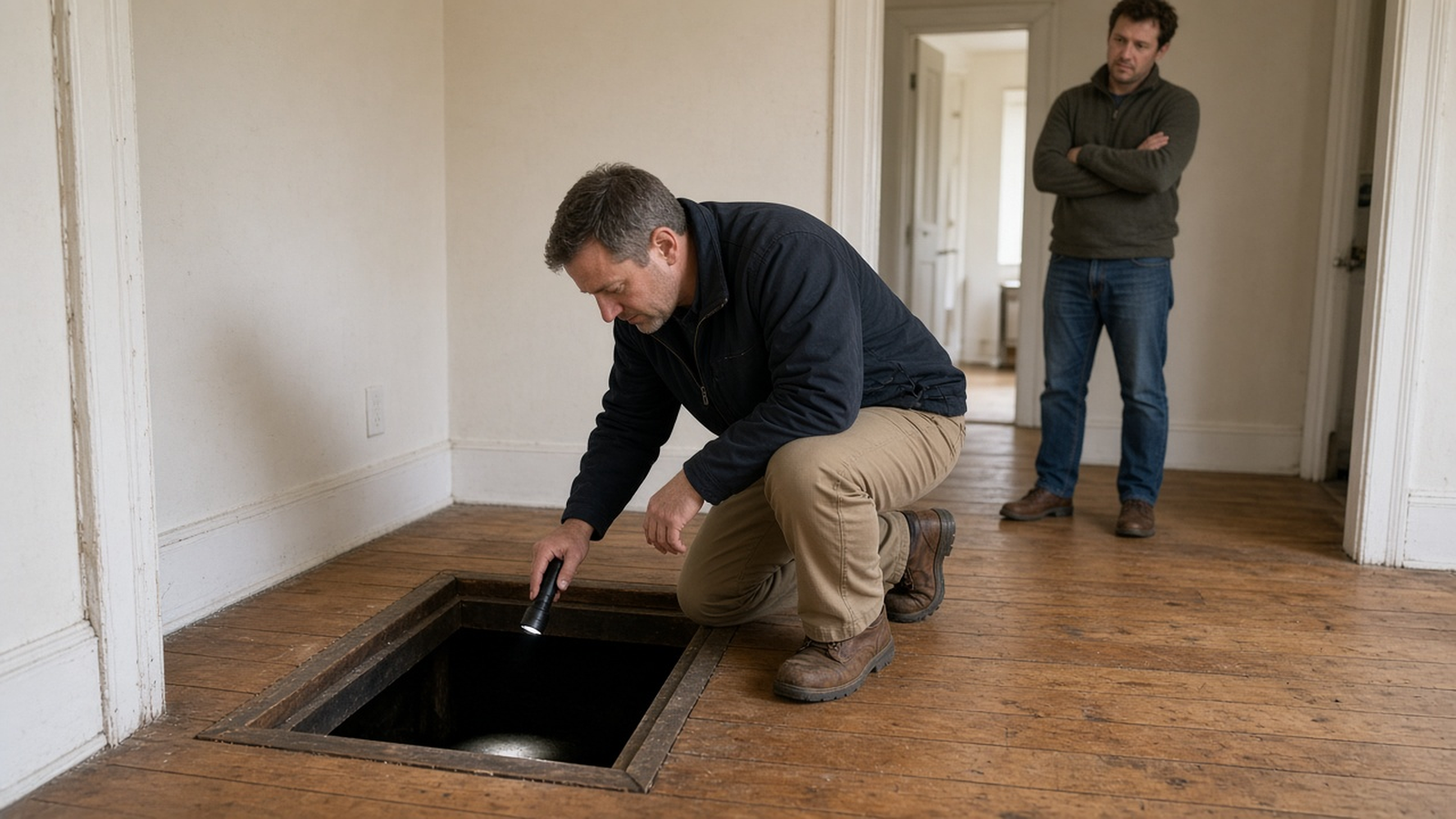
ASHI says the inspector inspects structural components, including the foundation and framing, and describes the foundation, the floor, wall, ceiling, and roof structure, and the methods used to inspect the crawlspace and the attic. The inspector is not required to provide engineering, to offer an opinion on the adequacy of the structure, to enter a crawlspace with less than 24 inches of clearance or an opening smaller than 16 by 24 inches, or to traverse attic framing concealed by insulation. A sentence that says the exterior foundation looked even, next to a sentence that says the crawl was not entered, is not a structural sign-off. It is a description of what was visible from the outside.
Roof and exterior water
ASHI says the inspector inspects roofing materials, drainage, flashing, skylights, chimneys, and roof penetrations, and describes the roofing materials and the method used to inspect the roof. InterNACHI says the inspector inspects the roof covering from ground level or the eaves, reports observed indications of active leaks, and is not required to walk the roof, predict service life, or certify the roof. A dry attic and a roof described as aged can both be true. The bid, if you need one, comes from a roofer who will name the material, the layers, and the price. The inspection report does not owe you that price. ASHI excludes methods, materials, and costs of corrections.
Plumbing, including what a sewer scope is
ASHI says the inspector inspects interior supply and drain piping, fixtures, water heating equipment, and visible fuel piping, and describes the piping materials and the shut-off locations. The inspector is not required to inspect underground items, including storage tanks. A general inspection is not a camera run of the building sewer. If the house is old, the drains are slow, or the scope of work will add bathrooms, order that camera as its own visit while the deadline still exists. Put the result on its own line. Do not hide it inside "plumbing looks tired."
Electrical
Read the service size, the wiring method the inspector could see, and any unsafe conditions the report names, such as a double-tapped breaker or missing shock protection where the inspector calls it out. ASHI's glossary defines a representative number of similar components, for interior outlets, as one component per room. The report can be silent about an outlet the inspector did not sample. That silence is not a promise that every outlet in the room is sound. If your scope already includes a new service and new circuits, mark the comment as already priced, then confirm the bid names the same panel.
Heating and cooling that would not turn on
ASHI says the inspector is not required to operate a system that is shut down. InterNACHI says the same. A furnace with the switch off, an empty oil tank, or a condenser the inspector would not start outside the maker's temperature range is an open item. "Not operated" is not "operates." Ask the seller to make the system operable for a return visit, or hire the trade, before you waive. If the contract clock will run out first, the choice is a price change that assumes replacement, or a walk. Guessing a remaining life from the data plate is the determination the standard says the inspector is not required to make.
What the general report leaves out on purpose
ASHI's general exclusions say the inspector is not required to determine wood-destroying organisms, mold, environmental hazards, or the presence of hazardous plants and animals. InterNACHI's exclusions say the inspector is not required to determine mold, radon, lead paint, asbestos, rodents, or insects. A general report that never mentions lead is not a lead clearance. Most housing built before 1978 is still in the federal lead disclosure world. The EPA explains that rule separately from a home inspection. Use the due diligence checklist for the pamphlet, the disclosure, and the 10-day opportunity. Use this page only to keep that lead inspection from being confused with the general report.
The same boundary applies to value, insurance, and whether you should buy. ASHI says the inspector is not required to determine market value, marketability, insurability, or the advisability of the purchase. InterNACHI says the inspection does not determine market value, insurability, or the advisability of the purchase. Your after-repair value still comes from closed sales, as the ARV guide describes. Your vacant-renovation policy still comes from the insurer, as the insurance guide describes.
6. Turn one finding into one budget line
A comment becomes a budget line only after you translate it. Copy this row for each item in the first stack, and for each open item in the second stack. Leave the price blank until a bid or a written allowance exists. An empty price is more honest than a round number you cannot explain.
| Field | What to write | Example, Amina's roof |
|---|---|---|
| Report page | The page that states the observation and any limit | Roof section, plus the attic limit on the following page |
| What was observed | The condition, in the inspector's words | Aged roof covering. No active leak observed from the method used that day |
| What was not done | The limitation, in the inspector's words | Attic deck partly blocked by stored items. Life expectancy not stated |
| Already in the scope? | Yes, no, or only in contingency | No. The first budget assumed a five-year coating, not a tear-off |
| Next visit | Trade, date, and what you asked them to answer | Roofer, before the objection deadline, to price a tear-off of the existing layers |
| Number you will use | A written bid, or a named allowance you can point to | $11,400 tear-off bid. Not an inspector estimate. The standard does not require one |
| Permit and days | Whether the city is involved, and the extra hold | Permit required in that city. Add the days to holding cost. Do not bury them in the bid |
The repair budget guide is the home for quantities, labor, and allowances. The scope of work guide is the home for the line a contractor can bid. This page only gets the inspection sentence onto that line without inventing a cost the inspector was not required to give. If the number is still unknown when you must decide, the contingency guide is where a named unknown belongs. A blanket percent is not a description of a roof nobody walked.
Then rerun the offer. Rehabfolio's maximum offer calculator uses this detailed ceiling:
Detailed maximum offer = (after-repair value - repairs - financing - holding - selling costs - target profit) / (1 + buying-cost rate).
Selling costs in that calculator are a percent of after-repair value. Buying costs are a percent of the price you solve for, which is why the formula divides instead of subtracting a guessed closing figure at the end. The 70 percent screen is a different number: after-repair value times 0.70, minus repairs. The 70 percent guide treats that screen as a quick filter. When the inspection changes repairs, change both numbers, and write down which one is your walk-away.
7. Work three named inspection files
These three buyers are original composites for teaching. The names, cities, bids, and outcomes are illustrative. They are not customer stories, not local price surveys, and not bids you should reuse. Each buyer uses the same detailed-offer formula as the calculator linked above. Round the ceiling to the nearest dollar after you divide.
Amina Brooks, a 1964 ranch in Columbus, Ohio
Amina is under contract at $185,000. Her after-repair value is $310,000. The first repair budget is $42,000 and does not include a tear-off. Financing is $9,000. Holding is $1,800 a month for five months, or $9,000. Selling costs are 8 percent of $310,000, or $24,800. Her target profit is $35,000. Buying costs are 2 percent of the price.
Before the report, the detailed ceiling is ($310,000 - $42,000 - $9,000 - $9,000 - $24,800 - $35,000) / 1.02. The parentheses equal $190,200. Divided by 1.02, the ceiling is $186,471. The contract is $1,471 under that ceiling. The deal is thin, and it still fits the written target.
The report says the roof covering is aged, that no active leak was observed by the method used that day, and that stored items blocked part of the attic. It does not state a remaining life, and the standard did not require one. Amina does not convert "no active leak" into a five-year roof. She hires a roofer. The written bid is $11,400 to tear off and replace. Repairs become $53,400.
The new ceiling is ($310,000 - $53,400 - $9,000 - $9,000 - $24,800 - $35,000) / 1.02. The parentheses equal $178,800. Divided by 1.02, the ceiling is $175,294. The $185,000 contract is $9,706 over it. She also runs the 70 percent screen on the new repair number: $310,000 times 0.70 is $217,000, minus $53,400 is $163,600. Both ceilings are below the contract. She asks, in writing, for a price of $175,000, which is just under the detailed ceiling, or she walks. She records that the 70 percent screen is tighter, and that she is using the detailed ceiling because her financing and hold are written down. She does not ask the inspector to split the difference.
A one-week permit delay on a $1,800 monthly hold is about $420 if you use a 30-day month ($1,800 divided by 30, times 7). She adds those days in the holding-cost guide if the city requires them. The roof bid is still the number that moved the ceiling. She uses the AS-IS credit guide only to decide whether a price cut is cleaner than a seller credit. The inspection page does not redo that closing math.
Luis Ortega, a 1971 bungalow in San Antonio
Luis is under contract at $171,000. After-repair value is $300,000. Planned repairs are $30,000. Financing is $12,000. Holding is $8,000. Selling costs are 8 percent of $300,000, or $24,000. Target profit is $50,000. Buying costs are 2 percent.
The detailed ceiling is ($300,000 - $30,000 - $12,000 - $8,000 - $24,000 - $50,000) / 1.02. The parentheses equal $176,000. Divided by 1.02, the ceiling is $172,549. The contract is $1,549 under it.
The report says no defects were observed at the visible exterior foundation. The next sentence says the crawlspace was not entered because clearance was under 24 inches. That limit matches a stop in the current ASHI standard. Luis does not highlight the first sentence and skip the second. Exterior observations are not a crawlspace inspection. He orders a structural engineer while the objection period is still open. The engineer's invoice in this example is $650. The pier bid that follows is $8,500. Those are the numbers in his file. They are not a national foundation price.
Repairs become $39,150. The new ceiling is ($300,000 - $39,150 - $12,000 - $8,000 - $24,000 - $50,000) / 1.02. The parentheses equal $166,850. Divided by 1.02, the ceiling is $163,578. The $171,000 contract is $7,422 over it. Profit at the contract price, after a 2 percent buying cost of $3,420, would be $42,430, which is $7,570 under his $50,000 target. He asks for a price of $163,500 or he walks. He does not invent a pier count from a crawl nobody entered, and he does not call the exterior sentence a clean foundation.
Nora Pell, a 1998 two-story in Raleigh
Nora is under contract at $195,000. After-repair value is $360,000. Her repair budget is already $55,000, and that figure includes $14,000 to replace the electrical service and $1,800 for a water heater. Financing is $12,000. Holding is $2,200 a month for five months, or $11,000. Selling costs are 8 percent of $360,000, or $28,800. Target profit is $40,000. Buying costs are 2 percent.
The detailed ceiling is ($360,000 - $55,000 - $12,000 - $11,000 - $28,800 - $40,000) / 1.02. The parentheses equal $213,200. Divided by 1.02, the ceiling is $209,020. The contract is $14,020 under it.
The report comments on missing shock protection in the kitchen and baths, a double-tapped breaker, and a water heater near the end of its service life. Nora opens her scope. Those items are already inside the $55,000. She photographs the panel label, confirms the electrician's bid names the double tap and the kitchen and bath locations, and does not add the comments again. ASHI allows a report to flag components near the end of their service lives. The same standard says the inspector is not required to determine remaining life. She treats "near the end" as a reason to keep the water heater that is already in the scope, not as a second heater.
A different sentence is still open. The cooling system was shut down, and the inspector did not operate it. Nora does not read that as a working condenser. She asks for a return visit with the system on, or for an HVAC technician, before she waives. In this example the technician's replacement quote, if the system will not run, is $6,200. Repairs would become $61,200. The ceiling would become ($360,000 - $61,200 - $12,000 - $11,000 - $28,800 - $40,000) / 1.02, or $202,941. Her $195,000 contract would still clear that profit target. She may proceed only after the system has been operated and the $6,200 is either in the file or crossed off. If the deadline arrives first, she does not waive a system nobody started.
8. Use an inspection checklist without an account
Copy this list into the notes you already keep. You can finish it before you create a workspace. Check a line only when you can point to the page.

- The report names this address, this client, and this date.
- The agreement names the standard, and any state license the inspector claims.
- You know who paid the inspector, and whether payment depended on closing.
- Every designated system is marked inspected, not present, or not inspected with a reason.
- Crawlspace, attic, and roof each have a method, not only a grade.
- Shut-down heating and cooling are still open items.
- Each material comment is in one stack: new scope, already priced, or unknown.
- No repair price was copied from the report unless a trade actually bid it. The standards do not require the inspector to price the work.
- Lead, sewer camera, wood-destroying insects, and mold are either ordered on their own or written as accepted unknowns. They are not assumed from a general report that excludes them.
- The detailed offer ceiling and the 70 percent screen are both rerun with the new repair total.
- The written choice is proceed, renegotiate, specialist, or walk, and it names the page it relies on.
If you want the ceiling without an account, use the maximum offer calculator and the rehab calculator. Replace any square-foot allowance with the bid you actually received before you treat the result as a walk-away price.
9. Keep the report on the property record
The checklist is enough for one decision. The next week is where the PDF, the roofer's bid, and the waiver date drift into different inboxes. Rehabfolio is where those facts can sit on the deal you are already underwriting. The property research page is the place for the address file. The rehab estimating page is where a report comment becomes a line with a quantity. The deal analysis page is where the new repair total moves the ceiling. The fix-and-flip workflow is the path from that number to the project. You still hire the inspector, and you still send the objection, yourself.
If a tool summarizes the PDF, keep the PDF next to the summary. The AI underwriting guide and the AI disclosure state the same limit for value and repairs. A model can group comments into the three stacks. It cannot enter a crawlspace, and it cannot tell you that your state's inspector used a different standard than the sample you saw online. You compare the summary with the signed report before the deadline.
When the same house is listed later, the buyer's inspector will write a new report. Work you opened up, and work you left behind, is what that file will be checked against. The pre-listing checklist is the home for what you disclose. The purchase report is not a substitute for that later disclosure.
10. Avoid the waivers that happen by summary
- Waiving from the first page. ASHI and InterNACHI both limit the inspection to what was accessible that day. A short summary can omit the sentence that says the crawl was not entered.
- Reading "not operated" as "works." A shut-down system is outside the operating step. It is still your open item until someone runs it or you price the replacement.
- Asking the report for a bid. Both standards say the inspector is not required to determine repair costs. A contractor's number belongs on the budget line. The comment belongs in the source note.
- Treating a general inspection as a code letter. ASHI does not require a code-compliance determination. The permit office is a different file. Use the permits guide once you know the work will be opened.
- Adding the same bathroom twice. A comment about worn finishes, on a room you already scoped as a full remodel, is a check against the bid. It is not a second project.
- Using the report as a mold, lead, or insect clearance. Those inspections are excluded from the general standards cited here unless the agreement adds them. Order the one you need, or write that you are accepting the unknown.
- Letting a photo estimate outrank the report. The photo guide is a screen you build before the walk. After the report, the observed page replaces the guess. Do not average them.
- Leaving the ceiling on the old repair number. Amina's roof moved the detailed ceiling by about $11,000. The bid is not in the deal until the offer math uses it.
None of these require a careless inspector. They require an ordinary week in which the fastest path is to say the inspection "came back fine." The three stacks are the slower path on purpose.
Frequently asked questions
What is a home inspection report on a house flip?
A home inspection report is the written record of a visual examination of the readily accessible, installed systems the adopted standard names, made on a stated date. The current ASHI Standard of Practice says the inspection gives the client information about the condition of those systems at the time of the inspection, and that the inspector provides a written report. InterNACHI's Standards of Practice, last revised October 2022, describe the same job as a non-invasive visual examination designed to identify material defects that were observed. On a flip, you use that writing to decide what was seen, what was not entered, and which lines in your repair budget have to change before you waive.
Is a home inspection the same as an appraisal?
No. The Consumer Financial Protection Bureau says a home inspection and an appraisal are different, and that a borrower generally needs both. The inspector's job is the physical condition of the house. The appraiser's job is an opinion of market value for the lender. ASHI's current standard says the inspector is not required to determine market value or the advisability of the purchase. A high appraisal does not fill in a crawlspace nobody entered.
Does a short summary mean the house has no hidden defects?
No. ASHI says inspections performed under its standard are not technically exhaustive and are not required to identify concealed conditions, latent defects, or consequential damages. InterNACHI says an inspection will not identify concealed or latent defects and will not reveal every issue that exists or ever could exist, only material defects observed on the date of the inspection. A summary that lists few defects can still sit next to a page that says the attic, the roof surface, or the crawlspace was not inspected. Read that page before you treat the summary as a pass.
Should every comment go into the repair budget?
No. Sort each comment first. A condition the inspector observed, that is outside the scope you already priced, needs a location, a limitation, a next step, and a number from a bid or a named allowance. A comment that repeats work already in the scope should be checked against that line, not added a second time. A cosmetic note the standard does not treat as a functional defect can stay off the budget. A system that was shut down or not entered is not a zero. It stays open until someone qualified sees it or you price the unknown on purpose.
Does the inspector have to price repairs or check the building code?
The current ASHI standard says the inspector is not required to determine methods, materials, or costs of corrections, and is not required to determine compliance with codes, regulations, or manufacturer instructions. InterNACHI's exclusions say the inspector is not required to determine code compliance or to provide correction or repair cost estimates. A sentence such as "further evaluation" is a handoff. The price comes from the trade or the engineer you hire next, and the permit question goes to the building department. The report is not a bid and it is not a code inspection.
What if the inspector could not enter the attic, the crawlspace, or the roof?
The current ASHI standard requires the written report to name systems that were present and designated for inspection but were not inspected, and the reason. It also says the inspector is not required to enter a crawlspace with less than 24 inches of vertical clearance or an access opening smaller than 16 inches by 24 inches, and is not required to traverse attic framing that is concealed by insulation. InterNACHI does not require the inspector to walk a roof, to enter a space the inspector judges unsafe, or to move stored items that block the view. The limitation is part of the report. Price the follow-up, or keep the right to object, until that limitation is closed or accepted in writing.
Can software decide whether to waive the inspection contingency?
Software can store the PDF, the deadline, and the revised repair number next to the offer. It cannot see the crawlspace, sign the report, or decide that a shut-down furnace is acceptable. The Consumer Financial Protection Bureau says you want an inspector who is accountable to you. You still compare the report with the contract deadline and with the repair budget. If a draft summary and the report disagree, the report wins.
Editorial methodology, limitations, and sources
The Rehabfolio editorial team wrote this as the report-reading page for a house flip. It does not replace the due diligence checklist, the repair budget, the scope of work, the contingency guide, the photo estimate, the survey, or the maximum-offer guide. Those pages remain the homes for the full window, the quantities, the bid-ready lines, the reserve, the listing-photo screen, the land drawing, and the offer formula. This article answers a different question: what a buyer should be able to prove from the home inspection report before waiving the right to object.
ASHI's current standard is the version posted on the American Society of Home Inspectors Standard of Practice page. ASHI states there that membership approved changes on January 8, 2026, and that until the implementation date the standard on that page is the current version. The sentences used here, including the purpose, the written-report contents, the 24-inch crawlspace limit, the attic limit, the definition of readily accessible, the definition of technically exhaustive, and the exclusions for cost, code, life expectancy, concealed conditions, value, and environmental hazards, are taken from that posted standard. The approved-changes PDF, which ASHI marks as not yet effective, is ASHI SOP changes approved January 8, 2026. Do not apply that PDF to a report until ASHI's implementation date, and do not ignore a state standard the agreement names.
InterNACHI's Home Inspection Standards of Practice, last revised October 2022, is the source for the non-invasive visual examination, the definition of a material defect, the statement that end of useful life is not by itself a material defect, the limitations on concealed defects and value, the exclusions for repair costs, code compliance, mold, lead paint, and insects, the shut-down rule, and the roof rules that inspect from the ground or the eaves and do not require the inspector to walk the roof or predict service life.
The difference between an inspection and an appraisal, the warning about an inspector who is paid by someone else or only at closing, the suggestion to attend, and the note that a contract contingent on a satisfactory inspection can allow a cancellation, are taken from the Consumer Financial Protection Bureau's schedule a home inspection page. Lead disclosure is a separate federal rule. The EPA's Lead-Based Paint Disclosure Rule page is the source for that boundary. This article does not restate the disclosure steps. The due diligence guide remains the home for them.
The offer arithmetic uses the detailed maximum-offer formula published on Rehabfolio's maximum offer calculator: (after-repair value - repairs - financing - holding - selling costs - target profit) / (1 + buying-cost rate). Selling costs in the examples are 8 percent of after-repair value. Buying costs are 2 percent. Those rates are the example's assumptions, not a survey of closing costs. The 70 percent screen is after-repair value times 0.70, minus repairs, as stated on the maximum offer guide.
Public standards cannot tell you whether to waive, whether a crack needs piers, or what a roofer in your city will charge. Examples are original composites created for teaching. Names, prices, bids, and outcomes are illustrative. They are not case studies of real customers. Dollar figures are educational, not quotes and not indexes of inspection fees or trade prices.
Editorial standard. We identify the audience, the author, the review date, the topic boundary, the assumptions, and the product limit. We do not invent credentials, licenses, testimonials, market statistics, or guaranteed results. AI may help organize research and draft, and a person reviews the claims, the links, the examples, and the limitations before publication. We revise the guide when a cited public page or a material product workflow changes. See the editorial methodology on the company page.
Keep the inspection, the deadline, and the revised repair number together.
Use a workspace for the PDF, the objection date, and the price or scope change. You still hire the inspector, and you still send the objection, yourself.
Create free account