How to read a house flip roof inspection before you waive
A home inspector can call a roof aged, or quiet, and still not have walked it, counted the layers, or priced a tear-off. This guide shows how to read that paragraph, what a roofer's visit has to add before you waive, and how two layers or a short remaining life change the offer.
Written by Red, founder of Rehabfolio, and reviewed by the Rehabfolio editorial team. Published and last reviewed November 2, 2026.
Who this guide is for. This guide is for United States residential investors buying a one-to-four-unit property they intend to renovate, then sell or hold. You might close in your own name or through a company, with cash or with a loan. The guide starts when the roof is still an open line in the inspection window: a listing that says "newer roof," a report that says the covering was viewed from the ground, or a bid that overlays shingles without saying how many layers are already there. It ends when you have a written choice: proceed on the current roof allowance, order a roofer before you waive, replace the allowance with a tear-off or a named repair, change the purchase price, or walk.
I have been buying and renovating houses for ten years, on more than 30 projects. The roof is one of the lines that has moved my own offers after the general inspection was already in the folder. I have stood at an eave while a report called the covering serviceable from the yard, then paid for a tear-off once a roofer lifted a course and found another layer and a soft spot in the deck. The town is not the lesson. The missing paper is. I still use the same screen I describe below, and I still do not treat a ground-level sentence as a price.
What this guide will not do. It will not certify a roof, predict a life in years for your house, or tell you that every city uses the same layer limit or the same permit rule. It is not a roofing license, an appraisal, an insurance binder, or legal advice. Inspection rules, code amendments, and what a carrier will bind differ by place and by the form you actually buy. The dollars in the three files below are illustrations I built so the arithmetic is visible. They are not quotes and they are not a national price list. Hire a qualified roofer, and read the contract deadline with a real-estate attorney if you are unsure what a waiver gives up.
Key terms in plain English
If this is your first roof file, read these definitions first. The rest of the guide uses them without stopping to explain.
- Roof covering: the outer layer you see, such as asphalt shingles, metal, tile, or a membrane. It is not the deck under it, and it is not the flashing at a chimney.
- Roof deck: the wood sheathing the covering sits on. A soft or water-stained deck is a different repair from a few loose shingles.
- Recover: a new covering installed over an old one, without tearing the old covering off. A recover is not the same bid as a replacement.
- Replacement or tear-off: the old covering comes off, down to the deck, and a new covering goes on. Disposal, deck repair, and extra days belong on this bid.
- Layer or application: one full covering. Two applications means someone already roofed over an older roof, or the roof was roofed twice. Your code may stop a third application.
- Remaining physical life: a judgment, in years, of how long the covering itself will keep working. It is not the economic life of the whole house, and a home inspector's standard may not require the inspector to state it.
- Active leak: water getting in now, as the inspector observed it. A stain with no current drip can be an old leak. The report should say which one was seen.
- After-repair value: the price you expect the finished house to sell for, based on comparable sales. It is not an appraisal.
- 70 percent screen: after-repair value times 0.70, minus repairs. It is a first filter. It is not the full cost of buying, holding, and selling.
- Inspection contingency and waiver: the contract right to inspect, object, or walk away by a written deadline. When you waive it, you give that right up.
1. Decide what the roof file has to prove
A roof file has one job before you waive. It has to show how this house sheds water, what was actually looked at, and what a repair would cost if the covering, the layers, or the deck will not carry the project. A shingle you can see from the street is a clue. It is not that file.
I split the question into four lines, and I leave a line blank when the paper does not answer it. What is the covering. How was it viewed. How many applications are on it, and is the deck sound where someone could see the deck. What is the bid for the work you will actually do, including days. A report can answer the first two and stay silent on the last two. Silence is a blank line. It is not a pass.
The full inspection window, including title, flood, insurance, and occupancy, is the due diligence checklist. That page names a roof visit as specialist follow-up after a general inspection. This page is that visit. The general report itself is the home inspection guide. Do not make one document do both jobs.
2. Keep a home inspection from standing in for the bid
InterNACHI's Standards of Practice, section 3.1, say the inspector shall inspect the roof-covering materials, gutters, downspouts, vents, flashing, skylights, chimney, and other roof penetrations from ground level or the eaves, and shall look at the general structure of the roof from readily accessible panels, doors, or stairs. The inspector shall describe the type of roof-covering materials and shall report observed indications of active roof leaks.
The same section says the inspector is not required to walk on any roof surface, predict the service life expectancy, remove snow, ice, or debris, move insulation, perform a water test, warrant or certify the roof, or confirm proper fastening. An older InterNACHI course page talks as if the standards require a layer count. The section I reviewed on November 2, 2026 does not. It requires the type of covering. It does not require a count of layers, a remaining-life number, or a price. If your inspector's agreement cites a different standard, read that agreement. InterNACHI does not bind an inspector who was hired under something else.
ASHI's standard approved January 8, 2026 is the other text I use as a boundary, not as your state's law. Section 6 says the inspector shall inspect visible and accessible roofing materials, drainage, flashing, skylights, chimneys, and other penetrations, describe the type and material, and state the method used. Section 6.3 says the inspector is not required to walk on roofs. Section 6.2 says the inspector is not required to inspect interiors of flues and chimneys that are not readily accessible. Section 15 says the inspector is not required to determine age, life expectancy, or remaining useful life, and is not required to determine methods, materials, and costs of corrections. The PDF cover still marked the effective date as "tbd" when I read it. A state board can adopt it later, or not. The point for a buyer is the stop: a general inspection can be complete under that text and still have no bid.
| Paper in the file | What it can prove | What it does not prove |
|---|---|---|
| A look from the street | You could see some of the covering from the ground that day. | The rear slope, the layers, the deck, the flashing you cannot see, or a price. |
| General home inspection | Covering type, and active leaks the inspector observed, if the inspector was working to the InterNACHI roof section above. ASHI also asks for the method in writing. | A walk, a life expectancy, a layer count, fastening, a water test, or a repair price. Both standards put those outside the required work. |
| Roofer's written visit | The slopes that person reached, the layer count they state, the deck they could see, and the bid for the scope they wrote. | A slope they did not reach, a warranty you did not buy, or a permit your city has not issued. |
| Seller's "roof replaced" note | A claim. Sometimes a year. Sometimes an invoice, if they attach one. | That the invoice matches this house, that the deck was replaced, or that a recover was allowed. Match the paper to the roof in front of you. |
| Dry attic on inspection day | No water was reported in the attic areas the inspector entered that day. | That the covering will last, or that insulation was moved. A dry day is not a remaining-life number. |
The due diligence checklist says a general inspection often creates specialist work, and it names the roof in that list, next to HVAC, electrical, structural, chimney, well, and septic. Well, septic, sewer, mold, and radon already have their own pages. The roof did not. That is why this one exists. I do not want a reader to waive because the home-inspection guide already mentioned shingles.
3. Read the method before you trust the sentence
The most useful line in a roof paragraph is often the method, not the adjective. "Viewed from the ground with binoculars" and "walked the south slope only" are different inspections. ASHI's 2026 text requires the method in writing. InterNACHI's roof section says the required view is from the ground or the eaves, and that a walk is not required. If the report never says how the roof was seen, I treat the condition sentence as incomplete and I ask.
An older ASHI interpretation, s010220, said walking the roof was strongly recommended, and required when the roof was readily accessible and a walk was the only way to see the exterior surfaces. It also said a walk was not required when those surfaces could be seen another way, or when the roof was too high, slippery, steep, or fragile. That interpretation is not the 2026 sentence that says a walk is not required. I keep both, because a report in your hand may have been written under the older habit, a state rule, or a contract that promised a walk. Read the method that was actually used. Do not argue with a sentence the inspector did not write.
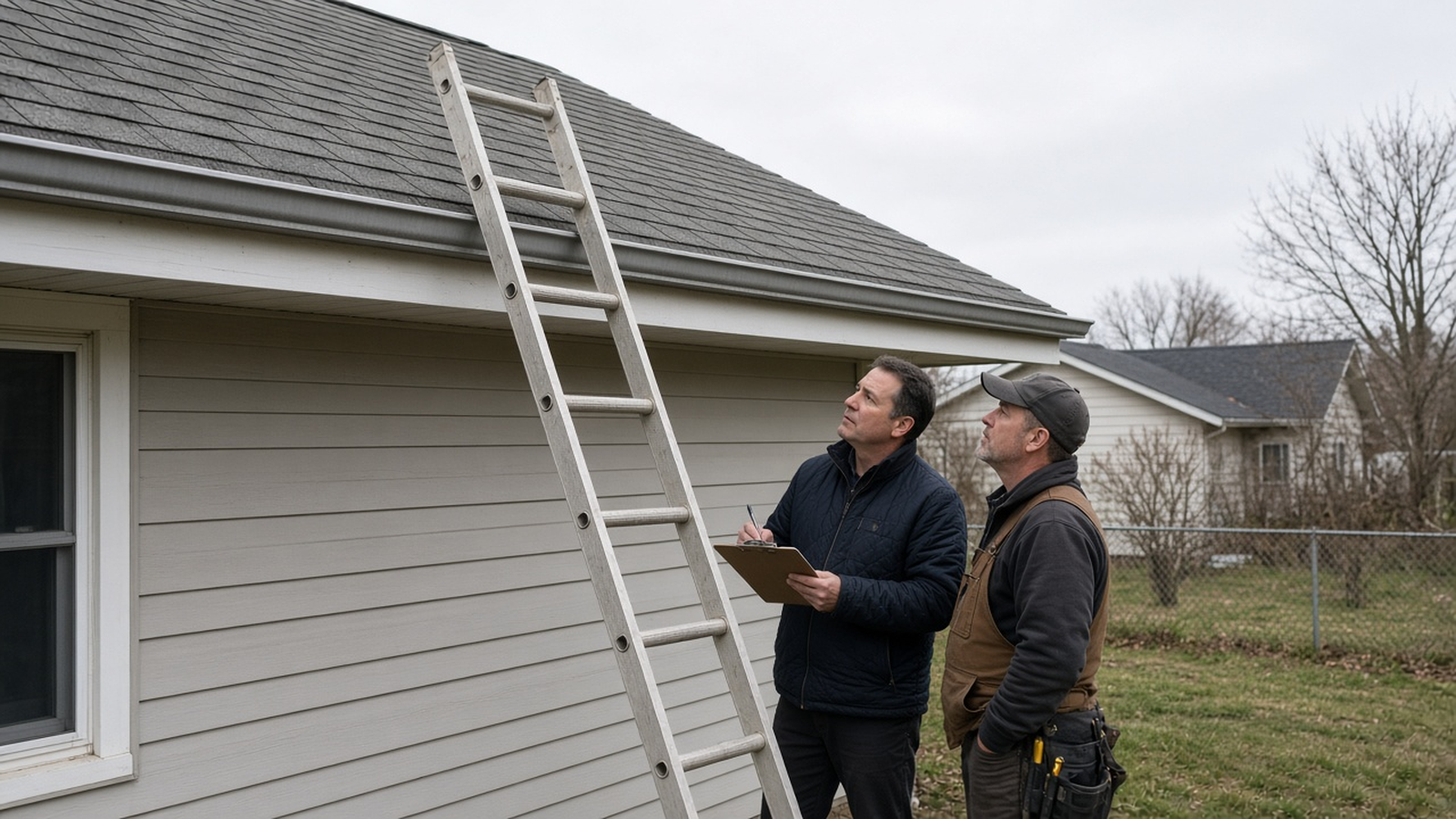
InterNACHI's note on accessing a roof draws the same line from the inspector's side. Binoculars, or a ladder that stops at the eave, can satisfy a general inspection. Tall ladders on a steep slope, or plywood laid over a fragile covering, are past that standard and into a specialist visit. Slate, the same note says, should not be walked if it can be avoided. I do not ask a general inspector to do a specialist's climb so I can save a day. I hire the roofer while the objection deadline still exists.
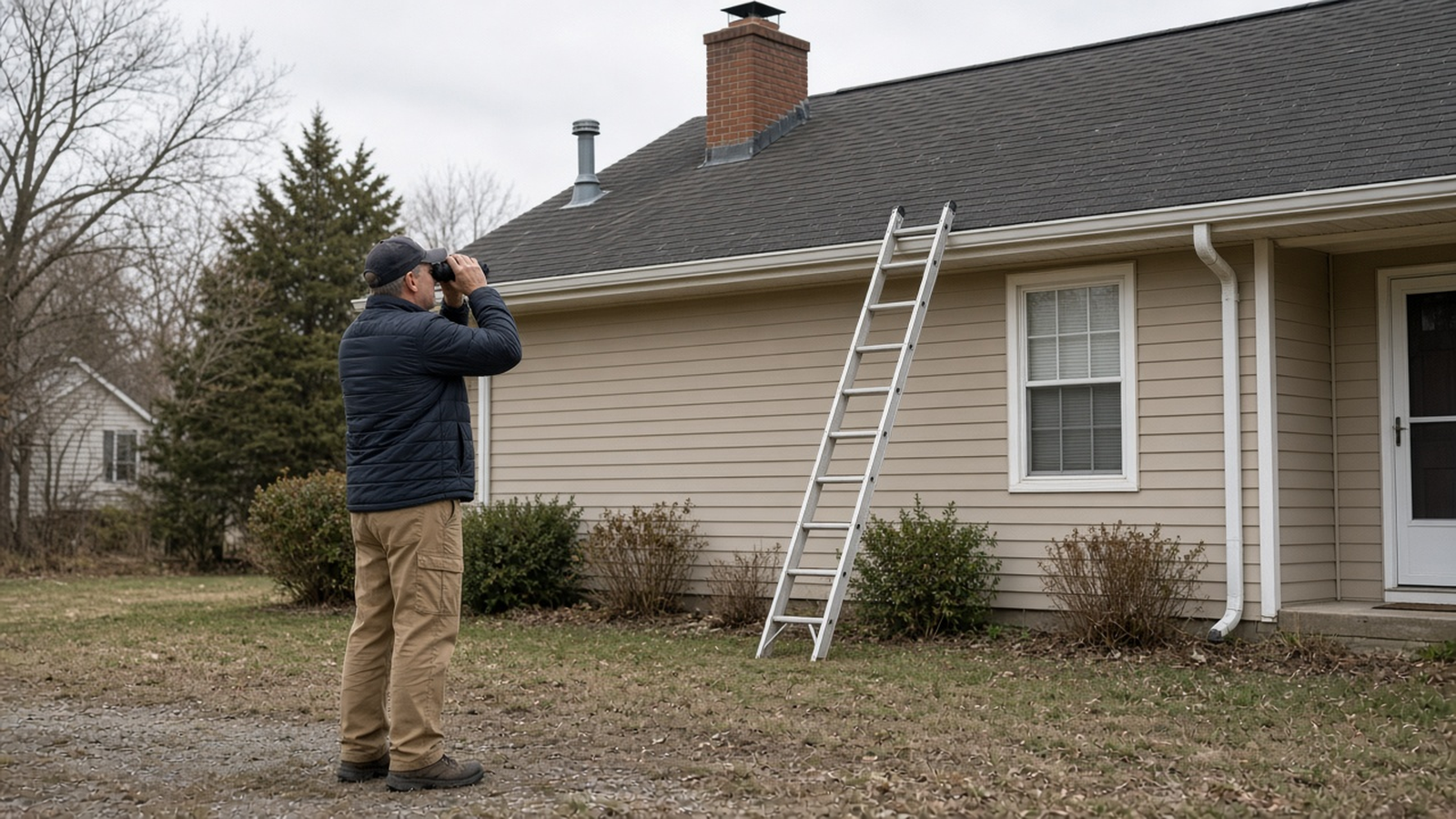
Write the unseen slopes in your own words. A front slope viewed from the street does not describe the rear. A chimney you saw from the yard does not describe the flue. ASHI does not require the inspector to inspect a flue interior that is not readily accessible. If your rehab opens that chimney, or the report already flags flashing at the brick, the chimney is its own line. This page does not replace a chimney specialist. It tells you not to hide that limit inside the word "roof."
4. Count layers, then read the deck
A recover looks cheaper on the first page of a bid because the tear-off and the dumpster are missing. The code question comes before the savings. Louisville Metro's reroofing sheet reprints 2015 International Residential Code section R908.3.1.1. A roof recover shall not be permitted where the existing roof or covering is water-soaked or has deteriorated to the point that it is not adequate as a base, where the existing covering is slate, clay, cement, or asbestos-cement tile, or where the existing roof has two or more applications of any type of roof covering.
That sheet is Louisville's reading of the code it adopted. It is not a national permit law. The same PDF says reroofing there does not require a building permit unless structural elements, such as the deck or rafters, are replaced. Pleasant Hill, Iowa's shingle sheet reprints a recover ban that also names wood shake and a manufacturer's instruction that prohibits a recover. Two cities, two sheets, the same idea: the third application is the problem the model code is aimed at, and the local page can add a row. Call the building department that has your house. The permits guide is where that call sits in the schedule. Do not import Louisville's "no permit" sentence into a city that requires one.
If the covering is cement tile, or the roofer says the old roof may contain asbestos, stop before anyone scrapes or tears it off. The model-code sentence above already refuses a recover over asbestos-cement tile. Disturbing that material is a different regulatory file. The page for the survey, the federal rule, and the budget change is the asbestos guide. This page will not tell you how to remove it.
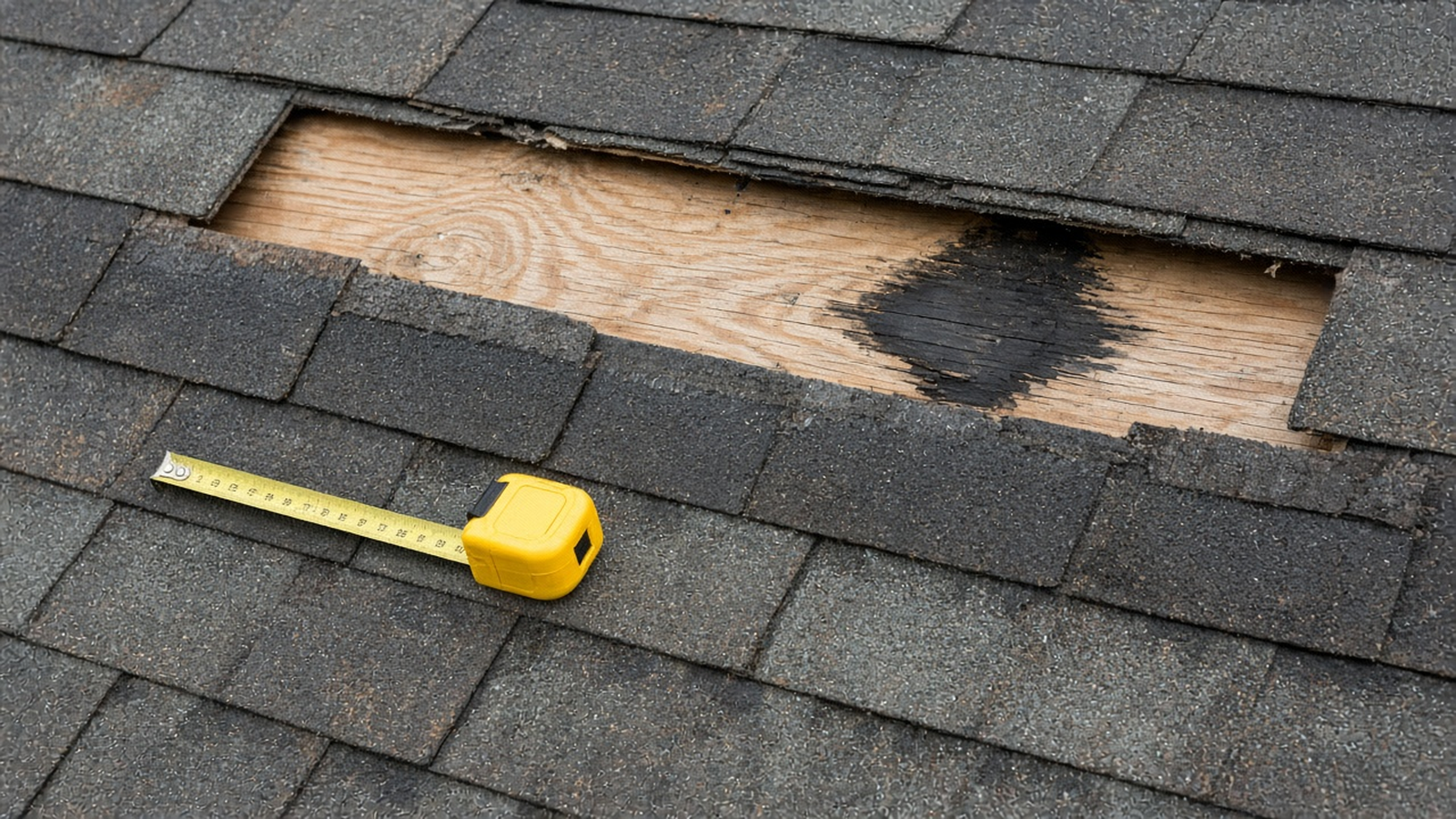
The deck is the second half of the same visit. A covering can look continuous from the yard and still sit on sheathing that has gone soft. I do not put a deck repair inside a shingle allowance. The roofer has to say whether they saw the deck, where, and what they excluded. A bid that says "new shingles" and excludes sheathing is an open number. Leave it open in the offer math until you have a price or you have decided the exclusion is a reason to walk. How to keep an allowance from pretending to be a finished scope is the repair budget guide.
When a tear-off, a deck repair, or a refused recover changes the repair total, rerun the offer before you waive. The public places to do that without an account are the rehab cost calculator, the flip profit calculator, and the holding cost calculator. Extra days on a tear-off are holding, not a line you bury in shingles. The holding cost guide is the page for that daily cost.
5. Separate flashing, penetrations, and attic stains
Most of the leaks I have actually paid for started at an edge, not in the middle of a field of shingles. Chimney flashing, a skylight, a vent boot, a valley, and a gutter that dumps against the fascia are separate lines. InterNACHI requires the inspector to look at those penetrations from the ground or the eaves and to report active leaks that were observed. It does not require a water test. I do not invent one with a hose. Water forced under shingles can create the leak you were trying to find. If you want a water test, that is a written scope for someone who will own the result.
An attic stain needs a date in your notes. "Stained sheathing" can be a leak that is over, a leak that is active, or a stain from before the last covering. The report should say whether the inspector saw daylight, wet wood, or only a mark. If the attic was not entered, write that too. A limitation is a remaining risk. The home inspection guide already treats "not entered" as a fact, not as a clearance. Use the same habit here.
Gutters and downspouts are part of InterNACHI's roof section, and underground extensions are not required. A downspout that ends at the foundation is a water problem for the basement even when the shingles are fine. Price the extension if you can see it. Do not call it a roof replacement. The mold guide is the page if the stain has become a moisture project inside the house. A roof bid does not price mold removal.
6. Keep remaining life off the calendar age
Sellers like a year. "Roof in 2018" is a calendar claim. It is not a remaining-life opinion, and it is not proof of one layer. ASHI's 2026 exclusions say the inspector is not required to determine age or remaining useful life. InterNACHI says the inspector is not required to predict service life, and a separate limitations section says the inspector is not required to determine the age of a component. When a report prints "15 years old" anyway, ask where that number came from: the seller, a permit, an invoice, or the inspector's guess. File the source next to the number. I have seen a "new roof" that was a recover over a worn one. The year on the invoice was real. The deck under it was not new.
A manufacturer's warranty is a third paper. It is not the inspection, and it is not your code. I do not copy a course article's claim that every overlay voids every warranty. Read the warranty that came with the product, if you have it, and ask the roofer whether the bid you are accepting keeps it or ends it. A missing warranty is not, by itself, a failed roof. It is a resale conversation you should expect.
Insurance is the other conversation that gets collapsed into age. Some carriers care how old a covering is. This guide does not print an age cutoff, because the form you buy is the rule, not a blog. Ask, while you can still walk away, whether the carrier will bind the vacant or renovation use with this roof, and whether a tear-off changes the premium or the exclusion. The page for that binder is the house flip insurance guide. A roof file that never asks the carrier is unfinished if you need the policy to close.
7. Read the FHA roof rule before you promise a buyer
If the exit might be a buyer using an FHA loan, the roof becomes the buyer's appraisal problem as well as your repair problem. I read this in HUD Handbook 4000.1 as published in the Update 18 PDF, issued August 12, 2026. Handbook page 826, section "Roof Covering," still carries the date September 14, 2015. The page header says last revised August 12, 2026. The appraiser must notify the mortgagee of a deficiency if the roof covering does not prevent entrance of moisture or provide reasonable future utility, durability, and economy of maintenance, and does not have a remaining physical life of at least two years. I am quoting that "or" and "and" as printed. I am not going to pretend the sentence is cleaner than it is.
The next sentences are plain. The appraiser must observe the roof and identify the material and the condition. The appraiser must report if the roof has less than two years of remaining life, and must make the appraisal subject to inspection by a professional roofer. If the appraiser cannot view the roof, the appraiser must explain why and report the underside, the attic, and the ceilings. That is a resale condition, not a suggestion. A cash closing on your purchase does not delete it.
Do not mix that physical-life sentence with the economic life of the whole property. Mortgagee Letter 2025-18 removed the requirement that an underwriter use the appraiser's opinion of remaining economic life, and it removed the requirement to report remaining economic life as a number. The August 12, 2026 handbook still prints the roof section. Economic life of the house and physical life of the covering are different lines. I do not let a headline about the letter talk me out of the roof paragraph.
The same PDF, handbook page 830, under repair requirements, says that if an element is functioning well but has not reached the end of its useful life, the appraiser should not recommend replacement because of age. An old roof that still sheds water and still has two years of physical life is not automatically a required replacement. An old roof the appraiser believes has less than two years left is a report and a roofer's inspection. Age on a listing is neither of those findings. Confirm the handbook version your buyer's lender is using. HUD revises it.
8. Work three named roof files
These three files are composites I built for teaching. The people are not customers. The bids are not quotes. Each one uses the same 70 percent screen from the 70 percent rule guide: after-repair value times 0.70, minus repairs. That screen ignores buying costs, selling costs, and most of the hold. Where days matter, I add them on a separate line at a daily rate the example states. The rate is not an index. The maximum allowable offer calculator and the flip analysis calculator are the public tools if you want the wider stack. Deal analysis in the product, when you are ready to keep the file, is deal analysis.
Illustrative scenario: Alicia Nguyen
Alicia is under contract at $155,000 on a one-story house. Her after-repair value, from comps she believes match the finished house, is $320,000. That value is not an appraisal. Her repair budget is $48,000, and $3,500 of it is a roof allowance for "a few shingles." The 70 percent screen is $320,000 times 0.70, which is $224,000, minus $48,000, which is $176,000. The contract sits $21,000 under that screen. On paper, the roof looks like a small patch.
The home inspection says the covering is asphalt, viewed from the ground, aged, with no active leak observed. It does not count layers and it does not walk the roof. Alicia hires a roofer before the objection date. The roofer finds two applications, and a bay of deck that is soft where the shingles were opened. A recover is not what the roofer will sign. The tear-off bid, including deck repair in that bay and disposal, is $16,400, and the roofer wants 12 working days once materials arrive.
She does not add $16,400 on top of the $3,500 allowance. She replaces the allowance. New repairs are $48,000 minus $3,500 plus $16,400, which is $60,900. The screen is now $224,000 minus $60,900, which is $163,100. Against a $155,000 contract, $8,100 of room remains on this screen. Twelve days of hold, at the $95 a day she is using for this example, is $1,140. That daily rate is her illustration, not a published index. The screen still clears.
Decision. Alicia proceeds only after the tear-off bid replaces the $3,500 line and the 12 days are on the holding sheet. She does not waive because the yard looked quiet. If the seller will not acknowledge the deck, she keeps the contingency until the number is in the contract. The room on the screen is not a reason to leave the wrong scope in the budget.
Illustrative scenario: Derek Cole
Derek is under contract at $128,000. His after-repair value is $275,000. Repairs are already $62,000, and the roof line is zero because the seller said the covering was eight years old. The screen is $275,000 times 0.70, which is $192,500, minus $62,000, which is $130,500. The contract is $2,500 under that screen. There is almost no slack.
The inspector, from the eaves, reports an active leak at a chimney and worn covering on the south slope. The roofer's note says the remaining physical life is under two years, the step flashing has failed, and the price to replace the covering and the flashing is $9,600. Lead time adds about eight days to a schedule that was already tight. Derek plans to sell to buyers who often use FHA loans. He does not want his buyer's appraiser to be the person who discovers the two-year problem.
New repairs are $62,000 plus $9,600, which is $71,600. The screen is $192,500 minus $71,600, which is $120,900. The contract is $7,100 above that screen. Eight days at the $110 a day in his example is another $880. The deal does not clear.
Decision. Derek objects for a price reduction of at least the $9,600 bid, and he puts the days on the hold. If the seller will not move, he walks. He does not waive to protect a $2,500 cushion that the roof already spent. A cash purchase would not make the resale roof younger.
Illustrative scenario: Samira Haddad
Samira is under contract at $175,000. Her after-repair value is $410,000. Repairs are $72,000. Separately, she is holding an $8,000 contingency that is not an allowance and not a roof scope. That separation is the point of the contingency guide. The screen is $410,000 times 0.70, which is $287,000, minus $72,000, which is $215,000. The contract is $40,000 under the screen.
The inspector walked the front slope and could not see the rear because of the pitch. No active leak was reported. The method line says so. Samira orders a roofer with the equipment to see the rear. The roofer finds one layer, a sound deck on the slopes reached, and failed step flashing priced at $1,800. The rear is not a second covering. It is a flashing job.
She adds $1,800 as a named repair. New repairs are $73,800. The screen is $287,000 minus $73,800, which is $213,200. Room against the contract is $38,200. She does not pour the $8,000 contingency into "roof, miscellaneous" now that the rear has been seen. Contingency stays for what is still unknown.
Decision. Samira proceeds. The written method told her the rear was unseen, the roofer closed that gap for a number she can carry, and the contingency is still a contingency. Waiving before the rear was seen would have been the mistake. Waiving after the $1,800 line is in the budget is a choice the screen supports.
| File | What changed | Screen after the roof | Decision |
|---|---|---|---|
| Alicia Nguyen | $3,500 allowance becomes a $16,400 tear-off. Twelve days at $95. | $163,100 against a $155,000 contract. About $8,100 left before the hold. | Proceed only with the tear-off in the budget. Do not waive on the allowance. |
| Derek Cole | $0 roof line becomes a $9,600 replacement. Eight days at $110. FHA resale is likely. | $120,900 against a $128,000 contract. The screen is short by $7,100 before the hold. | Object for at least the bid, or walk. |
| Samira Haddad | Unseen rear slope becomes a $1,800 flashing line. One layer. Contingency stays $8,000 and separate. | $213,200 against a $175,000 contract. | Name the flashing line and proceed. Do not spend contingency to avoid writing the line. |
Estimating in the product, once a bid is real enough to keep, is rehab estimating. The fix-and-flip use case is fix and flip. Neither one walks the roof.
9. Use a roof-file checklist without an account
Copy this onto a page. A blank line is an open item. It is not a pass.
- Write the objection deadline and the day you must order a roofer if the general report stops at the ground or the eaves.
- Copy the covering type and the method from the inspection. If the method is missing, ask before you treat the condition line as complete.
- List the slopes that were seen and the slopes that were not. A front slope is not the rear.
- Write the layer count from a person who looked, or write "not counted." Do not invent a count from the yard.
- If the count is two or more, or the covering is slate, clay, cement, wood shake, or possible asbestos-cement, ask the building department whether a recover is allowed. Do not accept an overlay price until that answer is written down.
- If the material may contain asbestos, stop the tear-off and open the asbestos guide. This checklist is not a removal procedure.
- Write what was seen of the deck: sound, soft, unseen, or excluded. A bid that excludes sheathing is an open number.
- Give chimney flashing, skylights, vents, valleys, and gutters their own lines. Do not fold them into "roof, general."
- Note the attic: entered, limited, or not entered, and whether any stain was wet, old, or undescribed.
- If an FHA resale is plausible, write whether anyone has given a remaining physical life, and whether that life is under two years. A calendar year from the seller is not that sentence.
- Ask the insurance agent, in writing, whether this roof is acceptable for the policy you need. File the answer with the binder, not in the shingle allowance.
- Replace the allowance with the bid you will actually sign. Add days to holding. Rerun the 70 percent screen and, if you are close, the full cost stack.
- Circle one decision: proceed, object with a number, or walk. Date it.

10. Keep the rehab from undoing a roof you accepted
A covering that was acceptable on purchase day can still be the wrong roof for the work you are about to do. New skylights, a solar mount, a deck over a porch, or a bathroom fan that needs a new boot are penetrations. Each one needs flashing in the scope. I do not let a "roof is fine" note survive a scope that cuts holes in it. Put the penetration in the scope of work before the roofer prices only the field shingles.
Ventilation is the quiet partner. I am not going to invent a vent ratio for your city. I am going to say that a roofer who excludes intake and exhaust has excluded something that can shorten the covering you just bought. Ask whether the bid includes it. If the answer is no, write the exclusion next to the price so it cannot hide.
Crews need the roof to stay weather-tight while the house is open. A tear-off scheduled before felt, ice barrier where your code requires it, and dry-in is a holding-cost event waiting for rain. Build that sequence with the project schedule, not as a surprise on the morning the dumpster arrives. If the city requires a permit only when the deck is replaced, confirm that in writing, and confirm the opposite if your city permits every reroof. Louisville's sheet is one example of the first pattern. It is not your permit counter.
Keep the paper on the property record: the inspection page with the method, the roofer's bid, the layer count, the deck note, the building-department answer, the insurance email, the permit, the photos, the objection, and the decision. A workspace can hold those next to the offer. It cannot stand on the slope or certify the covering. If a summary drafted from listing photos says the roof is newer and the roofer shows two layers and a soft deck, the roofer wins.
11. Avoid the waivers that happen from the yard
- Waiving because the inspection never used the word failed. InterNACHI does not require a life prediction, a walk, a layer count, or a price. Silence on those items is the standard working as written. It is not a clearance.
- Upgrading binoculars into a walk. The method line is the inspection you bought. Alicia's ground-level note did not become a tear-off diagnosis until a roofer opened a course.
- Treating a recover as the same bid with a discount. Two applications already on the roof can make the recover the bid your code will not allow. The tear-off is the real number.
- Hiding deck repair inside a shingle allowance. A soft bay is sheathing, disposal, and days. The allowance for "a few shingles" does not contain it.
- Using the seller's year as remaining life. Derek's eight-year claim did not answer HUD's two-year physical-life sentence, and it did not survive a leak at the chimney.
- Mixing economic life of the house with physical life of the covering. Mortgagee Letter 2025-18 took a reporting burden off the property's economic life. The roof section is still in the August 12, 2026 handbook.
- Spending contingency so you do not have to name the line. Samira's $1,800 flashing job was a repair. The $8,000 reserve stayed a reserve because the unknown had been looked at.
- Letting a photo summary overrule the bid. Listing photos and a software draft are not a layer count. The written visit is.
Frequently asked questions
Is a roof inspection the same as a home inspection?
No. InterNACHI's Standards of Practice tell the inspector to look at the covering, gutters, downspouts, flashing, and penetrations from the ground or the eaves, to name the covering type, and to report observed signs of an active leak. The same section says the inspector is not required to walk the roof, predict how long it will last, perform a water test, warrant or certify the roof, or confirm that it was fastened correctly. ASHI's January 8, 2026 approved standard also says the inspector is not required to walk roofs, and is not required to determine age, life expectancy, remaining useful life, or the cost of corrections. A sentence that the roof looked aged from the yard is not a roofer's bid.
Does the inspector have to walk on the roof?
Not under the two standards above. InterNACHI says a walk is not required, including where the inspector thinks the surface is unsafe or a walk might damage it. ASHI's 2026 text says the inspector is not required to walk on roofs, and it does require the report to state the method used. An older ASHI interpretation said a walk was strongly recommended when that was the only way to see the surfaces, so a state license or the contract you signed can still demand more than the national text. If the report says binoculars from the ground, write that down. Do not upgrade it to a walk you did not buy.
What does a second layer of shingles change?
It can change whether a recover is even allowed, and it changes the price. The 2015 International Residential Code section R908.3.1.1, as reprinted by Louisville Metro, says a roof recover is not permitted where the existing roof is water-soaked or too deteriorated to be a base, where the covering is slate, clay, cement, or asbestos-cement tile, or where the roof already has two or more applications of any type of covering. Another city can amend that list. A bid that overlays a third layer is not a savings until the building department says the recover is allowed. A bid that tears off to the deck is a different number, and it can add days.
Does a dry attic mean the roof passed?
No. A dry attic on the day of the inspection means the inspector did not see water there that day, if the attic was entered. InterNACHI does not require the inspector to move insulation, and ASHI does not require a report of concealed conditions. A stain can be old. A new leak can miss the stain you can see. HUD's roof section, in the August 12, 2026 handbook, tells an appraiser who cannot view the roof to explain why and to report the underside, the attic, and the ceilings. That attic note is part of the file. It is not a certification that the covering will last.
What if my resale buyer will use an FHA loan?
HUD Handbook 4000.1, section Roof Covering, still dated September 14, 2015 inside the handbook issued August 12, 2026, says the appraiser must report a roof with less than two years of remaining life and make the appraisal subject to inspection by a professional roofer. The same handbook says an appraiser should not recommend replacement merely because of age when the element is functioning and has not reached the end of its useful life. Those are different sentences. A cash purchase today does not retire the resale test. If you plan to sell to a buyer who may use FHA, put a roofer's opinion of remaining physical life in the file before you waive, and do not treat a calendar age as that opinion.
Can software decide that the roof is fine?
Software can store the inspection paragraph, the method, the roofer's bid, the layer count, the deck note, the permit answer, and the objection date next to the offer. It cannot walk a slope, count layers, certify remaining life, or bind an insurance policy. If a draft summary says the roof is fine and the roofer's note says the deck is soft or a recover is not allowed, the roofer's note wins. You still compare the new number with the contract deadline and send the objection yourself.
Editorial methodology and sources
I wrote this from roof files I have had to price, and from the public standards below. I have been investing for ten years and I have completed more than 30 projects. The reviewer is the Rehabfolio editorial team. We reviewed the cited pages on November 2, 2026. Where a PDF is dated earlier, the date in the citation is the one printed on that file.
The required roof observations, the ground-or-eaves limit, the active-leak report, and the list of work that is not required, including a walk, a life prediction, a water test, a warranty, and a fastening check, are from InterNACHI's Standards of Practice, section 3.1, reviewed November 2, 2026. The note that binoculars or a ladder at the eave can meet a general inspection, and that a steep or fragile roof is a specialist visit, is from InterNACHI's accessing-the-roof article. InterNACHI is an inspector association. It is not your building department.
The 2026 ASHI duties, the method requirement, the chimney-interior limit, the statement that a walk is not required, and the exclusions for age, remaining useful life, and cost of corrections are from the standard PDF approved January 8, 2026. The cover still printed an effective date of "tbd" on the copy I reviewed. The older walk interpretation is ASHI interpretation s010220. It does not cancel the 2026 text. A state license can be stricter than either page.
The recover limits for a water-soaked covering, for slate, clay, cement, or asbestos-cement tile, and for two or more applications are the 2015 IRC section R908.3.1.1 language as reprinted by Louisville Metro. That sheet's permit sentence, that a reroof needs a permit there when the deck or rafters are replaced, is Louisville's. Pleasant Hill, Iowa's sheet adds wood shake and a manufacturer prohibition. Read the code your city adopted.
The two-year remaining physical life language, the professional roofer condition, the attic fallback when the roof cannot be viewed, and the warning not to recommend replacement only because of age are from HUD Handbook 4000.1 in the Update 18 PDF, issued August 12, 2026, handbook pages 826 and 830. The removal of remaining economic life reporting is Mortgagee Letter 2025-18. Confirm the version a lender is using. This page did not find a dollar figure or a percentage of value in the roof section, so it does not state one.
Asbestos-cement tile is named in the code sentence above so a recover is not treated as ordinary. The regulatory file for disturbance is the EPA asbestos NESHAP overview, and the practical buyer page on this site is the asbestos guide. This article does not describe removal.
The offer arithmetic is the 70 percent screen, plus a holding line when the example includes days. Alicia's, Derek's, and Samira's prices are computed from the inputs in the scenario section. The tear-off, the flashing price, and the daily rates are illustrations. They are not quotes, indexes, or results from a Rehabfolio account.
Public pages cannot tell you whether to waive, what a roofer in your county will charge, which permit applies, or how a carrier's roof-age rule reads this year. Examples are original composites created for teaching. Names, prices, bids, and outcomes are illustrative. They are not case studies of real customers.
Editorial standard. We identify the audience, the author, the review date, the topic boundary, the assumptions, and the product limit. We do not invent credentials, licenses, testimonials, market statistics, or guaranteed results. AI may help organize research and draft, and a person reviews the claims, the links, and the examples before publication. We revise the guide when a cited public page or a material product workflow changes. See the editorial methodology on the company page.
Keep the roof report, the deadline, and the repair lines together.
Use a workspace for the inspection method, the roofer's bid, and the objection date. You still hire the roofer, and you still send the objection, yourself.
Create free accountRun the free ARV calculator if you want the ceiling in the browser before you create an account.