House flip asbestos: the survey, the federal line, and the budget
A beginner can buy one old house, hear that small houses are exempt, and then pay a crew to scrape a ceiling the lab has not seen. This guide shows how to tell whether the federal asbestos rule covers the building, why a home inspection is not a survey, and how to put the lab result in the offer before you waive.

Written and reviewed by the Rehabfolio editorial team. Published and last reviewed October 19, 2026.
Who this guide is for. This guide is for United States residential investors buying, renovating, or demolishing a one-to-four-unit house or a small multifamily building. You might close in your own name or in an LLC, with cash or with a loan. The guide starts when the year built, a textured ceiling, a vinyl floor, pipe wrap, or a demolition plan is in the file. It ends when you have a written choice: order the survey, put the quote in the offer, keep the contingency, or walk. The full inspection window is the due diligence checklist. Lead paint is a different federal file. Use the lead paint guide for the pamphlet, the 10-day lead period, and the renovation rule for paint. This page does not repeat that rule.
The Rehabfolio editorial team builds and reviews product workflows that connect a property record to documents, dates, photos, and the offer math. That is first-hand product experience with how a deal file is organized. It does not make the team an asbestos inspector, an industrial hygienist, a certified abatement contractor, an attorney, or a physician. We do not invent licenses, credentials, or customer results.
Federal coverage, state licensing, and penalties differ by the building, the project, and the state or local air program. This page is educational. It is not legal, medical, industrial-hygiene, or contracting advice. Use the accredited inspector and the state program for the house you are buying.
Tip: Read this beside the repair budget guide, the scope of work guide, the contractor vetting guide, the permits and inspections guide, the maximum offer guide, and the full cost breakdown. A photo of a popcorn ceiling is a reason to ask for a sample. It is not a lab result. The photo estimate guide is the home for that limit.
1. Define what the asbestos file has to prove
Beginners treat "old house" as a slogan and then treat a contractor's sentence that they "always work safe" as a survey. The file has to prove a shorter list. You can say whether this building, on this project, is a facility under the federal asbestos rule. You can point to the year built and the document that supports it. You can name the materials the scope will disturb. Where a survey is required, or where you are disturbing presumed material, the samples were collected by a qualified person and the lab result is in the folder. The dollar effect of that result is in the same offer stack as the other repairs. The notice date, if a notice is required, is on the calendar before demolition or before the disturbing work.
If you cannot point to those facts, you are not ready to waive. A listing that says the house was remodeled is not a lab. A home inspection that never uses the word asbestos is not a finding that the ceiling is clean. Paint over old texture does not retire the question. The due diligence checklist already says to put specialty testing in the rehab plan instead of discovering it on demolition day. This page is how you build the asbestos line.
Two federal systems sit next to each other, and they do not answer the same question. The asbestos NESHAP is the EPA air rule for demolition and renovation of a facility. NESHAP means National Emission Standards for Hazardous Air Pollutants. OSHA's construction standard, 29 CFR 1926.1101, is the worker rule for employers whose employees disturb asbestos-containing material or presumed asbestos-containing material. A project can miss the NESHAP and still hit OSHA. A project can hit both. A state license rule can hit a project that misses both federal triggers. Write down which rule you are applying before you celebrate an exemption.
EPA's NESHAP page names three major health effects associated with asbestos exposure: lung cancer, mesothelioma, and asbestosis. EPA's vermiculite page says there is no known safe level of asbestos exposure and that fibers have to be airborne to cause a health risk through inhalation. Those sentences explain why the file exists. They are not a diagnosis, and this guide does not tell you how to treat an exposure.
2. Decide whether the federal rule covers this project
Start with the building, then test the project. EPA's NESHAP overview says the work-practice rules apply to demolitions and renovations of facilities, including structures, installations, and buildings, and it states the exclusion for residential buildings that have four or fewer dwelling units. The same idea is in the facility definition EPA quotes in its demolition guide. A facility includes institutional, commercial, public, industrial, or residential structures, and it excludes residential buildings having four or fewer dwelling units. Condominiums and dwelling units operated as a residential cooperative are named inside that definition. A building that was previously subject to the asbestos NESHAP is not excluded later just because its use changed. A loft used as a dwelling does not turn a non-residential building into an exempt house. That loft sentence keeps a commercial building from slipping out because someone sleeps there. It is not a rule that an attic bedroom strips a one-family house of the small-building exclusion.
Count dwelling units from the records, not from the listing headline. A house with one kitchen and one address is usually one unit. A building with five apartments is not inside the four-or-fewer exclusion, even if you plan to renovate only one apartment. Write the count and the source next to each other. If the assessor card and the seller disagree, you do not pick the count that makes the rule disappear.
The exclusion is about the project as well as the building. On July 28, 1995, EPA published a clarification of intent in the Federal Register, Volume 60, pages 38725 to 38726. EPA said the notice does not replace the regulation. It is guidance. In that guidance, EPA's opinion is that demolition or renovation of an isolated small residential building is not covered by the asbestos NESHAP, whether the owner's crew does the work or a municipality does it. EPA also said the exemption does not apply in two situations. The first is when more than one small residential building on the same site is demolished or renovated by the same owner or operator as part of the same project. The second is when a single residential building is demolished or renovated as part of a larger project that includes demolition or renovation of non-residential buildings.
The 1990 rule preamble, as EPA quotes it in that 1995 notice, is the other half of the test. EPA does not consider residential structures demolished or renovated as part of a commercial or public project to be exempt. The examples are an urban renewal project, a highway project, or a project to develop a shopping mall, an industrial facility, or another private development. The same preamble says the owner who renovates a house, or demolishes it to build another house, is not subject to the NESHAP. Replacing one house with one house is not the same project as clearing three houses for a fourplex, a store, or a road.
"Same site" is not a radius you invent. EPA's 1995 notice says the regulations do not define site, and EPA declined to draw a universal boundary. The guidance says a site should be a relatively compact area. An entire city, or even a neighborhood, is not one site. Parcels on the same city block may be one site. Two houses separated by several city blocks should not be treated as one site. Contiguous houses on one parcel are the easy case. If your two purchases are on different blocks, do not staple them together to create a federal problem, and do not split a block-long demolition into cute separate contracts to avoid one. The notice points to 40 CFR 61.19, which forbids carrying out an operation piecemeal to avoid a standard that applies only above a specified size.
An installation is any building, or any group of buildings, at a single demolition or renovation site under the control of the same owner or operator. EPA's 1990 preamble, quoted in the 1995 notice, says a group of residential buildings under the same owner or operator is an installation and is therefore covered. That is why three houses on one parcel, one owner, one demolition plan, do not each get a fresh exclusion.
The federal answer is still not the local answer. The last paragraph of the 1995 notice says the notice applies only to the federal asbestos NESHAP and that other federal, state, or local rules may apply. Many state asbestos programs license inspectors, require a survey before a renovation permit, or require a notice for work the federal exclusion does not cover. Call the state program, or read its page, and write down what it says about this address. A sentence in this guide cannot make that local answer true.
| What is in the file | Federal NESHAP, from the pages cited below | What you still do |
|---|---|---|
| One residential building, four or fewer units, not part of a larger development, not previously covered | The 1995 clarification says an isolated small residential building is not covered. | Check the state program. Apply OSHA if employees will disturb presumed material. Survey before you disturb it. |
| Two or more small residential buildings, same owner, same project, same compact site | The exemption does not apply. The group can be an installation. | Thorough inspection before demolition or renovation. Notice even if the survey is clean, when the work is a demolition. |
| One house demolished as part of a mall, a road, a public project, or another private development that is more than replacing that house with a house | The 1990 preamble examples are covered. A single house inside a larger non-residential project is also outside the exemption. | Same inspection and notice path as any other facility. |
| Five or more dwelling units | The four-or-fewer exclusion does not apply. The building is a facility. | Inspect the part of the building the work will touch. Do not sample one unit and call the others clean. |
3. Separate a home inspection from a survey
Order the ordinary home inspection. Then order the asbestos question on purpose. ASHI's Standard of Practice says an inspection is not technically exhaustive. Section 13.2 says the inspector is not required to determine the presence of environmental hazards, including toxins, carcinogens, and contaminants in building materials, soil, water, and air. The PDF ASHI was still publishing as the current standard, while a revision approved on January 8, 2026 waited for an implementation date, uses that wording. ASHI's interpretation s101015 is plainer. An inspector is not required to report the presence of any possible asbestos-containing material. The condition of the material does not change that answer. Identification of environmental hazards is a separate discipline.
Read the inspection for what it is. If the inspector writes "possible asbestos, recommend testing," that sentence is a flag, not a quantity, not a lab result, and not a bid. If the inspector writes nothing, you did not receive a negative test. Put the asbestos task on the same deadline calendar as the rest of the due diligence checklist. A 10-day inspection period that is spent only on the roof and the panel can close before a lab returns. Ask the inspector, meaning the asbestos inspector, how many days the samples need. If the lab cannot beat the waiver date, extend the contingency or do not waive.
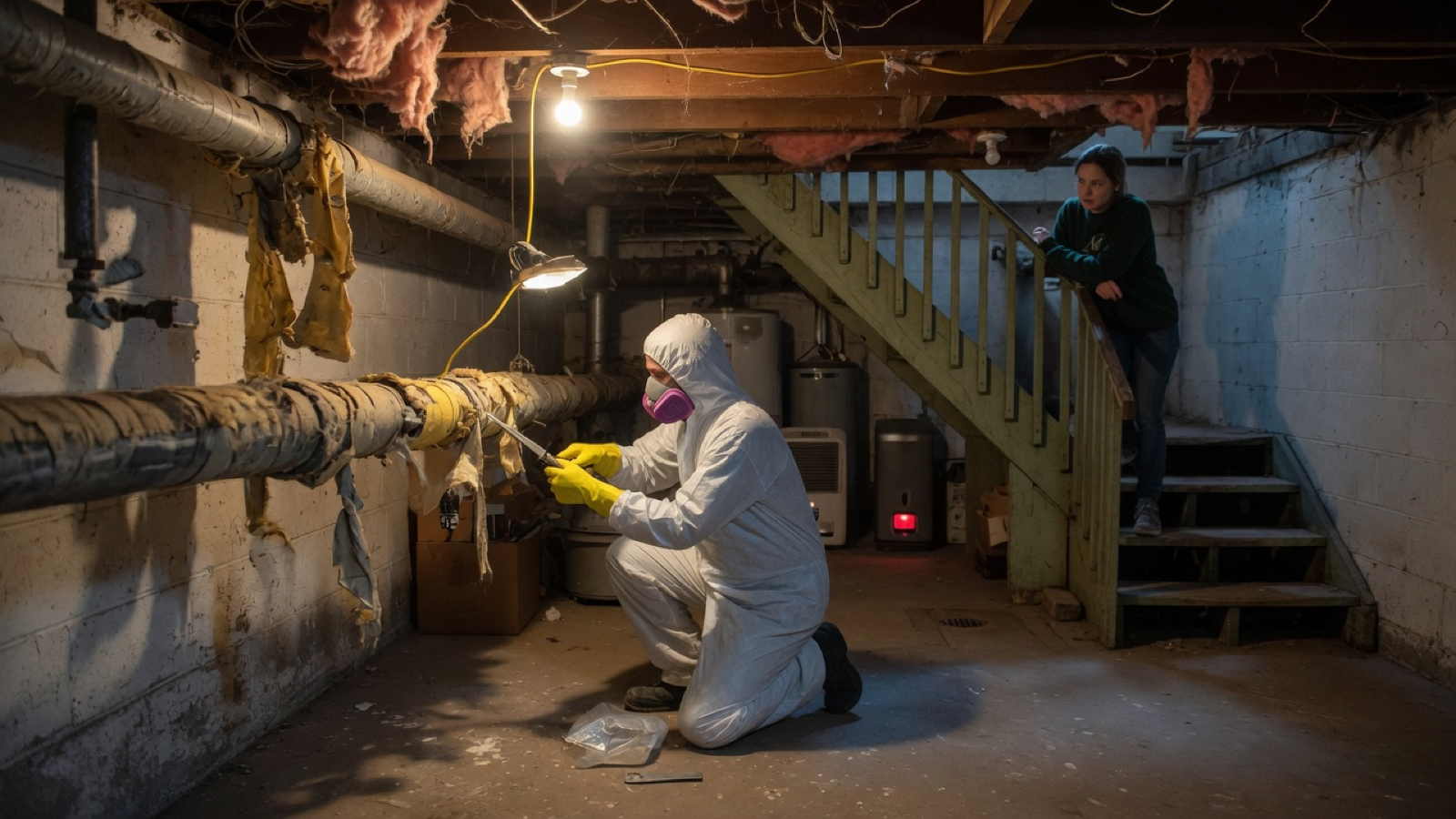
Where the NESHAP applies, 40 CFR 61.145(a) requires a thorough inspection of the facility, or the part of the facility where the demolition or renovation will occur, for asbestos, including Category I and Category II nonfriable asbestos-containing material. EPA's overview says the same thing in shorter words: the regulations require a thorough inspection where the demolition or renovation operation will occur. Category I nonfriable material, as EPA's demolition guide quotes the definition, includes asbestos-containing packings, gaskets, resilient floor covering, and asphalt roofing products with more than 1 percent asbestos. Category II is the other nonfriable material that, when dry, cannot be crumbled, pulverized, or reduced to powder by hand pressure. A walk that only looks at friable pipe wrap misses the floor and the roof that the rule told the inspector to include.
EPA's page on protecting a family from asbestos exposure says you generally cannot tell whether a material contains asbestos by looking at it, unless it is labeled. If in doubt, treat it as if it contains asbestos and leave it alone. The same page says taking samples yourself is not recommended, because bad sampling can be more hazardous than leaving the material alone. A flip is the case where leaving it alone only works for material the scope will not touch. If the scope will scrape, cut, demo, or demolish it, the sample belongs to a trained accredited inspector before the crew arrives. You are not the lab.
Asbestos-containing material, under OSHA's construction page, means any material containing more than 1 percent asbestos. A result that says "trace" or "less than 1 percent" is not the same sentence as "more than 1 percent." Read the number the lab printed. Do not let a summary replace the PDF. For vermiculite insulation, EPA tells homeowners to assume asbestos and not to disturb it even when the urge is to trust a single low result. That attic rule is in the next section. It is not a reason to ignore a ceiling result that is over 1 percent.
4. Apply the threshold and the notice clock
The threshold is a removal and work-practice line for a facility. It is not a permission slip for an excluded house, and it is not a reason to skip notice on a demolition. EPA's NESHAP overview says that if the total amount of asbestos to be removed or disturbed is less than 260 linear feet, 160 square feet, or 35 cubic feet off of facility components, the NESHAP does not require regulated asbestos-containing material to be removed before demolition or renovation. EPA's later statement of the regulatory line uses "at least" those same amounts: at least 260 linear feet on pipes, at least 160 square feet on other components, or at least 35 cubic feet where length or area could not be measured. At the line, the removal requirements apply. Under the line, that particular removal requirement does not.
Regulated asbestos-containing material is not only the fluffy pipe wrap. Friable material counts. Category I material counts when it has become friable or when it will be sanded, ground, cut, or abraded. Category II material counts when the forces of the job are likely to crumble it. Those are the categories in 40 CFR 61.141. A plan to grind mastic off a slab is a different plan from a plan to lift intact tile. Write the method in the scope before anyone uses the threshold to shrink the job. The scope of work guide is where that method belongs, as its own line, not as a note in the margin.
Notification is a second clock. EPA's December 2009 guidance on catastrophic events quotes the ordinary rule from 40 CFR 61.145, and the quote is not limited to storms. For a demolition of a facility, notification is required even if no asbestos is found. For a renovation, notification is required if threshold amounts of regulated asbestos-containing material will be disturbed. The owner or operator provides written notice at least 10 working days before the covered activity. Ten working days are not ten calendar days. Count the business days the authority will count, and ask that authority which holidays it skips. Emergency renovations and demolitions ordered because a building is in danger of imminent collapse use a shorter clock. A flip you scheduled is not that emergency because the contractor is free on Thursday.
The notice goes to the delegated authority, which is often a state or local air program, not automatically to EPA. EPA's compliance page, updated July 23, 2026, says owners or operators may have to notify, conduct a thorough inspection, and use methods that do not cause visible emissions, and that regulated material has to be managed and buried in an approved landfill. Update the notice when the amount of asbestos affected changes by at least 20 percent. That update duty is in 40 CFR 61.145(b). A bid that grows after the first notice is not a private surprise. It is a revised notice if it crosses that change.
Do not slice the job to stay under the line. The 1995 notice points to 40 CFR 61.19. Owners and operators may not carry out an operation piecemeal to avoid a standard that applies only above a specified size. Four invoices for one ceiling, or three demolition contracts for three contiguous houses you always planned to take down together, are the pattern that sentence is about. Measure the work you will actually do this project. If you already know the other units get the same scrape this year, count them now.
Put the clock on the hold, not only on the checklist. The holding-cost guide is the home for interest, tax, insurance, utilities, and delay. A 10-working-day notice that does not fit inside the days you already funded is an extra hold. A notice you file during diligence, before you are obligated, can use days you were going to spend anyway. Those are different deals. The scenarios below keep them apart.
5. Treat pipe wrap, ceilings, floors, and vermiculite until a lab speaks
OSHA does not wait for the NESHAP exclusion to expire. On the construction asbestos page, presumed asbestos-containing material means thermal system insulation and surfacing material found in buildings constructed no later than 1980. Thermal system insulation is material applied to pipes, fittings, boilers, tanks, ducts, or similar parts to slow heat loss or gain. Surfacing material is material that is sprayed or troweled on, including acoustical plaster on ceilings and fireproofing on structure. A building put up in 1981 or later does not have this presumption. A building put up in 1980 does. "No later than 1980" includes 1980.
The same OSHA page says asphalt and vinyl flooring installed not later than 1980 must be treated as asbestos-containing unless the rebuttal procedure shows it is not. Class I work is removal of thermal system insulation and surfacing material that is asbestos-containing or presumed. Class II work is removal of other asbestos-containing material, which is where a floor often lands. A painter's skim price is not a Class I price. If your employees will do the removal, you are the employer who has to meet the standard. If a contractor's employees will do it, that contractor is the employer for those workers, and the bid still has to include the qualified work, the waste path, and the time. Vet that firm the way the contractor vetting guide says to vet any firm: license, insurance, and a scope that matches the disturbance, not a slogan.
The presumption can be rebutted. OSHA points that rebuttal to 29 CFR 1926.1101(k)(5). The path includes an inspection that meets AHERA rules, or bulk samples collected in the manner described in 40 CFR 763.86 and evaluated by an accredited inspector or a Certified Industrial Hygienist. Keep the data for as long as you rely on it. A contractor who "has seen a hundred of these" did not rebut anything. A sample from unit 2 does not rebut unit 4. A sample from the living room ceiling does not rebut the bedroom ceiling unless the inspector treats them as the same homogeneous material and the report says so.
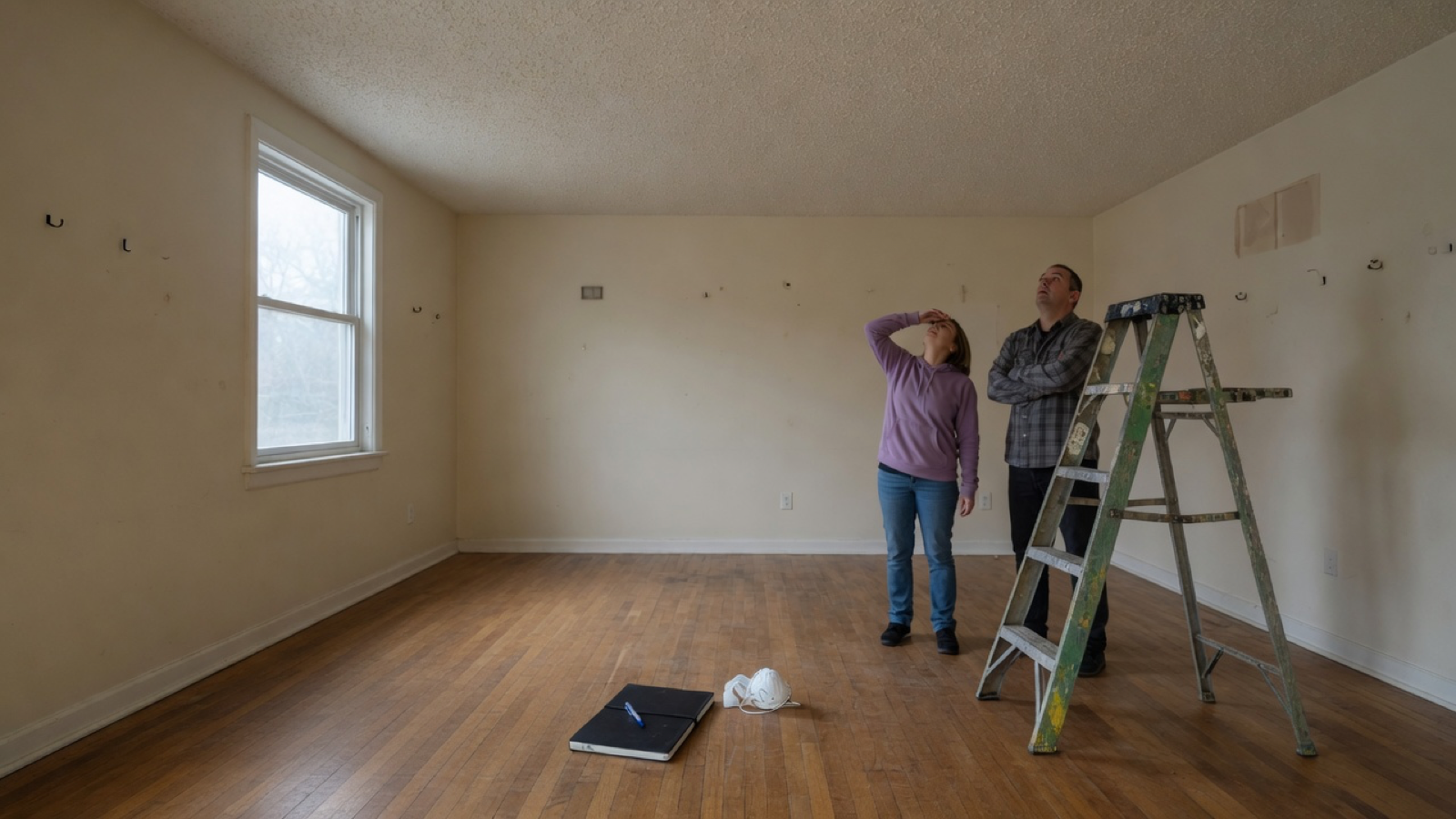
Vermiculite insulation is its own instruction. EPA's page on asbestos-contaminated vermiculite says you should assume the insulation is from Libby and treat it as if it contained asbestos, by not disturbing it or by using a trained professional if it must be removed. EPA says the Libby mine was estimated to be the source of over 70 percent of all vermiculite sold in the United States from 1919 to 1990, and that vermiculite from Libby was contaminated with asbestos. Further testing is not necessary to take those precautions. EPA's attic answer says to leave the insulation undisturbed, and that if you choose removal, a trained accredited abatement contractor should do it, separate and independent from the company that assessed the insulation. Do not store the flip's cabinets in that attic. Do not let a crew open the attic floor and call the dust "old cellulose" without looking.
Material you will not disturb can stay in place. EPA says asbestos-containing material that is in good condition and will not be disturbed is not likely to release fibers, and that undamaged material is usually best left alone. A flip scope that needs the wall open is a disturbance. Say so in the scope. A scope that paints around an intact transite panel and never cuts it is a different scope. Write which one you mean. The contingency budget guide is where a named unknown sits until the lab replaces it. Contingency is not a substitute for a sample you still have time to take.
When you sell, EPA's answer updated February 26, 2026 is narrow. Federal law does not require a home seller to disclose asbestos or vermiculite. State or local requirements may. Contact the state about those requirements. If your file contains a positive lab, keep it. The pre-listing checklist is where known property facts go before a photographer arrives. Do not type "asbestos-free" because the texture was skimmed. A skim is not a certified finding that every material in the house is clear.
6. Work three named asbestos files
The dollars below are teaching assumptions for three fictional files. They are not quotes, city averages, or predictions. Each investor already has a profit floor. The asbestos result is allowed to miss that floor. The decision is renegotiate to the floor, or walk. None of them treats a home inspection as the survey.
Nora Ellison renovates one 1949 house
Nora is under contract on 27 Birchwood Avenue, a one-unit house built in 1949. The assessor card and the seller's disclosure agree on the year. She is not demolishing it. She is not combining it with another building. Nothing in the file shows a prior commercial use that would have made the building a NESHAP facility before. Under the 1995 clarification, this isolated small residential renovation is not covered by the federal asbestos NESHAP. She writes that conclusion down, and she does not stop there. Her state program's page is a local fact she still has to read. Her contractor's employees will scrape the ceiling texture and lift the vinyl tile. The house was built no later than 1980, so OSHA presumes the surfacing material is asbestos-containing, and vinyl flooring installed in that era is treated as asbestos-containing until rebutted.
Her stack, before any lab, is an after-repair value of $310,000, a contract price of $180,000, rehab of $62,000, buying costs of $4,000, holding costs of $9,000, and selling costs of 8 percent of $310,000, which is $24,800. The $62,000 already includes $8,000 for the ceiling skim and the new floor. Profit is $310,000 minus $180,000 minus $62,000 minus $4,000 minus $9,000 minus $24,800, which is $30,200. Her floor is $28,000. She has $2,200 of room.
She keeps the inspection contingency open and hires an accredited inspector. The lab says the ceiling texture contains more than 1 percent asbestos, the floor tile contains more than 1 percent, and the basement pipe wrap does not. The abatement quote for the ceiling and the tile, including disposal, is $11,400. She does not swap that quote for the $8,000 finish line. The finish still has to happen after the removal. She adds $11,400. The quote also adds 4 calendar days before the finish crew can start. She funded $9,000 of holding cost for 90 days, which is $100 a day in her model. Four days are $400. Profit falls by $11,800, from $30,200 to $18,400. The floor is $28,000, so she is short $9,600.
She asks for a $9,600 price cut, to $170,400. Selling costs stay $24,800 because the after-repair value did not change. Holding becomes $9,400. Profit returns to $28,000. The seller agrees. She proceeds. She does not let the scrape start on the day the price cut is accepted. The abatement contractor's start date goes into the scope, and the finish line stays in the budget as its own number. The federal exclusion never made the $11,400 optional. It only told her which rule had not been the one that priced the ceiling.
Samuel Adeyemi demolishes three houses on one parcel
Samuel is under contract on 8, 10, and 12 Porter Street, three contiguous 1924 houses on one parcel, one city block, one owner when he closes. The plan is to demolish all three and build a fourplex. That is more than one small residential building, the same owner, the same project, and a compact site. It is also a private development, not an owner replacing one house with another house. The 1995 clarification says the residential exemption does not apply. He does not ask the demolition contractor to write three contracts so each house can pretend to be isolated. That is the piecemeal pattern 40 CFR 61.19 is there to stop.
His finished fourplex has an after-repair value of $980,000. Selling costs at 8 percent are $78,400. The purchase price is $261,600. The demolition allowance is $54,000, which is $18,000 a house and assumes no survey and no abatement. Construction after demolition is $500,000. Soft costs and buying costs are $18,000. Holding costs are $22,000 across 200 days, which is $110 a day in his model. Profit is $980,000 minus $261,600 minus $54,000 minus $500,000 minus $18,000 minus $22,000 minus $78,400, which is $46,000. His floor is $40,000.
The inspector measures 310 linear feet of friable pipe insulation in 8 Porter Street alone. That is already at least 260 linear feet, so the removal requirement is triggered before the other two houses are added. He still reports quantities for each house and for the project. The survey invoice in this file is $2,100. The abatement quote is $16,800. Because the work is a demolition of a facility, he also has to notify even if a later house had come back clean. The ordinary notice is at least 10 working days before demolition. He counts 10 working days as 14 calendar days on this calendar, and he confirms that count with the air program.
If he waives first and orders the survey after closing, the 14 days are extra. At $110 a day, that delay is $1,540. The adder is $2,100 plus $16,800 plus $1,540, which is $20,440. Profit falls from $46,000 to $25,560. The floor is $40,000, so he misses it by $14,440. He cannot unwaive because the math is ugly. He does not take that path.
He orders the survey while the inspection contingency is open. His purchase timeline already had 20 calendar days between the planned survey delivery and the demolition start. Those 20 days can hold 10 working days, so the notice does not add hold he has not funded, as long as the survey does not slip. The adder he has to fund is $18,900. He asks for $18,900 off the purchase price, to $242,700. Profit stays $46,000, which clears the floor. The seller agrees. He proceeds, and the notice date is a line on the schedule before any machine arrives. If the survey slips, the $110 daily clock starts and he recomputes before he calls the delay free.
Helen Cho opens one unit in a five-unit building
Helen is under contract on 55 Westgate Avenue, a 1958 building with five dwelling units. Five is not four or fewer. The building is a facility. She had planned to scrape the ceiling in unit 3 first and call the rest of the building cosmetic. Unit 3's ceiling is 680 square feet. If that texture contains more than 1 percent asbestos and the scrape will disturb it, 680 square feet is at least 160. The renovation notice and the work practices are in play for that room alone. She also planned, in the same budget, to renovate the other units this year. Counting only the pretty unit would be the piecemeal reading 40 CFR 61.19 warns against.
Her stack before the lab is an after-repair value of $740,000, a purchase price of $407,800, rehab of $95,000, buying costs of $8,000, holding costs of $15,000, and selling costs of 8 percent of $740,000, which is $59,200. The $95,000 includes $4,500 of skim and paint for each of five ceilings, $22,500 in all. Profit is $740,000 minus $407,800 minus $95,000 minus $8,000 minus $15,000 minus $59,200, which is $155,000. Her floor is $140,000.
The first survey of the suspect list is $900. Unit 3's ceiling is over 1 percent. Unit 1's ceiling was replaced in 2004, and the invoice is in the file, so she does not sample a ceiling that is gone. The floors she will touch are sampled by an accredited inspector under the OSHA rebuttal procedure and come back not greater than 1 percent. She does not add a floor line. She does not treat an unsampled ceiling as cleared because unit 3 was positive or because the texture "looks the same." She orders samples of the four remaining original ceilings for $1,600. All four are over 1 percent, so four ceilings need removal. The quote is $6,800 each, which is $27,200. The skim dollars stay in the $95,000. The adder is $900 plus $1,600 plus $27,200, which is $29,700.
Profit falls from $155,000 to $125,300. The floor is $140,000, so she is short $14,700. Four ceilings at 680 square feet are 2,720 square feet, which is past the threshold by a wide margin. She asks for $14,700 off the purchase price. The seller's best offer is $10,000 off. Profit would be $135,300, still $4,700 under the floor. She walks. She does not let a crew scrape unit 3 "while they are here" on a contract she is not accepting. The notice is not her job if she does not do the renovation. The report stays in her diligence file so she can show why she canceled.
| File | Federal coverage in this file | Added cost | Decision |
|---|---|---|---|
| Nora Ellison, 27 Birchwood Avenue | Isolated one-unit renovation. NESHAP exclusion applies. OSHA presumption still applies. | $11,400 removal plus $400 of extra hold | Price cut of $9,600, to $170,400. Proceed. Finish work stays in the budget. |
| Samuel Adeyemi, 8, 10, and 12 Porter Street | Three houses, one site, one demolition project. Exemption does not apply. | $18,900 if the notice fits in the days already funded | Survey before waiver. Price cut of $18,900, to $242,700. Proceed. Do not split the contracts. |
| Helen Cho, 55 Westgate Avenue | Five units. The building is a facility. 2,720 square feet of ceiling to be disturbed. | $29,700 | Seller's $10,000 cut still misses the floor by $4,700. Walk. |
All three used the same habit. They named the rule that applied. They priced removal on top of finish work instead of instead of it. They compared the result with a floor they had written down before the lab arrived. The AS-IS credit guide is the home for choosing a price cut over a credit when a lender or a leftover credit would trap the number. Nora and Samuel took price cuts because their teaching files had no lender cap to model. Helen did not take a partial cut that left her under the floor. A credit that cannot be used is not a repair budget. Recompute before you call either shape a win. Then run the new stack through the maximum offer guide so the walk-away price moves with the evidence.
7. Use an asbestos checklist without an account
Copy this list into the notes app you already use. Check each line against the year-built record, the unit count, the scope, the lab PDF, or a written reply from the state program. An empty line is an open item.
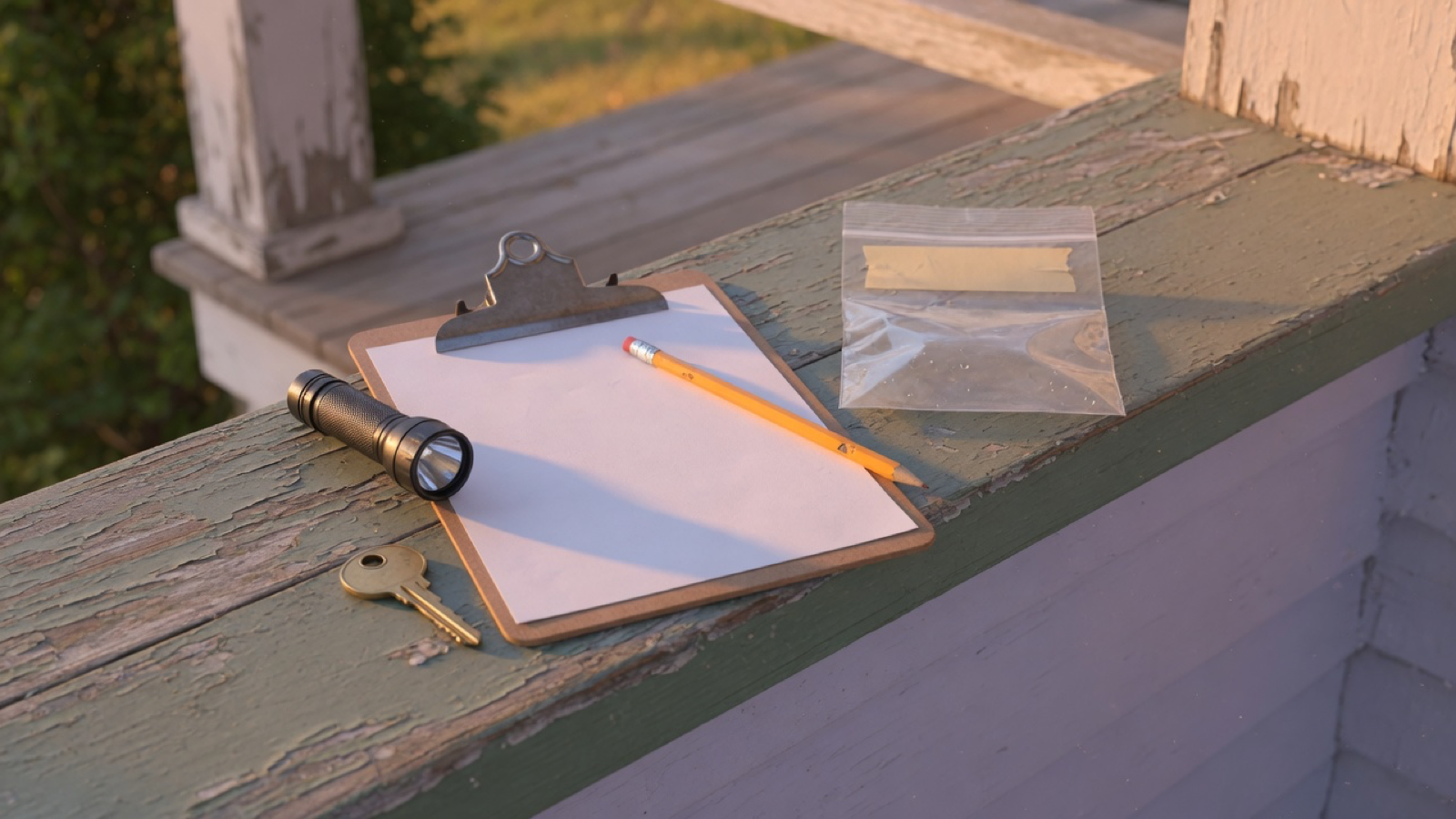
- The year built is written down, with the document that supports it. A listing headline is not the document. If the records disagree, the older year stays in force until you resolve it.
- The dwelling-unit count is written down. Four or fewer is not assumed from the words "single family" if the building has more than one kitchen or more than one address history.
- The project is named. Isolated renovation, demolition for another house, several buildings on one site, or a larger commercial or public project. The 1995 situations are checked against that name, not against a hope.
- The state or local asbestos program page for this address is in the file, including any survey or license rule that applies even when the federal exclusion applies.
- The scope lists every material the work will disturb: ceiling texture, vinyl tile, mastic, pipe or duct wrap, roofing, siding, and vermiculite. Material the scope will not touch is listed too, as left in place.
- The home inspection is filed as a home inspection. It is not described as an asbestos survey. A recommendation to test is a task, not a result.
- Samples, if the scope will disturb presumed or suspect material, were taken by an accredited inspector or other person the state recognizes. You did not bag the scrape yourself. The lab PDF is next to any summary.
- Results say whether each material is more than 1 percent asbestos. A rebuttal of presumed material follows 29 CFR 1926.1101(k)(5). One room does not clear the next room unless the report says the material is the same and was sampled that way.
- Vermiculite, if it is in the attic or the walls, is marked do-not-disturb unless a trained accredited contractor, independent from the assessor, is priced to remove it.
- If the building is a facility, quantities are measured against 260 linear feet, 160 square feet, and 35 cubic feet for the work you will actually do. The job is not split to stay under the line.
- If the work is a demolition of a facility, the notice is on the calendar at least 10 working days before demolition, even when the survey is clean. If it is a renovation over the threshold, the notice is on the calendar before the disturbance. The authority that receives the notice is named.
- The removal quote is added to the finish work. It does not replace the skim, the new floor, or the demolition allowance unless the quote says those items are inside it.
- Extra days are priced at the daily holding cost you already use. A notice that fits inside days you funded is not an extra cost. A notice that does not fit is an extra cost.
- Profit is recomputed against the written floor before you waive, cut the price, or accept a credit. A partial concession that leaves you under the floor is a walk unless you change the floor on purpose and write the new floor down.
If you cannot check a line, you are not required to waive in order to look cooperative. Ask for the page, or keep the inspection period. A short delay has a holding cost you can compute. A waived period plus an untested scrape is a different kind of cost.
8. Keep the asbestos file on the property record
The lab PDF, the inspector's license or accreditation, the state reply, and the notice receipt are project documents. The day they arrive, put six facts on the property: the year built and its source, the unit count, whether you concluded the NESHAP applies, the date the notice clock ends if there is one, the dollar change in repairs, and the materials marked do-not-disturb. The four-stage pipeline should show the survey as an open task until the PDF is in the file. A task called "inspector booked" is not a result.
Rehabfolio is where those facts can sit on the deal you are already underwriting. The property research page is the place for the year built, the unit count, and the documents. The deal analysis page is where the removal adder changes the number. The rehab estimating page is where the ceiling line stays attached to the survey instead of collapsing into "paint and texture." The fix-and-flip workflow is the path from that number to the job. You still hire the inspector, and you still hire the abatement contractor, yourself.
If a tool summarizes a lab report or a notice form, keep the PDF next to the summary. The AI underwriting guide and the AI disclosure state the same limit for value and repairs. A model can list the federal questions. It can remind you that four or fewer units is not the whole test, and that 160 square feet is a threshold rather than a mood. It cannot look at a kitchen photo and declare a ceiling free of asbestos. It cannot decide that your state's program is silent, or that a license from another state covers this house. You compare the summary with the lab PDF, the scope, and the state page before the deadline. The editorial methodology is where that review standard is described.
Permits are a separate file. The permits and inspections guide remains the home for the building department. An asbestos notice does not replace a building permit, and a building permit does not replace the notice. Change orders found after the walls open, including pipe wrap nobody sampled, go through the change order guide. They are not a reason to skip the sample you could have taken while the contingency was alive.
9. Avoid the exemptions that hide a removal cost
- Using the small-house exclusion as a reason to skip the lab. Nora's house was excluded from the NESHAP and the ceiling was still over 1 percent. OSHA and the scope priced the work. The exclusion answered a different question.
- Treating the home inspection as the survey. ASHI's standard does not require the inspector to determine environmental hazards in building materials. Silence is not a negative result.
- Splitting one project into small contracts. Samuel's three houses are one demolition. Helen's five ceilings were one renovation plan. 40 CFR 61.19 is the reason those splits do not reset the rule.
- Calling a city a site, or calling one block several sites. EPA's 1995 guidance says a neighborhood is not one site, and it also says parcels on the same block may be. Contiguous houses you plan together are the covered case. Two flips several blocks apart are not automatically one installation.
- Replacing the finish budget with the abatement budget. Removal does not skim the ceiling or lay the new floor unless the quote says it does. Adding the numbers is the repair budget. Swapping them is how a deal looks cheaper than it is.
- Scraping first because you have no employees today. EPA says not to take your own samples and not to disturb suspect material. A helper hired on Saturday can make you the employer for work you already started.
- Letting one sample clear the building. Helen did not treat three unsampled ceilings as twins of the first positive test, and she did not treat them as clean either. She sampled them. Then she walked.
- Reading the federal disclosure answer as a shredder. EPA says federal law does not require a seller to disclose asbestos or vermiculite, and that state or local rules may. A report you have is still a project record. The listing does not say asbestos-free unless a qualified inspection supports that sentence for the materials you are describing.
None of these require a reckless seller. They require an ordinary week in which the fastest path is to call the house exempt and let the cheapest crew open the ceiling. The checklist is the slower path on purpose.
Frequently asked questions
Does the federal asbestos rule apply to every house flip?
No. EPA's asbestos NESHAP covers facilities. The facility definition excludes residential buildings with four or fewer dwelling units, and EPA's July 28, 1995 clarification says demolition or renovation of an isolated small residential building is not covered, no matter who hires the crew. The exclusion does not apply when more than one small residential building on the same site is demolished or renovated by the same owner as part of the same project, when the house is part of a larger project that also demolishes or renovates a non-residential building, or when the building has five or more dwelling units. State and local rules can still cover the excluded house. OSHA's construction standard can still cover the employer whose workers disturb presumed asbestos-containing material.
Is a home inspection an asbestos survey?
No. ASHI's Standard of Practice, the version the society still displayed as current while the January 8, 2026 revision waited on an implementation date, says the inspector is not required to determine the presence of environmental hazards, including contaminants in building materials. An ASHI interpretation says the inspector is not required to report possible asbestos-containing material at all. A sentence that recommends testing is voluntary. A silent report is not a clean test. The NESHAP survey, where it applies, is a thorough inspection for asbestos, including nonfriable materials, before demolition or renovation.
What do 260 linear feet, 160 square feet, and 35 cubic feet mean?
They are the federal thresholds for regulated asbestos-containing material on a covered demolition or renovation. EPA's NESHAP overview says that if the amount to be removed or disturbed is less than 260 linear feet, 160 square feet, or 35 cubic feet, the NESHAP does not require that material to be removed before the work. At or above those amounts, the removal and work-practice requirements apply. A demolition of a facility still needs a notification even when the survey finds no asbestos, or finds an amount under the threshold. A renovation notification is tied to threshold amounts that will be disturbed. These numbers do not decide a house the NESHAP does not cover, and they do not turn off OSHA.
Do I notify before I demolish a covered building if the survey is clean?
Yes. EPA's demolition guidance, quoting 40 CFR 61.145, says a demolition notification is required even if no asbestos is found. The ordinary clock is at least 10 working days before demolition begins. Emergency renovations and government-ordered demolitions use a shorter clock. A renovation notification is required when threshold amounts of regulated asbestos-containing material will be stripped, removed, or similarly disturbed. File the notice with the delegated state or local authority, not with a generic inbox you have not confirmed.
Can I scrape a popcorn ceiling myself if I have no employees?
Do not plan on it. OSHA's construction standard is an employer rule, so a person with no employees is not, by that fact alone, an OSHA-covered employer. EPA still says you generally cannot tell asbestos by looking, that taking your own samples is not recommended, and that material you will disturb should be handled by a trained accredited professional. The moment you hire a helper, you may be the employer for that work. On a building constructed no later than 1980, surfacing material such as sprayed or troweled ceiling texture is presumed asbestos-containing until the presumption is rebutted by the procedure in 29 CFR 1926.1101. Price that procedure, and price the removal if the lab confirms asbestos, before you waive.
Does a pre-1981 vinyl floor have to be treated as asbestos?
Until it is rebutted, yes, when it was installed no later than 1980. OSHA's construction asbestos page says asphalt and vinyl flooring installed not later than 1980 must be treated as asbestos-containing unless the specified rebuttal procedure shows otherwise. The same page says thermal system insulation and surfacing material in buildings constructed no later than 1980 are presumed asbestos-containing material. A new floor installed in 2004 is not that presumption. An unsampled floor in the next room is not cleared by a sample from a different floor.
Does federal law make me disclose asbestos when I sell the flip?
EPA's disclosure answer, updated February 26, 2026, says federal law does not require a home seller to disclose asbestos or vermiculite, and that state or local rules may. That answer is not permission to drop a lab report you already have. Keep the report in the project file. When you list, follow the state disclosure form and the pre-listing checklist. Do not write asbestos-free on the listing because you painted the ceiling.
Editorial methodology, limitations, and sources
The Rehabfolio editorial team wrote this as the asbestos page for a house flip. It does not replace the due diligence checklist, the lead paint guide, the repair budget, the scope of work, the contractor vetting guide, the permits guide, or the pre-listing checklist. Those pages remain the homes for the full inspection window, the paint rule, the estimate, the bid document, the hire, the building department, and the listing packet. This article answers a different question: what a buyer should be able to prove about asbestos before waiving, hiring, demolishing, or scraping.
Facility coverage, the four-or-fewer exclusion, the thorough inspection, and the removal threshold are described from EPA's Overview of the Asbestos NESHAP and from EPA's asbestos NESHAP rule summary. The health effects named on the rule summary are lung cancer, mesothelioma, and asbestosis. This article does not restate exposure limits or medical advice.
The isolated-building reading, the same-site reading, the private development examples, the installation definition, and the warning against piecemeal jobs are taken from EPA's Asbestos NESHAP Clarification of Intent, Federal Register, Volume 60, pages 38725 to 38726, July 28, 1995. That notice says it does not replace the regulation. It also says it applies only to the federal asbestos NESHAP and that other federal, state, or local rules may apply. The facility and installation definitions quoted in the notice are the 1990 revisions codified at 40 CFR 61.141. Category I nonfriable examples are taken from EPA's guide to normal demolition practices, which excerpts the November 20, 1990 definitions.
The inspection duty, the demolition notice even when no asbestos is found, the renovation notice when threshold amounts will be disturbed, and the 10-working-day clock are described from EPA's December 2009 asbestos guidance, which quotes 40 CFR 61.145, and from EPA's demolition and renovation compliance page, updated July 23, 2026. The 20 percent notice update is the duty in 40 CFR 61.145(b) as described in EPA's NESHAP materials. The eCFR link for the current electronic text is 40 CFR part 61, subpart M. The eCFR is a current electronic version. It is not the official printed edition of the CFR. Recheck the section before you rely on a number in a live deal.
Presumed asbestos-containing material, the 1980 cutoff, vinyl and asphalt flooring installed not later than 1980, the more-than-1-percent definition, and Class I and Class II work are described from OSHA's construction asbestos training page and from 29 CFR 1926.1101. The rebuttal path cited in the scenarios is 29 CFR 1926.1101(k)(5). This article does not state a permissible exposure limit.
The home inspection limit is ASHI's Standard of Practice section 13.2 as published in the standards PDF ASHI's Standard of Practice page was still presenting as current on review, because the revision approved on January 8, 2026 did not yet have an implementation date. The reporting interpretation is s101015. If ASHI's implementation date arrives, reread section 13 before you treat this paragraph as the new text.
Vermiculite precautions, the Libby estimate of over 70 percent of vermiculite sold in the United States from 1919 to 1990, and the instruction not to disturb it are from EPA's vermiculite insulation page. Removal by a trained accredited contractor who is independent from the assessor is from EPA's attic vermiculite answer. Looking is not a test, do-it-yourself sampling is not recommended, and undamaged material that will not be disturbed is best left alone: those sentences are from EPA's protect your family from asbestos exposure page. Seller disclosure is from EPA's asbestos and vermiculite disclosure answer, updated February 26, 2026.
Dollar amounts, addresses, and timelines in the three scenarios are teaching assumptions. They are not quotes, averages, or predictions. Nora Ellison, Samuel Adeyemi, and Helen Cho are not customers. The editorial team does not claim a license to inspect, sample, or remove asbestos. A state program can be stricter than the federal exclusion. Read that program for the house in the contract. The editorial methodology explains how Rehabfolio labels product experience separately from professional licenses it does not hold.