How to read a house flip mold inspection before you waive
A lab email can say "black mold" and still leave out the leak, the square footage, and the wall nobody opened. This guide shows how to read a mold file before you waive: what was seen or smelled, why a species name is not a repair bid, and how to put the water and the removal on two separate lines.
Written and reviewed by the Rehabfolio editorial team. Published and last reviewed October 26, 2026.
Who this guide is for. This guide is for United States residential investors buying a one-to-four-unit property they intend to renovate, then sell or hold. You might close in your own name or in an LLC, with cash or with a loan. The guide starts when a mold file arrives: a written inspection, a moisture-meter log, a lab PDF, or a one-line email that says the house is fine or that it is not. It ends when you have a written choice: proceed on the current repair budget, add a moisture-repair line, add a separate removal line, keep a named allowance for a cavity nobody opened, change the purchase price, or walk. The full inspection window is the due diligence checklist. The general home inspection, which does not determine mold, is the home inspection report guide. Those pages can name mold. This page is how you read the file they point at.
The Rehabfolio editorial team builds and reviews product workflows that connect a property record to documents, dates, photos, and the offer math. That is first-hand product experience with how a deal file is organized. It does not make the team an industrial hygienist, a remediator, a physician, or an attorney. We do not hold those licenses, and we do not invent them.
Red is the founder of Rehabfolio. He has bought and renovated houses for ten years, across more than 30 projects, and he keeps the city off this page on purpose. On those jobs a stain has never been one number. The water that fed it and the material that has to come out are separate lines, and a lab name has never replaced either line. The three files below are original teaching examples built in that shape. They are not records of a named customer, a named city, or a result the product promises.
Cleanup rules, disclosure forms, and the number of days in your contract differ by state. A federal consumer page and a state disclosure can use the word mold for different duties. This page is educational. It is not a mold inspection, a remediation plan, medical advice, or legal advice. It does not tell anyone which chemical to spray. Use the report in your hand, the agreement you signed, and qualified local professionals for the house you are buying.
Tip: Read this beside the repair budget guide, the scope of work guide, the contingency guide, the asbestos guide, the lead paint guide, and the free maximum offer calculator. Opening a wall can be a mold question and a lead or asbestos question at the same time. Do not scrape first and sort the rules later.
1. Decide what the mold file has to prove
A mold file has one job before you waive. It has to show whether moisture is still feeding growth, where that growth was actually seen, and which surfaces nobody looked at. EPA's brief guide says the key to mold control is moisture control, and that if you clean up the mold but do not fix the water problem, the mold will most likely come back. CDC says the same pair of jobs in shorter words: if mold is growing in the home, clean it up and fix the moisture problem. A report that only names an organism has not done either job.
You are not trying to prove the house is sterile. EPA says it is impossible to get rid of all mold and mold spores indoors, because some spores will remain in the air and in house dust, and that those spores will not grow if moisture is not present. A "zero mold" promise is not a reading of that page. The decision is whether the moisture and the material you can see, plus the cavities you cannot, still fit the repair budget you used to write the offer.
Write the question in one sentence before you open the PDF. "Is the bathroom stain dry, smaller than the patch EPA describes as often a do-it-yourself cleanup, and limited to a surface I will already replace?" is a question the file can answer. "Is this house safe?" is not. EPA says its health overview does not describe every effect of mold exposure and tells readers to consult a health professional. This page does not diagnose anyone who will live or work in the house.
2. Separate the general inspection from a mold visit
The general home inspection is allowed to ignore mold. The American Society of Home Inspectors standard says the inspector is not required to determine the presence of molds and mold-like substances. The same standard says the inspector is not required to determine methods, materials, or costs of corrections. InterNACHI's Standards of Practice say the inspector is not required to determine the presence of mold, mildew, or fungus. A summary that never uses the word mold is not a clearance. It is often the report doing what the standard permits.
| Question | General home inspection | Mold file you can use |
|---|---|---|
| Must it find mold? | No. ASHI and InterNACHI both exclude that determination. | Only if the visit you ordered was asked to look. |
| Must it price the work? | ASHI says the inspector is not required to determine costs of corrections. | A remediator's bid, a plumber's bid, or a blank you refuse to fill with a guess. |
| Does a lab result close it? | The general report is not that lab. | EPA says there is no federal airborne limit for the lab to meet. CDC says you do not need the type. |
| What if a room was blocked? | The limitation belongs in the inspection report. | The unopened cavity stays an open line until someone sees it or you accept it in writing. |
Book the specialist while the objection window is still open. The due diligence checklist already lists mold next to the sewer scope and the other visits a general inspection can create. Waiting for a prettier PDF does not add days to the contract. If the general inspector writes "possible microbial growth" and does not measure it, that phrase is a referral. It is not the mold file.
3. Read what was seen, smelled, and measured
Start with the header, the way you would start a termite report or a sewer video. The address has to be this house. The date has to sit inside this contract. The rooms have to be listed. A report about the detached garage does not inspect the basement you plan to finish. If the company name, the person's credential, or the method is missing, write that down. This page does not invent a national license for mold inspectors. Your state's own page, if it has one, is the license record. Silence on a blog is not that page.
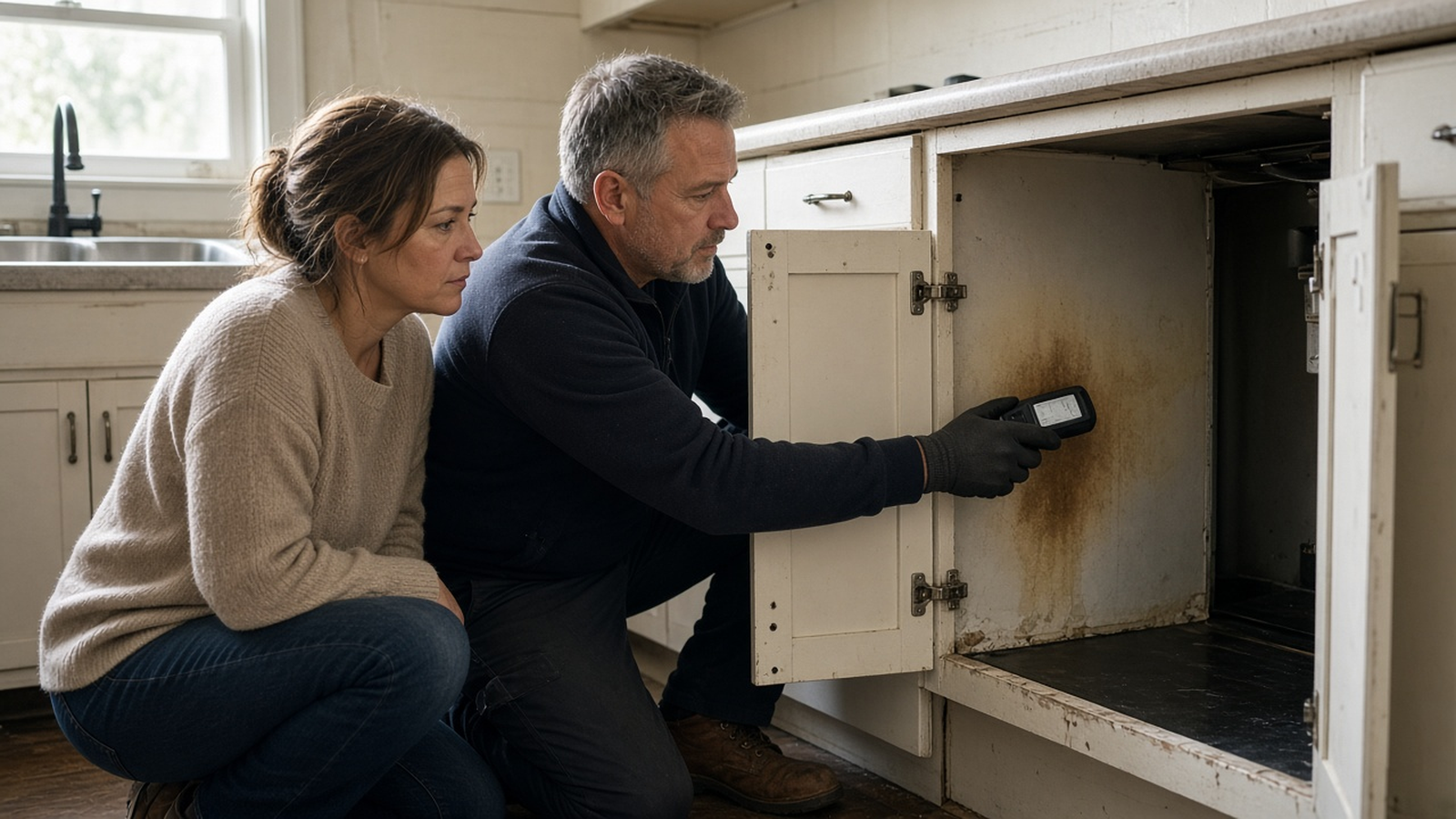
Then copy three observations, separately. What was visible. What was smelled. What a meter said. CDC says mold can look like spots of many colors and can smell musty, and that if you see or smell mold you should remove it. A musty room with no visible spot is still a finding. EPA treats that pattern as a reason to suspect hidden mold. A visible spot with a dry meter is a different finding from a visible spot with a wet meter. The dry reading does not erase the spot. It changes whether you are pricing an old stain, an active leak, or both.
Measure the area in the notes, or write that nobody measured it. EPA's cleanup page uses "less than about 10 square feet" and "more than 10 square feet" as the split between a small patch many occupants can clean and a larger problem that should be read against its remediation guide. A photo of a corner is not a square-foot count. If the report says "extensive" and does not give a size, the size is blank. Blank is not 10, and it is not zero.
Read the moisture source in the same pass. EPA lists leaks in roofs, windows, and pipes, flooding, and condensation. CDC lists leaks in roofs, windows, or pipes, and floods. A stain under a supply line is not the same job as a wall that was under standing water. The insurance guide is where flood, sewer backup, and other water are separated for coverage. This page only asks which water the mold file actually names, because that is the repair you can bid. A mold sentence does not tell you whether a policy will pay.
Humidity is context, not a pass. EPA says to keep indoor relative humidity below 60 percent if possible, ideally between 30 and 50 percent. CDC says to keep humidity no higher than 50 percent all day long. Those are two published targets, not one number this article averages. A single afternoon reading does not describe the month the house sat vacant. Write the reading, the room, and the time. Do not convert it into a year of dryness.
4. Treat a species name as a label, not a bid
The email that scares buyers is usually a name. CDC says the most common indoor molds are Cladosporium, Penicillium, and Aspergillus, and that you do not need to know the type in order to remove what you can see or smell. EPA says molds come in many colors, and that both white and black molds are ordinary enough to appear in the same caption. A black spot is a color. It is not, by itself, a scope of work.
EPA also says molds produce allergens, irritants, and in some cases potentially toxic substances called mycotoxins. Inhaling or touching mold may cause allergic reactions in sensitive people. The same guide says mold exposure can irritate eyes, skin, nose, throat, and lungs of people who are allergic and people who are not, and that symptoms other than the allergic and irritant types are not commonly reported as a result of inhaling mold. CDC, summarizing a 2004 Institute of Medicine review, says there was sufficient evidence to link indoor mold exposure with upper respiratory symptoms, cough, and wheeze in otherwise healthy people, with asthma symptoms in people with asthma, and with hypersensitivity pneumonitis in people susceptible to that condition. CDC also says exposure to damp and moldy environments may cause a variety of health effects, or none at all.
Those paragraphs are why you do not skip a wet wall, and why you do not let a Latin name set the price. There is no federal airborne number on EPA's testing page that turns "elevated" into a dollar. The page says standards or threshold limit values for airborne concentrations of mold or mold spores have not been set, and that there are currently no EPA regulations or standards for airborne mold contaminants. CDC says there are no set standards for an acceptable quantity of different kinds of mold in a home, and that you cannot rely on sampling to know whether someone might become sick. A lab line that says "elevated" without quoting a limit you can look up is a word. Ask what it was compared with. If the answer is "outdoors" or "the lab's own scale," write that down. It is still not a bid.
EPA says surface sampling may be useful to determine whether an area has been adequately cleaned or remediated, and that sampling should be done by people with specific experience in protocols, methods, and interpretation. That is a different use from the pre-offer email that arrives before anyone has cleaned anything. If you already have visible growth, EPA says sampling is unnecessary in most cases. Spend the objection window on the leak and the square footage.
5. Treat an unopened cavity as moisture you have not seen
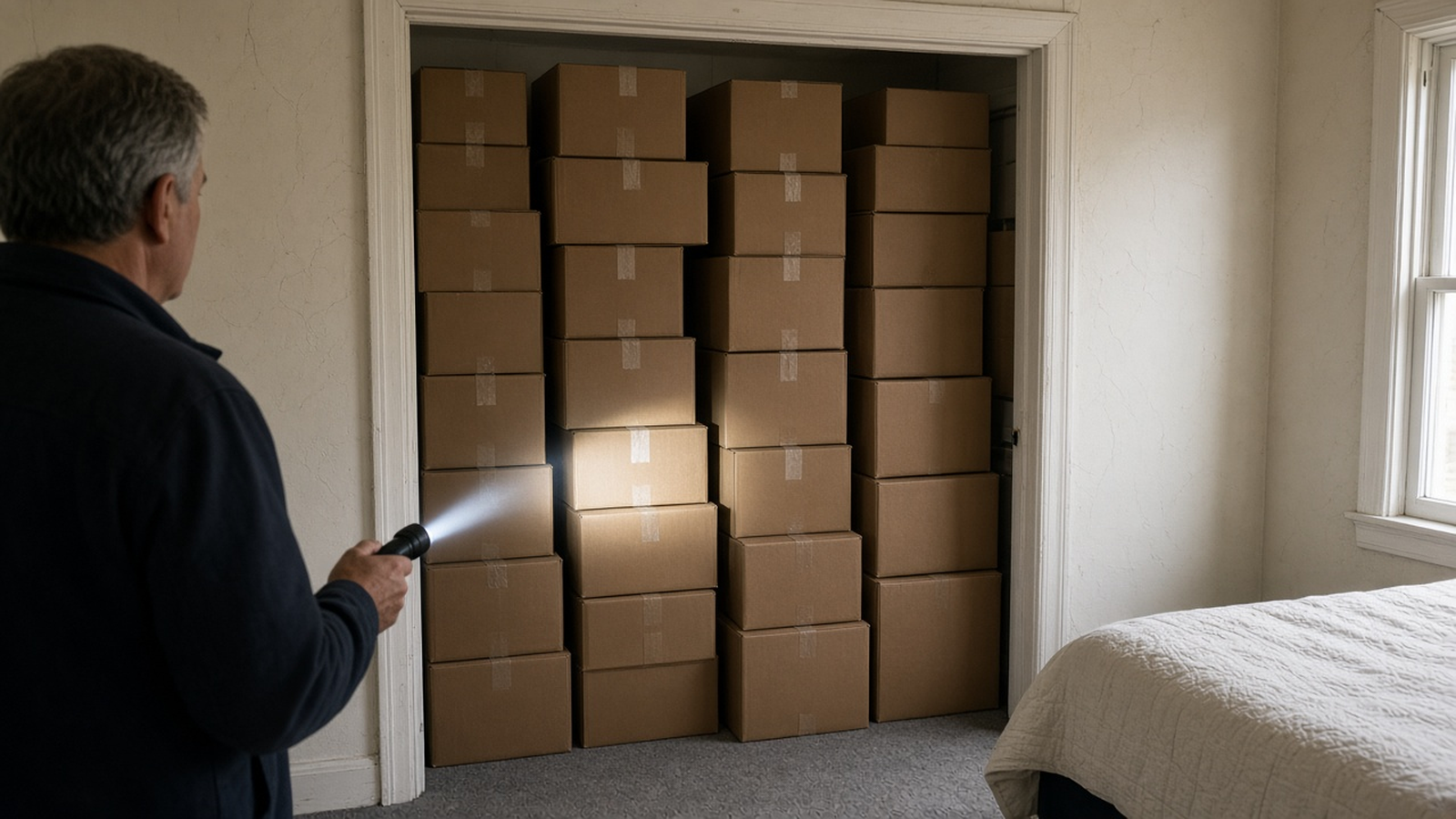
A closet full of boxes is not a dry wall. EPA lists hidden locations that include the back of drywall, wallpaper, or paneling, the top of ceiling tiles, the underside of carpets, the inside of walls around leaking or condensing pipes, the surface of walls behind furniture, the inside of ductwork, and roof materials above a ceiling. If the report says the stored items were not moved, the surface behind them is absent from the file. Copy the sentence. Do not translate "not moved" into "nothing there."
Opening that cavity is its own decision. EPA says investigating hidden mold can be difficult, and that disturbing a site, for example removing wallpaper with growth on the underside, can lead to a massive release of spores. It says to consider hiring an experienced professional if you believe there is a hidden problem. On a flip, the same opening can hit materials covered by other rules. The lead paint guide is the page for pre-1978 paint. The asbestos guide is the page for ceilings, tile, and pipe wrap you should not scrape on a guess. A mold objection does not cancel those pages.
The HVAC note is the same kind of limit. EPA's cleanup page says not to run the heating and cooling system if you know or suspect it is contaminated with mold, because it could spread mold through the building, and it points readers to EPA's guide on whether to have air ducts cleaned before they take that step. A sentence that says "musty at the return" is a reason to stop the system and get a written look. It is not an order to buy a duct cleaning from the first advertisement. Consult EPA's duct-cleaning guide before you treat a cleaning invoice as the fix.
6. Turn one finding into two budget lines
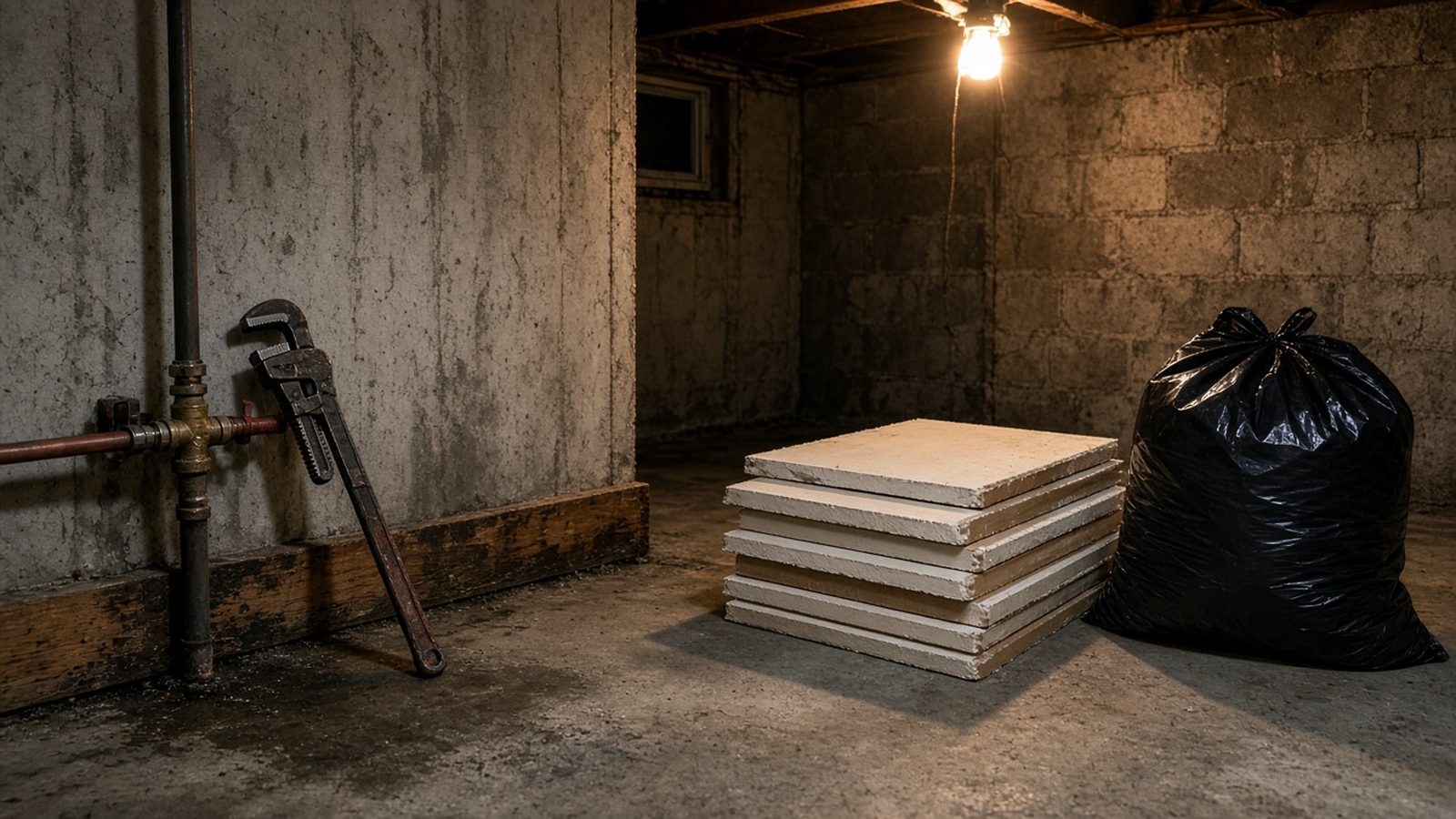
EPA says that if you clean the mold and leave the water, the mold will most likely come back. That is why the offer gets two lines even when one contractor wants to send one invoice. Line one is the moisture: the pipe, the roof, the grading, the sump, the window, or the dryer that vents into the attic. Line two is the material: the drywall, the carpet, the insulation, the trim, and the labor to remove them without spreading what is already growing. A spray that kills growth and leaves a wet wall has not finished the job. EPA also says dead mold may still cause allergic reactions, so it is not enough to kill mold. It has to be removed.
Use EPA's size note without turning it into a national price. Under about 10 square feet, the cleanup page says that in most cases an occupant can handle the job, with the techniques on that page. Over about 10 square feet, or where there has been a lot of water damage, it says to consult the remediation guide written for schools and commercial buildings, and that the document applies to other building types. Sewage or other contaminated water is a professional job on that same page, regardless of how small the stain looks. If you hire someone, EPA says to check references and to ask the contractor to follow that remediation guide, the guidelines of the American Conference of Governmental Industrial Hygienists, the Institute of Inspection, Cleaning and Restoration Certification, or other professional or government guidelines. Asking which of those the bid follows is part of reading the bid. This article does not reprint those guides.
This article also does not pick a cleaner. EPA's brief guide says the use of a biocide such as chlorine bleach is not recommended as a routine practice during mold cleanup, and that dead mold must still be removed. It says never to mix chlorine bleach with other cleaning solutions or detergents that contain ammonia, because toxic fumes could be produced. CDC's consumer page describes a hard-surface method that can include a bleach solution and gives the same never-mix warning. Those are two public pages, not one recipe. A flipper does not choose the chemical from a blog. A small hard surface still needs the water fixed. A wall you are opening, a sewage history, or a suspect air handler is already outside the small-patch sentence.
Porous material often leaves the house. EPA says absorbent materials such as ceiling tiles and carpet may have to be thrown away, because mold can fill spaces you cannot scrub. Do not paint or caulk a moldy surface. EPA says paint applied over mold is likely to peel. If the scope already replaces that drywall, attach the mold note to the existing line. Do not add a second removal budget on top of the same board and call it caution. The scope of work guide is where that line gets written so a contractor can bid it. The repair budget guide is where the quantity lives.
Days are a third number, not a mood. Drying and a return visit can add a week or two of carry. Put those days in holding cost, which is the subject of the holding cost guide. Do not hide them inside the remediation invoice. If the city has to see opened walls, the permit path is the permits and inspections guide. A percent contingency is for what you have not named. A 12-foot wet wall is named. The contingency guide is the page that keeps the reserve from swallowing a finding you already have.
| Field | What to write | Example, a wet basement wall |
|---|---|---|
| Where | Room, surface, and the page or photo that shows it | Basement north wall, photo 14, about 12 feet by 4 feet |
| Seen, smelled, measured | Three separate notes | Visible growth. Musty at the return. Meter wet at the baseboard |
| Water line | The source, or the words "source not identified" | Sump discharge disconnected. Plumber's bid still blank until it arrives |
| Material line | What comes out, and what goes back | Drywall and insulation out. New drywall and paint back. Not a spray |
| Not opened | The cavity the visit did not enter | Ducts not inspected. HVAC left off until that look is written |
| Already in the scope? | Yes, no, or only in contingency | No. The first budget painted this wall. It did not remove it |
| Days | Extra hold, kept out of the bid | Two weeks of carry, added to holding cost |
Crew protection is not a line you invent here. EPA's brief guide says an N-95 respirator must fit to be effective, and that OSHA requires respirators to fit properly when they are used in an occupational setting. It points readers to OSHA for that rule. A flip crew is an occupational setting. Follow the page EPA points to, and the remediator's own written plan. Do not treat a dust mask from the truck as the plan.
EPA says cleanup is not finished until the water problem is fixed, visible mold and moldy odors are gone, and a return visit shows no new water damage or growth. People being able to occupy the area without health complaints is part of that same list, and EPA calls the final call a judgment, not a meter you can buy. On a resale, that return visit belongs on the punch list before you list the room as finished. If more growth shows up after demolition, the added cost and the added days are a change order. The change order guide is the page for that packet. Discovering it does not make the original allowance larger by silence.
7. Work three named mold files
The offer math below uses the detailed maximum-offer formula on Rehabfolio's maximum offer calculator: (after-repair value minus repairs minus financing minus holding minus selling costs minus target profit) divided by (1 plus the buying-cost rate). Selling costs in these examples are 8 percent of after-repair value. Buying costs are 2 percent of the purchase price, which is why the formula divides by 1.02. The 70 percent screen is after-repair value times 0.70, minus repairs, as stated on the maximum offer guide. Ceilings are rounded to the nearest dollar. The people, the streets, and the bids are teaching composites. They are not customers.
Priya Shah's dry patch still has an unopened attic
Priya is under contract at $186,000 for 14 Maple Court. After-repair value is $320,000. Selling costs are $25,600. Repairs are $46,000 and cover a kitchen, a bath, and floors. Financing is $6,400. Holding is $5,200. Target profit is $32,000. The detailed ceiling is ($320,000 minus $46,000 minus $6,400 minus $5,200 minus $25,600 minus $32,000) divided by 1.02, which is $204,800 divided by 1.02, or $200,784. The 70 percent screen is $224,000 minus $46,000, or $178,000. The contract is $14,784 under the detailed ceiling and $8,000 over the quick screen. She does not waive because the screen is prettier. She reads the file.
The mold visit finds a bathroom ceiling stain about 2 feet by 2 feet, which is 4 square feet. That is under the "about 10 square feet" patch on EPA's cleanup page. A plumber has already repaired the supply leak. The moisture meter reads dry on the day of the visit. There is no musty odor in the adjacent rooms. Nobody took a sample. The attic hatch above the tub is painted shut, and the report says the attic was not entered.
She writes two small lines instead of ordering a lab. Cleanup, skim, and paint of the patch is $650. Opening the hatch for a look, with a handyman and not a species test, is $400. Repairs become $47,050. The new ceiling is ($204,800 minus $1,050) divided by 1.02, or $199,755. The new 70 percent screen is $176,950. The $186,000 contract is still $13,755 under the detailed ceiling. Her decision is to proceed on that ceiling, with both amounts written down, and with a written note that she has not seen the attic until the hatch is opened. EPA says visible growth usually does not need a sample when there is no federal limit to satisfy. CDC says she does not need the type. The unopened attic is the item she refuses to call clear.
Marcus Hale's wet wall breaks the ceiling
Marcus is under contract at $248,000 for 9 Birch Street. After-repair value is $420,000. Selling costs are $33,600. Repairs are $68,000. Financing is $11,000. Holding is $7,400, which he is treating as five months, or $1,480 a month. Target profit is $40,000. The detailed ceiling is ($420,000 minus $68,000 minus $11,000 minus $7,400 minus $33,600 minus $40,000) divided by 1.02, which is $260,000 divided by 1.02, or $254,902. The 70 percent screen is $226,000. Buying costs at his contract are 2 percent of $248,000, or $4,960. Profit on the original stack is $420,000 minus $372,960, or $47,040, which is above his $40,000 target. Before the basement photos, the detailed number still works.
The basement family room has visible growth along a wall about 12 feet long and 4 feet high. That is 48 square feet, well past the small-patch sentence. The meter is wet at the base. The sump discharge is disconnected. The room smells musty at the return grille. The inspector does not claim the ducts are clean. Marcus leaves the system off, which is the instruction on EPA's cleanup page when contamination is known or suspected.
The bids come back as separate lines. Drainage and the sump connection are $4,200. Removal, containment, and cleaning, with the contractor asked to follow the EPA remediation guidance EPA tells owners to request, are $9,800. New drywall, insulation, baseboard, and paint are $6,400. An HVAC company has not written a number yet, so he parks $1,500 as a named allowance for the inspection, not as a duct-cleaning product he found online. Two extra weeks of carry are half of $1,480, or $740. New repairs are $89,900. New holding is $8,140.
The new ceiling is ($420,000 minus $89,900 minus $11,000 minus $8,140 minus $33,600 minus $40,000) divided by 1.02, which is $237,360 divided by 1.02, or $232,706. The contract is $15,294 over that ceiling. The new 70 percent screen is $204,100. A $500 spray that leaves the wet drywall in place would have kept the old ceiling and violated the page that says killing mold is not the same as removing it. Marcus objects in writing and asks for a price of $232,706, or he walks. He does not accept a seller credit that pretends the wall is paint.
June Patel's lab name still is not a scope
June is under contract at $175,000 for 22 Linden Avenue. After-repair value is $310,000. Selling costs are $24,800. Repairs are $38,000 and cover finishes, not a wet wall. Financing is $5,500. Holding is $4,800. Target profit is $30,000. The detailed ceiling is ($310,000 minus $38,000 minus $5,500 minus $4,800 minus $24,800 minus $30,000) divided by 1.02, which is $206,900 divided by 1.02, or $202,843. The 70 percent screen is $179,000. Buying costs are $3,500. Profit on the contract is $310,000 minus $251,600, or $58,400. On price alone, this is the easiest of the three files.
The email says Stachybotrys was detected and calls the result elevated. It does not state square footage. It does not state a moisture reading. It does not name a leak. The closet where the sample was taken was full of boxes, and the report says the wall behind them was not seen. EPA says there is no federal airborne standard for the word elevated to satisfy. CDC says she does not need the type, and that testing is not the step CDC recommends. The name is a label on a cavity she has not looked at.
She tests a stand-in so the blank cannot hide inside the old repair number. If a remediator later prices removal at $7,500 and a plumber prices a leak at $2,200, repairs become $47,700. The ceiling becomes ($206,900 minus $9,700) divided by 1.02, or $193,333. The $175,000 contract would still sit $18,333 under that ceiling. The 70 percent screen would fall to $169,300, and the contract would sit $5,700 over that screen. The detailed formula would still say the money can work. The email would still not be a scope. Her decision is to keep the objection open until someone measures the area, finds or rules out the water, and prices both lines, or until she writes the $9,700 as a named allowance she accepts. She does not buy a second lab to learn the color.
The three files are the worksheet. Priya prices a small dry patch and refuses to call an unopened attic clear. Marcus's wet wall pushes the contract through the detailed ceiling, so he reprices or walks. June's math can still clear and she still refuses to waive, because a species name is not the water and it is not the material. A mold file that only changes a dollar figure has been only half read.
8. Use a mold-file checklist without an account
Copy this list into the notes you already keep. Check a line only when the report, a photo, a meter log, or a written bid supports it. A blank line stays on the objection list.
- The file matches this address, these buildings, and a date inside the current contract.
- The general home inspection is saved next to it, and nobody has treated that inspection as a mold clearance.
- Visible growth, odor, and meter readings are three separate notes.
- The area is measured, or the report is marked "size not stated."
- The moisture source is named, or the words "source not identified" are written on purpose.
- Every unopened closet, attic, crawl, wall, and duct is listed. A blocked surface is not recorded as dry.
- Any lab page is saved with what it was compared against. A species name is not copied into the repair budget as a price.
- Sewage, standing floodwater, and a suspect air handler are marked for a professional. The HVAC stays off if contamination is known or suspected.
- Lead paint and asbestos are checked before anyone scrapes or opens a cavity those guides cover.
- The water repair has its own bid. The removal and rebuild have their own bid. A spray is not used as a substitute for either one.
- Material the scope already replaces is attached to that existing line. It is not added a second time.
- Extra days sit in holding cost. They are not buried in the remediation invoice.
- The detailed ceiling and the 70 percent screen are both rerun with the new repair total.
- The written choice is proceed, reprice, or walk, dated before the deadline.
That list is enough to decide this contract. A workspace can hold the same lines later. You do not need one to refuse a waiver you cannot explain.
9. Keep the report on the property record
When you do use a workspace, put the mold file where the offer already lives. Store the report, the photos, the meter log, the lab PDF if you have one, the plumber's bid, the remediator's bid, the allowance, and the objection deadline on the property. Then update the repair lines and rerun the ceiling. Rehab estimating is the workflow for the lines a contractor can price. Deal analysis is the workflow for the ceiling after those lines change. The fix-and-flip workflow is the path that keeps both on one property from contract to resale.
A draft summary that says the house is "clean" loses to the unopened closet and the wet meter. The AI page describes drafts a person accepts. A mold report is one of those drafts' source documents. The software does not open the wall, sign the report, or send the objection. If the summary and the file disagree, keep the file and correct the number.
If you buy, the same report becomes the baseline for the renovation. The remediator's invoice should name the same wall you wrote down. A change from a paint plan to a tear-out is a change order with its own cost and its own days. If you walk, keep the report on the pipeline card so the next offer does not start from a blank stain. If you later rent the house, a moisture problem that returns is an operating repair, not a second copy of this acquisition file. The rental operating expense guide is the page for that monthly bucket. Do not count the same drywall in the flip budget and in the first month of NOI.
10. Avoid the waivers that happen by text message
- Waiving because the general inspection never said mold. ASHI and InterNACHI do not require that determination. Silence is not a clearance. Order the look, or write that you are accepting the unknown.
- Paying for a species name before you have a size. EPA says sampling is unnecessary in most cases when growth is visible, and that no federal airborne limit exists to pass. June's email did not become a scope by using a Latin word.
- Treating "black mold" as a unique budget. EPA shows white and black molds as colors. CDC says you do not need the type in order to remove what you see or smell. The wet wall is the budget.
- Pricing only the spray. EPA says that if you clean the mold and leave the water, it will most likely come back, and that dead mold can still cause allergic reactions. Marcus's $500 spray would have left $21,900 of work and a suspect air handler out of the ceiling.
- Calling a blocked closet dry. The boxes are the limitation. The wall behind them is not inspected until someone moves the boxes or you accept that you did not.
- Running the air handler to "air the house out." EPA says not to run a system you know or suspect is contaminated, because it can spread mold through the building.
- Scraping a pre-1978 wall, or a suspect ceiling, as the mold plan. Lead and asbestos have their own pages. Opening the wrong material is a second project.
- Hiding a measured wall inside a blanket contingency. A percent reserve is for what you have not named. Forty-eight square feet of wet drywall is named.
- Double-counting drywall you are already replacing. If the scope already removes that bathroom wall, attach the mold note to the existing line.
- Leaving the ceiling on the old repair number. Marcus's added work moved the detailed ceiling from $254,902 to $232,706. The bids are not in the deal until the offer math uses them.
None of these require a careless inspector. They require an ordinary week in which the fastest path is to say the mold test "came back clear," or to panic at a species name and skip the leak. The two lines and the unopened cavity are the slower path on purpose.
Frequently asked questions
What is a mold inspection on a house flip?
A mold inspection is a separate look for visible growth, musty odor, and the moisture that would let that growth continue. The useful file names the address, the date, the rooms entered, what was seen or smelled, where a moisture meter read wet or dry, which cavities were not opened, and whether anyone took a sample. It is not a species name in an email, and it is not a sentence in the general home inspection that says the inspector was not required to determine mold.
Is a mold inspection the same as a home inspection?
No. The American Society of Home Inspectors standard says the inspector is not required to determine the presence of molds and mold-like substances, and is not required to determine the cost of corrections. InterNACHI's Standards of Practice say the inspector is not required to determine the presence of mold, mildew, or fungus. Order the mold visit on its own while the contract still lets you object. The home inspection guide is the page for the general report.
Do I need a lab test if I can already see mold?
Usually, no. EPA says that if visible mold growth is present, sampling is unnecessary in most cases, because no EPA or other federal limits have been set for mold or mold spores, so a sample cannot show that a building complies with a federal mold standard. CDC does not recommend mold testing and says that if you see or smell mold you should remove it, and that you do not need to know the type. A sample can still help after cleanup, which is the use EPA names for surface sampling. It does not replace the moisture source or the removal price.
Does a species name, including black mold, tell me the repair cost?
No. CDC says you do not need to know the type of mold in order to remove it, and it names Cladosporium, Penicillium, and Aspergillus as the most common indoor molds. EPA says molds come in many colors, including white and black, and that some can produce mycotoxins, while also saying that symptoms other than allergic and irritant types are not commonly reported from inhaling mold. None of those sentences is a square-foot count, a leak, or a bid. Price the water and the material. Do not price the Latin name.
How big does the area have to be before I hire someone?
EPA's cleanup guidance says that if the moldy area is less than about 10 square feet, less than roughly a 3 foot by 3 foot patch, in most cases you can handle the job yourself. The same page says to consult its remediation guide for schools and commercial buildings when there has been a lot of water damage or growth covers more than 10 square feet, and that the guide applies to other building types. It also says to call a professional for sewage or other contaminated water, and not to run an HVAC system you know or suspect is contaminated. A flip that opens walls is often past the small-patch sentence. Measure the area. Do not guess it from a photo of one corner.
What if the closet, the attic, or the wall was not opened?
Then that surface is not in the file. EPA says you may suspect hidden mold when a building smells moldy but you cannot see the source, or when you know there has been water damage, and it lists the back of drywall, the underside of carpet, the inside of walls around pipes, and roof materials above a ceiling as places growth can hide. It also says disturbing a site, such as removing wallpaper, can release a large number of spores, and that you should consider hiring an experienced professional. Write the unopened area as its own line. A clear email about the room next door does not inspect the cavity.
Can software decide whether to waive a mold objection?
Software can store the report, the photos, the moisture readings, the two bids, and the objection date next to the offer. It cannot see behind the boxes, certify a remediator, or decide that an unopened wall is acceptable. If a draft summary and the report disagree, the report wins. You still compare the new repair number with the contract deadline and send the objection yourself.
Editorial methodology, limitations, and sources
The Rehabfolio editorial team wrote this as the mold-file page the home inspection guide and the due diligence checklist point toward and did not yet have. It does not replace those pages, the sewer scope guide, the termite guide, the lead paint guide, the asbestos guide, the insurance guide, the repair budget, the scope of work, the contingency guide, the permits guide, or the maximum-offer guide. Those pages remain the homes for the full window, the general inspection, the building sewer, the insect report, the federal lead and asbestos rules, coverage questions, quantities, bid-ready lines, the reserve, the city process, and the offer formula. This article answers a different question: what a buyer should be able to prove from a mold file before waiving the right to object.
Moisture control, the instruction to fix water and remove growth, the statement that spores cannot be eliminated entirely, the health overview including mycotoxins and the limit of that overview, the 24 to 48 hour drying window, the humidity targets of below 60 percent and ideally 30 to 50 percent, the hidden-mold locations, the warning about disturbing wallpaper, the statement that biocides are not recommended as a routine practice, the never-mix-bleach-with-ammonia warning, the note that dead mold can still cause allergic reactions, the respirator note that points to OSHA for occupational fit testing, and the statement that EPA does not regulate mold or mold spores in indoor air are from EPA's Brief Guide to Mold, Moisture, and Your Home. The about-10-square-foot cleanup split, the instruction to consult the schools and commercial buildings guide for larger or heavily water-damaged areas, the instruction to hire experienced help and to ask that the work follow EPA, ACGIH, or IICRC guidelines, the sewage warning, the instruction not to run a suspect HVAC system, the porous-material and do-not-paint-over-mold notes, and the definition of a finished cleanup are from EPA's Mold Cleanup in Your Home page, which points at that same brief guide. The duct step is the guide that page names: Should You Have the Air Ducts in Your Home Cleaned?. This article does not reprint EPA's cleanup steps.
The absence of a federal airborne limit, the statement that visible growth usually makes sampling unnecessary, and the limited use of surface sampling after cleaning are from EPA's Mold Testing or Sampling page, last updated January 14, 2026 on the copy reviewed for this guide. EPA revises these pages. Read them again before you treat a sentence here as today's wording.
The instruction to remove mold you can see or smell without needing the type, the decision not to recommend mold testing, the statement that there are no set standards for an acceptable quantity, the common indoor molds Cladosporium, Penicillium, and Aspergillus, the health-effect range including the possibility of no effect, the summary of the 2004 Institute of Medicine findings, the note that WHO issued additional indoor-air guidance in 2009, the humidity target of no higher than 50 percent, and the 24 to 48 hour flood dry-out are from CDC's Mold page, dated September 26, 2024 on the copy reviewed here. This article cites CDC's summary of the Institute of Medicine and WHO. It does not summarize those books on its own.
The boundary with a general home inspection is the subject of the inspection guide on this site. The inspector's exclusion for molds and mold-like substances, and the exclusion for costs of corrections, are the American Society of Home Inspectors Standard of Practice. The exclusion for mold, mildew, or fungus is InterNACHI's Standards of Practice. This article uses those sentences only to keep a general report from being mistaken for a mold file.
The offer arithmetic is the detailed formula and the 70 percent screen named above. Priya's, Marcus's, and June's prices are computed from those inputs in the sections above. They are illustrations. They are not quotes, indexes, or results from a Rehabfolio account.
Public pages cannot tell you whether to waive, what a remediator or a plumber in your city will charge, which state license applies, or how a policy will respond. Examples are original composites created for teaching. Names, prices, bids, and outcomes are illustrative. They are not case studies of real customers.
Editorial standard. We identify the audience, the author, the review date, the topic boundary, the assumptions, and the product limit. We do not invent credentials, licenses, testimonials, market statistics, or guaranteed results. AI may help organize research and draft, and a person reviews the claims, the links, and the examples before publication. We revise the guide when a cited public page or a material product workflow changes. See the editorial methodology on the company page.
Keep the mold file, the deadline, and the two repair lines together.
Use a workspace for the report, the objection date, and the water or removal price. You still hire the inspector, and you still send the objection, yourself.
Create free accountRun the free ARV calculator if you want the ceiling in the browser before you create an account.