How to read a house flip septic inspection before you waive
A camera that stops at a tank, or a receipt that says the tank was pumped, can look like a pass and still say nothing about the drainfield. This guide shows how to read a septic inspection on a flip, which measurements mean the tank needs pumping, which signs mean the field is failing, and how to put the repair and the extra days into the offer.
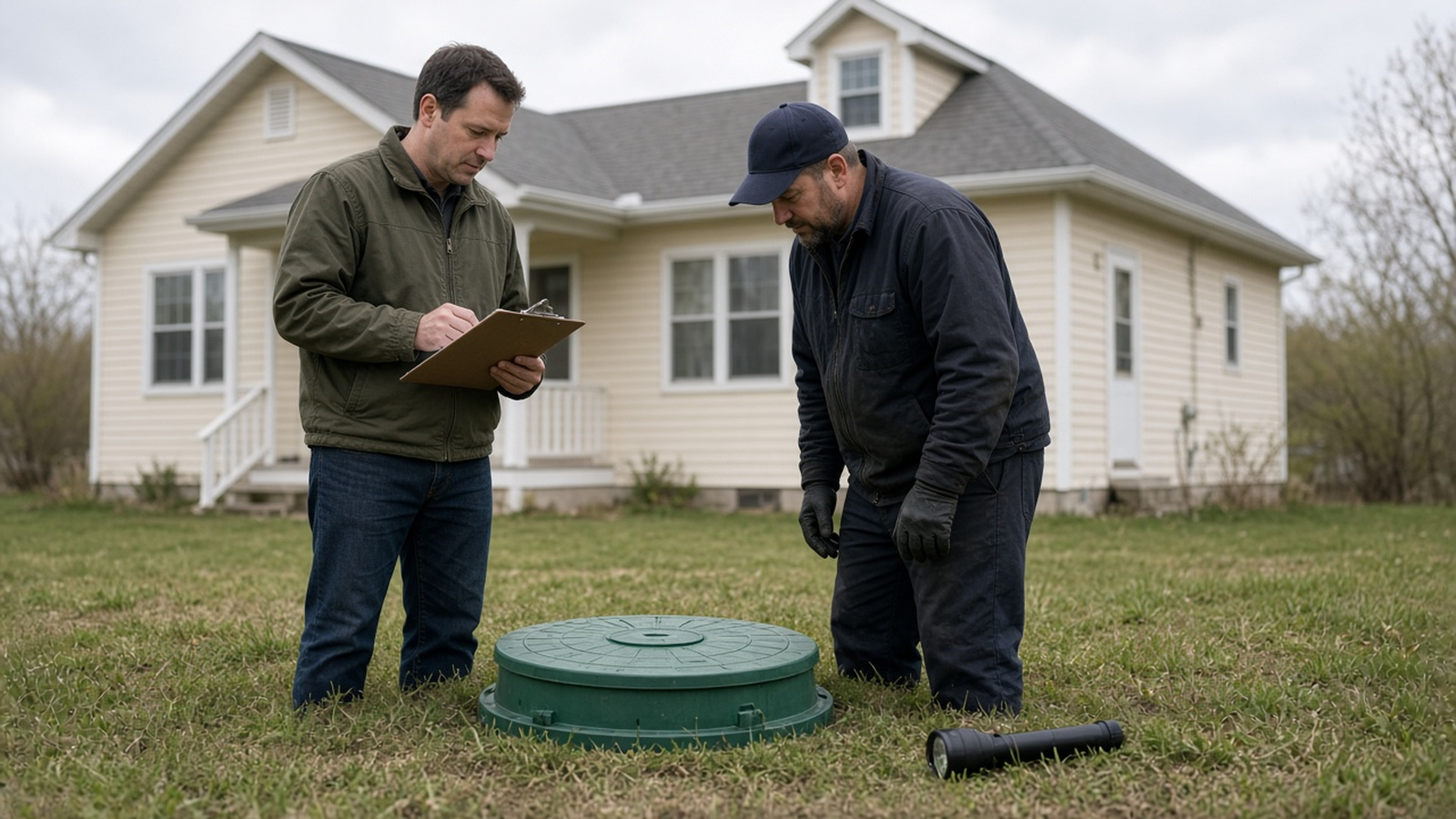
Written and reviewed by the Rehabfolio editorial team. Published and last reviewed October 28, 2026.
Who this guide is for. This guide is for United States residential investors buying a one-to-four-unit property they intend to renovate, then sell or hold. You might close in your own name or in an LLC, with cash or with a loan. The guide starts when the wastewater question is on the lot: a listing that says septic, a sewer scope that ends at a tank, a green lid in the grass, or a blank line in the inspection window. It ends when you have a written choice: proceed on the current repair budget, order an inspection that opens the tanks before you waive, add a pump line, add a drainfield or replacement allowance, change the purchase price, or walk. The full inspection window is the due diligence checklist. The pipe to a public main is the sewer scope guide. Those pages can name a septic system. This page is how you read the tank and the drainfield.
The Rehabfolio editorial team builds and reviews product workflows that connect a property record to documents, dates, photos, and the offer math. That is first-hand product experience with how a deal file is organized. It does not make the team a septic inspector, a soil evaluator, a pumper, or an attorney. We do not hold those licenses, and we do not invent them.
Red is the founder of Rehabfolio. He has bought and renovated houses for ten years, across more than 30 projects, and he keeps the city off this page on purpose. On those jobs a septic question has never been the same page as a sewer camera. The lid, the measurement, and the bid to repair the field are separate lines. The three files below are original teaching examples built in that shape. They are not records of a named customer, a named city, or a result the product promises.
Inspection forms, who may sign them, setbacks, and the number of days in your contract differ by state and county. EPA says it does not regulate single-family septic systems. A federal consumer page and a state health department can use the word septic for different duties. This page is educational. It is not a septic inspection, a soil test, a permit, or legal advice. It does not tell anyone where to dig. Use the report in your hand, the agreement you signed, and qualified local professionals for the house you are buying.
Tip: Read this beside the repair budget guide, the holding cost guide, the contingency guide, the permits guide, the maximum offer guide, and the free maximum offer calculator. A pump receipt and a failed field are not the same repair. Do not let one of them stand in for the other.
1. Decide what the septic file has to prove
A septic file has one job before you waive. It has to show how this house treats wastewater on this lot, from the tank through the soil, on a report that names what was opened and what was not. EPA's About Septic Systems page says these systems are underground wastewater treatment structures. The process typically begins with solids settling in the septic tank and ends with treatment in the soil through the drainfield. A lid in the grass is a clue. It is not that file.
The same page says more than one in five households in the United States depend on individual septic systems or small community cluster systems, usually where a public sewer does not serve the house. That sentence is why the question shows up on flips outside a city main. It is not a reason to skip the inspection because "a lot of houses have septic." EPA also lists other names you will see on older paperwork: decentralized system, onsite system, cluster system, package plant, on-lot system, individual sewage disposal system, and private sewage system. Write down the name the report uses. A cluster system shared with the house next door is not the same repair as a tank that serves only your lot.
You are not trying to prove the lawn looks fine. The treatment ends in the soil. A mowed field can still be ponding under the turf. EPA's frequent questions page says a typical inspection may excavate parts of the drainfield to look for ponding or groundwater. If nobody opened the ground, and the report does not say why, you have a surface look. Say so on the deal file before you price a replacement you have not seen, and before you call the system clear.
2. Keep a sewer scope from standing in for the tank
InterNACHI's Standards of Practice say the inspector is not required to inspect wastewater treatment systems, septic systems, or cesspools, and is not required to inspect drainfields or dry wells. The same section says the inspector is not required to inspect underground items or wells. A general home inspection that never uses the word septic has not failed a box it was required to open. It has stayed inside the standard. If you want the tank opened, you order that inspection on its own while the contract still lets you object. The home inspection report guide is where the rest of that boundary is written down.
A sewer scope is a different document again. It films a pipe. It can be useful on the line between the house and the tank, because a crushed run is a real repair. EPA's inspection list says a septic inspection may use a camera on solid pipes and leach lines for blockages or collapsed piping. "May" is not "already did." A scope header that says the camera stopped at a tank has identified the system. It has not measured sludge, opened a pump tank, or walked the field. Do not price a "lateral replacement to the city main" on a house that has no main. The sewer scope guide stays the page for the pipe. This page starts at the tank.
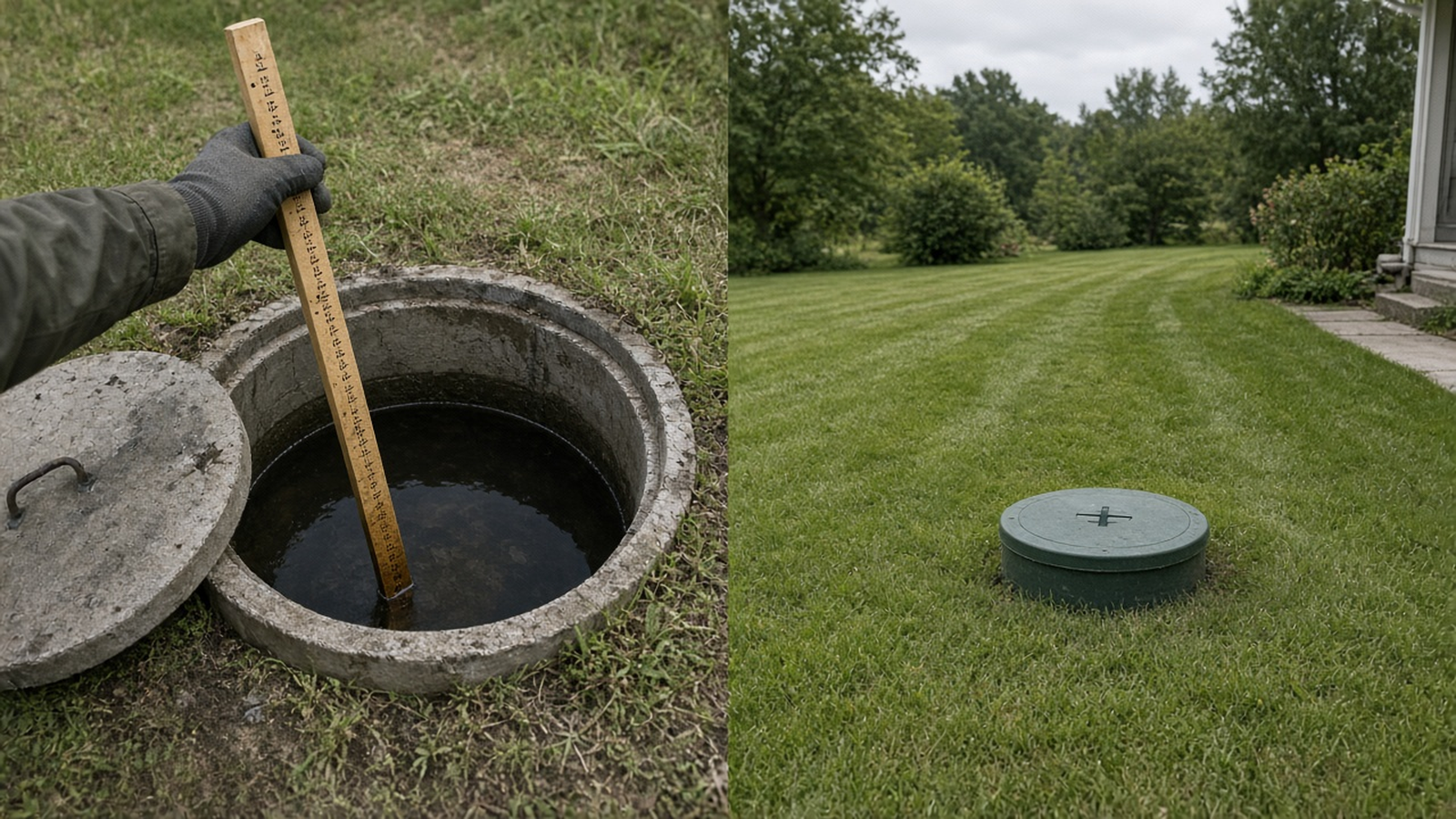
Nobody on the crew should climb into the tank to "take a look." InterNACHI's septic inspection notes say septic inspection is outside the scope of a general home inspection and, in many states, is a separately licensed job. The same page says a professional pumping service, not an inspector, should remove the solids, and that no one besides a licensed, equipped professional should enter a tank. It names methane as a gas that can cause rapid asphyxiation and death. A lid that looks easy to lift is not an invitation. Hire the person who is allowed to open it, and stay out of the hole.
3. Read what a typical inspection actually opens
EPA's frequent-questions page says that in many states a septic system must be inspected with the transfer of real estate, and that an owner should also have the system inspected every 1 to 3 years. Transfer rules are not the maintenance rhythm. A house can be inside a state that requires a transfer inspection and still have no maintenance record. The same page says very few permitting agencies conduct regular inspections after the system is installed, and that EPA does not regulate single-family systems. Local health departments usually issue the construction and operating permits under state law. Ask that office for the as-built and the permit before you treat a seller's memory as the map.
EPA says a typical inspection, in general, includes the items in the table below. Copy the list onto the deal file. Write "in the report," "missing," or "not applicable, and why" on each row. A missing row is a question for the inspector before the deadline. It is not a reason to average the rows you do have into a pass.
| What EPA says a typical inspection covers | What you write on the deal file | What it is not |
|---|---|---|
| Permit, design, and installation records, including age | The year, the permitted flow or bedroom count if the permit states one, and where the drawing lives | A listing remark that says "septic, newer" |
| Pumping and maintenance records | The last pump date, who pumped it, and whether sludge and scum were written down | A verbal "we pump it when it needs it" |
| All tanks opened: septic tank, pump tank, distribution box | Which lids were opened on this visit | A photo of one lid that stayed closed |
| Sludge and scum, and whether the tank needs pumping | The measurements, and the pump bid if the report says pump | A pump price with no measurements |
| Effluent filter, if one is installed | Present or absent, and whether it was cleaned | A guess because the kitchen has a disposal |
| Leaks, such as a low water line, and backup staining above the outlet | The sentence in the report, or "not mentioned" | A clear box you add yourself |
| Tank, inlet, and outlet condition, including corrosion | Concrete, metal, plastic, or unknown, and any crack the report names | "Tank is fine" with the lid still on |
| Pumps, controls, and wiring, when the system has them | Whether the alarm and the float were tested | A gravity-system assumption on a house with a pump tank |
| A camera, if the inspector used one | Which pipe was filmed, and where the camera stopped | A sewer scope of a different house |
| Drainfield: surfacing, unequal drainage, and any excavation | Dry, wet, or not walked, and whether anyone dug | A mowed lawn photographed from the porch |
| Distribution box: structure and equal flow | Opened or not found | A pass copied from the tank page |
The table is a reading aid. The sentences are EPA's, from the inspection answer on the frequent-questions page, shortened into rows. If your report uses a state form with different boxes, the state form wins for that transfer. Use this table to see what the federal consumer page told you to expect, then write down every box the state form adds.
4. Use the pump thresholds without calling them a pass
Two EPA pages describe pumping, and they do not use the same sentence. Read both before you argue with an inspector who used one of them. The care page says the average household system should be inspected at least every three years, and that household tanks are typically pumped every three to five years. Alternative systems with electrical float switches, pumps, or mechanical components should be inspected more often, generally once a year. The frequent-questions page says, in general, inspect every 1 to 3 years and pump every 3 to 5 years, and that the interval depends on tank size, how many people live there, water habits, and how many solids have accumulated. A flip that sat vacant is not "a household of four for five years." Use the measurement, not the calendar alone.
The care page gives the measurement. It says the tank has a T-shaped outlet that keeps sludge and scum from leaving the tank and entering the drainfield. Pump if the bottom of the scum layer is within six inches of the bottom of the outlet, if the top of the sludge layer is within 12 inches of the outlet, or if more than 25 percent of the liquid depth is sludge and scum. Write those three numbers down when the report includes them. If the report says only "pump recommended," ask for the measurements before you treat the recommendation as optional.
The frequent-questions page, in the answer about preventing failure, gives a different rule of thumb: pump when the solids are two-thirds of the volume in the tank. That is a coarser sentence than the six-inch, 12-inch, and 25 percent tests. Do not average them into a private standard. Ask the inspector which threshold the report used. Then price the pump from a written service bid. This page does not publish a national pump price. EPA does not publish one on the pages reviewed here.
A pump can still be the right next step and the wrong last step. The care page says the service provider should note repairs and tank condition, and that if other repairs are recommended you should hire a repair person soon. "Soon" on a flip is before you waive, if the contract still allows the objection. Solids that leave the tank can clog the field. The frequent-questions page says a tank full of solids may eventually clog the drainfield, and that replacing the field can be required if that happens. A pump bid does not include that field. Put the pump on its own line. Leave the field line blank or filled with a named allowance until a designer or the health department prices it.
5. Separate a vent odor from a failing field
EPA lists common signs of a failing system on the frequent-questions page. Use the list as a reading key, not as a diagnosis you make from the sidewalk.
- Water and sewage from toilets, drains, and sinks backing up into the house plumbing.
- Bathtubs, showers, and sinks draining very slowly.
- Gurgling sounds in the plumbing.
- Standing water or damp spots near the tank or the drainfield.
- Sewage odors around the tank or the drainfield.
- Bright green, spongy, lush grass over the tank or the drainfield, even in dry weather.
- A straight pipe discharging untreated wastewater onto the ground.
- Algae blooms in nearby ponds or lakes, which are a watershed clue, not a measurement of this tank.
- High nitrates or coliform bacteria in surface water or in a drinking-water well.
An odor is not automatically that list. The same page says a smell can come from a roof vent that equalizes pressure, and that a vent smell can be a normal part of the system. A vent can also be clogged with leaves, or blocked by ice, or affected by wind. EPA says it is not possible to diagnose the cause of an odor remotely, and it tells you to contact a local septic professional or a plumber. Soft, wet, or spongy soil over the drainfield, especially when it has not just rained, is the sentence EPA calls a good indication of failure. Write down the weather on the inspection day so a puddle from last night's storm is not filed as a failed field, and so a failed field is not filed as weather.
A failing system is also a health line, not only a resale line. EPA says untreated wastewater can carry pathogens, including E. coli, plus nutrients and other harmful substances, into groundwater or onto the ground. Surfacing wastewater is a direct hazard to anyone who touches it, including children and pets. The page says to contact a health professional if people have been exposed. Crews should not be sent to grade that spot, plant it, or cover it with mulch while you "see if it dries." Stop the work, keep people off the wet ground, and get the local health department and a septic professional on the file.
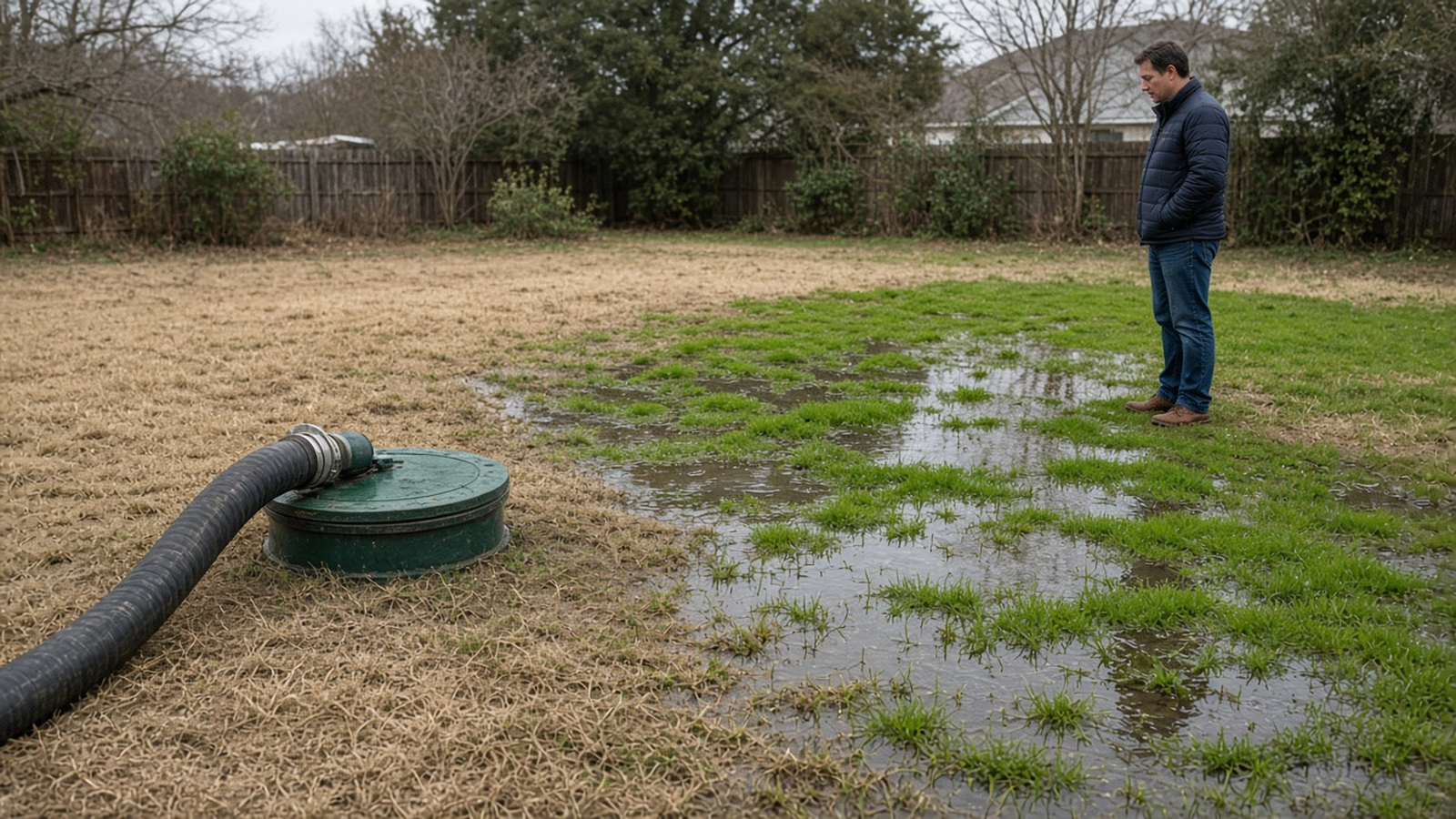
The photo is a teaching contrast, not a diagnosis. A hose means someone is prepared to pump. Standing water and a bright patch mean you still have to read the field. One visit can include both. The invoice for the pump does not retire the wet grass.
6. Treat transfer rules as local, then read one state example
EPA's regulation answer is the national boundary. Individual onsite systems are regulated by states, tribes, and local governments, not by EPA. Large-capacity septic systems can fall under the Safe Drinking Water Act underground-injection program. Systems that discharge to surface water can fall under the Clean Water Act permit program. Septage hauling falls under the sewage sludge rule in 40 CFR Part 503. A one-to-four-unit flip is usually in the first bucket, the one EPA says it does not regulate. The permit and the transfer inspection, if any, come from the health department. Call that office. Do not download another state's form and staple it to your contract.
Massachusetts is one worked example of a state that does require the inspection at sale, so you can see how specific the local rule can be. It is not the rule for the rest of the country. Mass.gov's buyer and seller guide says an inspection is required within two years before a sale. If weather prevents the inspection at the sale, it must be done within six months afterward, and the seller has to notify the buyer in writing. The purpose, on that page, is to determine whether the system in its current condition can protect public health and the environment. The inspection does not guarantee that the system will keep working, and the page flags that limit in particular if you plan to increase the flow.
The same page says only MassDEP-approved inspectors can do a Title 5 inspection, that the report has to be on the state form, and that the report is submitted within 30 days. For most systems the inspector sends it to the Board of Health, and the buyer must also receive a copy from the seller. A sale inspection is generally good for two years, or three years if the system is pumped annually and the pumping records are included. A new or upgraded system with a Certificate of Compliance is exempt from the transfer inspection for two years, and up to three if it was pumped at least once in the third year. Family transfers, a refinance, and some trust changes are on the exemption list. Read the exemptions on the page before you assume a prior deed transfer produced a report.
Conditional pass, on that Massachusetts page, is a narrow door. A metal or cracked tank, a broken or obstructed pipe, an uneven distribution box, or a malfunctioning pump chamber can qualify. Soil absorption systems and cesspools cannot be repaired under a conditional pass. A failed system must be upgraded within two years unless the Board of Health or MassDEP allows another schedule. If the owner decides not to sell after a failure, the page says the owner still has to repair it. That is a seller fact and a buyer fact. A credit that leaves a failed field in the ground does not match a rule that requires an upgrade.
Adding a bedroom is the flip fact on that page. A change of use or an increase in flow requires an inspection when the work needs a building permit or an occupancy permit. The example Mass.gov gives is adding a bedroom. Any change in the building footprint also requires an inspection so the new work is not built on a component or on the reserve area. Your state may not use those triggers. Ask the local health department whether the extra bedroom, the new bathroom, or the addition changes the permitted flow or lands on the field. The certificate of occupancy guide is the page for the paper the building department issues. It does not replace the health-department question about the tank.
7. Read the FHA sewage rule before you promise a buyer
Many flips are bought with cash or hard money and resold to a buyer who needs a loan. The purchase inspection and the resale loan are different gates. For an FHA-insured mortgage, the copy reviewed for this guide is HUD's Single Family Housing Policy Handbook 4000.1, the PDF file dated August 13, 2025, in the sewage section of property underwriting. The handbook PDF says the mortgagee must confirm a connection to a public or community sewage system whenever feasible and available at a reasonable cost. If that cost is not reasonable, existing onsite systems are acceptable provided they function properly and meet the local health department.
The next two sentences are the ones a passing inspection does not erase. If the onsite system is not sufficient and an off-site system is available, the mortgagee must confirm the connection. If the onsite system is not sufficient and an off-site system is not available, the mortgagee must reject the property unless the onsite system is repaired or replaced and then complies with local health department standards. "Reasonable cost" and "not sufficient" are the lender's determinations under that paragraph. The paragraph reviewed here does not publish a percentage of value. Do not invent one, and do not recycle an older bulletin that used a percent unless the handbook version in your file still says it.
If the property also has a well, the same handbook's existing construction table sets minimum distances between the well and sources of pollution. The rows reviewed here are 50 feet from a septic tank, 100 feet from a drain field, and 75 feet from a septic tank drain field if the local authority allows that reduction. The table says local distance requirements prevail if they are greater. Those numbers are well-to-system distances for an FHA file. They are not a universal setback for a house that has city water. Write "well" or "no well on this parcel" on the septic page so the 50-foot row is either measured or marked as not this deal. A neighbor's well is a question for the health department, not a distance you pace off from a fence and call compliant.
Grants are not a line in the offer. EPA's frequent-questions page describes the Clean Water State Revolving Fund as assistance that each state awards, and it says individual homeowners are not eligible to receive Nonpoint Source grants directly. It also describes USDA repair loans and grants with caps, on the copy reviewed for this guide, of $20,000 for the loan and $7,500 for the grant, aimed at eligible rural homeowners. A flip purchased for resale is not that program until an eligible owner and an award letter say it is. Price the repair from a bid. Do not price it from a grant you have not been awarded.
8. Work three named septic files
These three files are illustrative. The names, the bids, and the contract prices are teaching numbers, not quotes and not customer results. Each one uses the same screen the 70 percent guide explains: after-repair value times 0.70, minus repairs. Holding cost stays on its own line, the way the holding cost guide separates a daily carry from a contractor invoice. Run your own inputs in the maximum offer calculator or the flip analysis calculator. The screen is not an appraisal.
Illustrative scenario: Maya Chen. Maya is under contract at $158,000 on a vacant house. Her after-repair value, from closed sales she can explain, is $280,000. Her repair budget before anyone opens a tank is $42,000. The 70 percent screen is $280,000 times 0.70, which is $196,000, minus $42,000, which is a maximum offer of $154,000. The contract is already $4,000 over that screen. The general inspection does not open the septic tank. She orders a septic inspection. The report opens the tank. Sludge and scum are more than 25 percent of the liquid depth, which is one of the three pump triggers on EPA's care page. The drainfield is walked and described as dry, with no surfacing. The as-built is not in the file. The pumper bids $750. That bid is hers, for this example. It is not an EPA price.
She does not drop the $750 into a blanket contingency and waive. The care page treats a pump and "other repairs" as different notes. The missing as-built means she does not know whether a future field repair has a place to go. She writes her own $8,000 field allowance, labeled as her number until a designer or the health department replaces it, and she keeps it out of the "passed" column. New repairs are $42,000 plus $750 plus $8,000, which is $50,750. The new screen is $196,000 minus $50,750, which is $145,250. The contract is $12,750 above that ceiling. Her contingency, if she had been holding 10 percent of the original $42,000, would be $4,200. That reserve does not cover the new septic lines. Her decision is an objection: a price cut or a credit that actually funds the pump and the allowance, or she walks. A seller who will pay only the $750 has not closed the unknown field.
Illustrative scenario: Owen Blake. Owen is under contract at $225,000. After-repair value is $410,000. Repairs before the septic visit are $55,000. The screen is $410,000 times 0.70, which is $287,000, minus $55,000, which is $232,000. The contract sits $7,000 under that screen, which feels like room. The sewer camera stops at a tank. The septic inspection finds standing water and spongy, bright grass over the drainfield, two of the failure signs on EPA's list, plus staining in the tank above the outlet, which EPA lists as a backup clue. This is not a pump-only file. A designer's written allowance, his number for the example, is $28,000 to replace the field, and the health department tells him a permit is required before the work. He allows 21 days. His holding assumption is $85 a day. That rate is his, not a published index. Twenty-one days cost $1,785.
New repairs are $55,000 plus $28,000, which is $83,000. The new screen is $287,000 minus $83,000, which is $204,000. The contract is $21,000 over that screen. The 70 percent shortcut still has not subtracted the $1,785 of holding. A detailed ceiling that also subtracts those days is $202,215, and the gap to the contract is $22,785. The $7,000 cushion is gone. Owen's decision is an objection for a reduction of at least the $21,000 screen gap, with the holding days written beside it, or he walks. He does not hide $28,000 inside the old contingency, and he does not send a crew to rake the wet grass.
Illustrative scenario: Priya Shah. Priya is buying with cash at $198,000 and plans to resell. After-repair value is $360,000. Repairs are $48,000. The screen is $360,000 times 0.70, which is $252,000, minus $48,000, which is $204,000. The contract is $6,000 under the screen. The septic report opens the tanks, records sludge and scum under the care-page triggers, and describes a dry field. A pump receipt from two years ago is attached. There is no well on the parcel, so the FHA well-distance table is marked "not this water source" rather than skipped in silence. A contractor quotes $18,400 to connect the house to the public main at the street. That quote is her example number.
She does not add $18,400 to the rehab because a quote is not the handbook's trigger. The trigger is a mortgagee finding that connection is feasible at a reasonable cost, or that the onsite system is not sufficient. She does not have that finding. She files the passing inspection, asks the future buyer's lender in writing whether the onsite system is acceptable, and leaves the connection quote in the sale file as a conditional cost. If a lender later requires it, repairs become $66,400 and the screen falls to $185,600, which is $12,400 under her purchase price. That math is a reason to know the number now. It is not a reason to spend it, and it is not a reason to advertise the house as ready for an FHA buyer. Her decision is to proceed on the purchase, keep the quote named and unspent, and rerun the exit before she accepts a financed offer. The fix-and-flip workflow is where that purchase math and the resale math stay on one property. The deal analysis feature is the product page for the offer, not a septic certification.
9. Use a septic-file checklist without an account
You can do this on paper. You do not need an account to decide whether the report in your hand is complete enough to waive.
- Write the address, the inspection date, and the inspector's name and license or approval, if your state issues one.
- Name the system with the words on the report: tank and field, cesspool, mound, pump tank, cluster, or unknown.
- Attach the permit and the as-built, or write "requested, not received" and the date you asked the health department.
- List every lid the inspector opened, and every lid that was not found.
- Copy sludge depth, scum depth, liquid depth, and the distance from those layers to the outlet. If those numbers are missing, ask before you waive.
- Mark whether the report used the six-inch, 12-inch, or 25 percent test, the two-thirds rule of thumb, or a state form that names a different test.
- Put the pump bid on its own line. Leave it blank until you have the bid. Do not borrow a national price this guide does not contain.
- Write what the drainfield showed: dry, damp, standing water, lush spongy grass, or not walked. Note the weather that day.
- Note whether anyone excavated, camera'd a line, or opened the distribution box. "Not done" is an acceptable note. Silence is not.
- If a pump, alarm, or filter exists, note whether it was tested.
- If the rehab adds a bedroom, a bathroom, or a footprint, ask the health department whether the permitted flow or the reserve area changes. Write the answer.
- If a well is on the parcel, measure the tank and the field against the distances your lender and your health department actually require. If there is no well, write that.
- Convert the finding into a repair line and, if a permit adds days, a holding line. Rerun the maximum offer. Compare it with the contract.
- Circle one decision: proceed, object with a number, or walk. Date it. A blank circle is not a waiver you can explain later.

10. Keep the rehab from driving on the field
The inspection can pass and the renovation can still break the system. EPA's care page says not to park or drive on the drainfield. The frequent-questions page says most fields are not built for vehicles or heavy equipment, because the weight compacts soil and can damage pipes. Concrete and asphalt on top of a field cut off evaporation and oxygen. Do not build on the field without checking with the local designer or permitting authority. A dumpster, a skid steer, or a material pile parked on the green lid's lawn is a construction choice and a septic choice. Mark the field on the site plan before the first delivery. The scope of work guide is where an exclusion belongs: "no equipment on the drainfield shown on the as-built."
Water from the rehab counts too. The care page says all the water a household sends down its pipes ends up in the septic system, and that a single leaky or running toilet can add as much as 200 gallons a day. It also says indoor use in a typical single-family home can be as much as 70 gallons per person per day. A vacant flip with a running toilet is not a vacant system. Fix the leak before crews move in. The same page says doing all the laundry in one day can flood the field, and it tells you to keep roof drains, sump pumps, and other rainwater off the field because extra water slows or stops treatment. A new downspout aimed at the field, or a sump that used to dump in the street and now dumps in the yard, belongs in the scope. It is not a landscaping detail.
The new kitchen can change the pump schedule. The care page says to eliminate or limit a garbage disposal because fats, grease, and solids can clog the field. The frequent-questions page says a disposal can mean more frequent pumping. If the rehab adds a disposal the old house did not have, write a shorter pump interval into the resale notes. Do not claim the old three-to-five-year habit still fits. Toilets, on that care page, are not trash cans. An easy rule of thumb there is to flush only human waste and toilet paper. Crews washing paint, wipes, and joint compound down the fixture are using the tank as a dumpster. Say so in the job rules.
If you later connect the house to a public sewer, the old tank does not vanish because the meter does. EPA says a property owner may be required to remove an abandoned tank or field, and that other places allow abandonment in place. Contact the local permitting authority before you fill the tank with debris and call it closed. Utility transfers for a house on a public main are covered in the utility transfer guide. A septic system is not a meter you move into the owner's name.
Keep the paper on the property record: the report, the as-built, the measurements, the pump receipt, the health-department email, the bid, the objection, and the decision. A workspace can hold those next to the offer. It cannot inspect the tank or decide the waiver. The rehab cost calculator and the holding cost calculator are the public places to separate the pump, the field allowance, and the extra days before you create an account. If a summary drafted from the photos says the yard is fine and the report shows surfacing, the report wins.
11. Avoid the waivers that happen from a pump receipt
- Waiving because the general inspection never said septic. InterNACHI does not require the inspector to open the tank, the field, or a cesspool. Silence is not a measurement.
- Pricing a city lateral on a house that ends at a tank. A scope that stops at the tank has named a different system. The sewer page does not price the field.
- Treating a pump receipt as a pass. Pumping is maintenance. Surfacing, backup staining, and a clogged field are separate findings. Maya's $750 does not buy Owen's field.
- Mixing the two EPA pump sentences into one private rule. Six inches, 12 inches, and 25 percent of liquid depth are the care-page tests. Two-thirds of the volume is the other page's rule of thumb. Ask which one the report used.
- Using another state's form. Massachusetts Title 5 is a real transfer rule, with a two-year window and a conditional pass that does not cover a failed soil absorption system. Your county may not have that form. Call the health department.
- Calling a clear field an FHA approval. The handbook accepts a functioning onsite system that meets the local health department when a public connection is not reasonable. The lender still decides sufficiency and cost. Priya's $18,400 quote stays unspent until that decision is written.
- Parking the dumpster on the field. EPA says vehicles and heavy equipment compact the soil and can break pipes. Mark the field before delivery day.
- Ignoring a running toilet in a vacant house. The care page says one running toilet can add as much as 200 gallons a day, and that all of that water reaches the system.
- Adding a bedroom without asking about flow. In Massachusetts, a bedroom that needs a building or occupancy permit triggers an inspection, and a footprint change has to stay off the field and the reserve area. Ask your own health department the same question even when the form is different.
- Putting a grant you do not have into the offer. EPA's homeowner programs are not a flipper's signed check. Price the bid you can attach.
- Sending someone into the tank. InterNACHI's septic notes say a licensed, equipped professional is the person who enters, because the gases can kill. The crew does not "just look."
- Letting a draft summary overrule the report. If the summary says the yard is fine and the report shows standing water, the report wins. You still send the objection yourself.
Frequently asked questions
Is a septic inspection the same as a sewer scope?
No. A sewer scope films a pipe. EPA's description of a typical septic inspection opens the tanks, reads sludge and scum, checks pumps and the effluent filter when one is installed, and looks at the drainfield for surfacing or unequal drainage. A camera may be part of that work. A camera that stops at a tank has not finished the list. The sewer scope guide is the page for a pipe headed to a public main. This page starts when the system treats wastewater on the lot.
Does a pumped tank mean the septic system passed?
No. EPA says a service visit examines scum and sludge and decides whether the tank should be pumped. Pumping removes solids. It does not, by itself, tell you the drainfield is accepting water. Standing water, sewage odors, or spongy lush grass over the field are separate signs of failure on EPA's list. A receipt that says the tank was pumped is a maintenance record. It is not a pass unless the report you have actually evaluated the field.
What should a house flip septic inspection include?
EPA's frequent-questions page says a typical inspection reviews the permit, design, and installation records, reviews pumping and maintenance records, opens all tanks, evaluates sludge and scum, checks the effluent filter if one is installed, looks for leaks and backup staining, checks tank and pipe integrity, verifies electrical parts on systems that have them, may camera solid pipes and leach lines, evaluates the drainfield, may excavate part of the field, checks the distribution box, and reviews water-use and compliance records. If a line on that list is blank, ask for it before you waive. A blank is not a clearance.
Do I have to inspect the septic system before I buy a flip?
There is no single federal form for every house. EPA says it does not regulate single-family septic systems, that local health departments usually permit them, and that in many states a system must be inspected when real estate transfers. Your contract and your state decide the deadline. Massachusetts Title 5, as one example on Mass.gov, generally wants an inspection within two years before a sale, with a weather delay of up to six months if the seller notifies the buyer in writing. Another state can require something else, or nothing, at transfer. Order the inspection while you can still object, and do not treat another state's form as yours.
What if the resale buyer is using an FHA loan?
HUD's Single Family Housing Policy Handbook 4000.1, in the sewage section reviewed from the August 13, 2025 PDF, tells the mortgagee to confirm a connection to a public or community sewer whenever that connection is feasible and available at a reasonable cost. An existing onsite system is acceptable when connection is not reasonable, the system is functioning properly, and it meets the local health department. If the onsite system is not sufficient and a public system is available, the mortgagee must confirm the connection. If it is not sufficient and no off-site system is available, the mortgagee must reject the property unless the system is repaired or replaced to local health standards. A passing inspection is evidence. It is not the lender's feasibility decision. The handbook does not print a percentage for reasonable cost in that paragraph.
Can software decide that a septic system is acceptable?
Software can store the report, the as-built, the sludge and scum measurements, the drainfield notes, the pump receipt, the health-department letter, the repair bid, and the objection date next to the offer. It cannot open the tank, measure the layers, certify an inspector, or decide that a dry lawn means the field will accept a new bathroom. If a draft summary and the report disagree, the report wins. You still compare the new repair number with the contract deadline and send the objection yourself.
Editorial methodology, limitations, and sources
The Rehabfolio editorial team wrote this as the septic page the sewer scope guide points toward and did not yet have. The due diligence checklist names septic as a specialist follow-up. It does not teach the tank measurement or the drainfield signs. This article does not replace the sewer scope guide, the home inspection guide, the due diligence checklist, the repair budget, the holding cost guide, the contingency guide, the permits guide, the certificate of occupancy guide, the scope of work, the utility transfer guide, or the maximum-offer guide. Those pages remain the homes for the building sewer, the general report, the inspection window, quantities, daily carry, the reserve, the city process, the occupancy paper, bid-ready lines, meters, and the offer formula.
The description of septic systems as underground treatment that starts in the tank and ends in the drainfield, the "more than one in five households" figure, and the alternate names (decentralized, onsite, cluster, package plant, on-lot, individual sewage disposal, private sewage) are from EPA's About Septic Systems page, reviewed October 28, 2026. EPA revises these pages. Read them again before you treat a sentence here as today's wording.
The statement that EPA does not regulate single-family systems, that local health departments usually permit them, that in many states a transfer requires an inspection, the 1-to-3-year inspection rhythm, the list of what a typical inspection opens, the failure signs, the vent-odor explanation, the pathogen note naming E. coli, the two-thirds solids rule of thumb, the warning against driving or building on a drainfield, the abandonment note, and the financing programs including the $20,000 USDA loan cap and the $7,500 grant cap as printed there, are from EPA's Frequent Questions on Septic Systems page, reviewed October 28, 2026. The three-year inspection minimum, the three-to-five-year pump interval, the once-a-year note for systems with floats or pumps, the six-inch scum test, the 12-inch sludge test, the 25 percent liquid-depth test, the 70 gallon indoor-use figure, the 200 gallon running-toilet figure, the laundry and downspout warnings, and the garbage-disposal warning are from EPA's How to Care for Your Septic System page, reviewed October 28, 2026.
The home-inspection boundary is InterNACHI's Standards of Practice, exterior section, the items that say the inspector is not required to inspect septic systems, cesspools, drainfields, dry wells, underground items, or wells, on nachi.org/sop.htm, reviewed October 28, 2026. The warning not to enter a tank, the note that a pumping service removes solids, and the statement that septic inspection is outside a general home inspection are from InterNACHI's septic system inspection page, reviewed the same day. InterNACHI is a home-inspector association. It is not a health department, and its standard does not bind an inspector who was hired under a different standard. Read the agreement on your report.
The Massachusetts timing, the weather delay, the purpose and the "no guarantee" sentence, the approved-inspector rule, the 30-day report, the two-year and three-year validity, the Certificate of Compliance exemption, the conditional-pass examples, the two-year upgrade, and the bedroom and footprint triggers are from Mass.gov, reviewed October 28, 2026. They apply in Massachusetts. They are included so a national page does not pretend every state uses one form.
The FHA connection rule, the "reasonable cost" and "not sufficient" sentences, and the existing-construction well distances of 50 feet to a septic tank, 100 feet to a drain field, and 75 feet where the local authority allows the reduction, are from HUD Handbook 4000.1 as read in the August 13, 2025 PDF. HUD revises the handbook. Confirm the version your lender is using before you treat a distance or a sewage paragraph as current. This page did not find a percentage-of-value test in the sewage paragraph of that PDF, so it does not state one.
The offer arithmetic is the 70 percent screen named above, plus a holding line when the example includes days. Maya's, Owen's, and Priya's prices are computed from the inputs in the scenario section. The pump bid, the field allowances, the daily rate, and the sewer-connection quote are illustrations. They are not quotes, indexes, or results from a Rehabfolio account.
Public pages cannot tell you whether to waive, what a pumper or a field installer in your county will charge, which license applies, or how a transfer statute reads this year. Examples are original composites created for teaching. Names, prices, bids, and outcomes are illustrative. They are not case studies of real customers.
Editorial standard. We identify the audience, the author, the review date, the topic boundary, the assumptions, and the product limit. We do not invent credentials, licenses, testimonials, market statistics, or guaranteed results. AI may help organize research and draft, and a person reviews the claims, the links, and the examples before publication. We revise the guide when a cited public page or a material product workflow changes. See the editorial methodology on the company page.
Keep the septic report, the deadline, and the repair lines together.
Use a workspace for the report, the objection date, and the pump or field price. You still hire the inspector, and you still send the objection, yourself.
Create free accountRun the free ARV calculator if you want the ceiling in the browser before you create an account.