How to read a house flip sewer scope before you waive
A plumber can text "roots, we can jet it" and still leave a collapsed joint, a shared line, or half the lateral off camera. This guide shows how to name the pipe that was filmed, separate structural defects from maintenance, and put a real number on the offer before the inspection deadline.
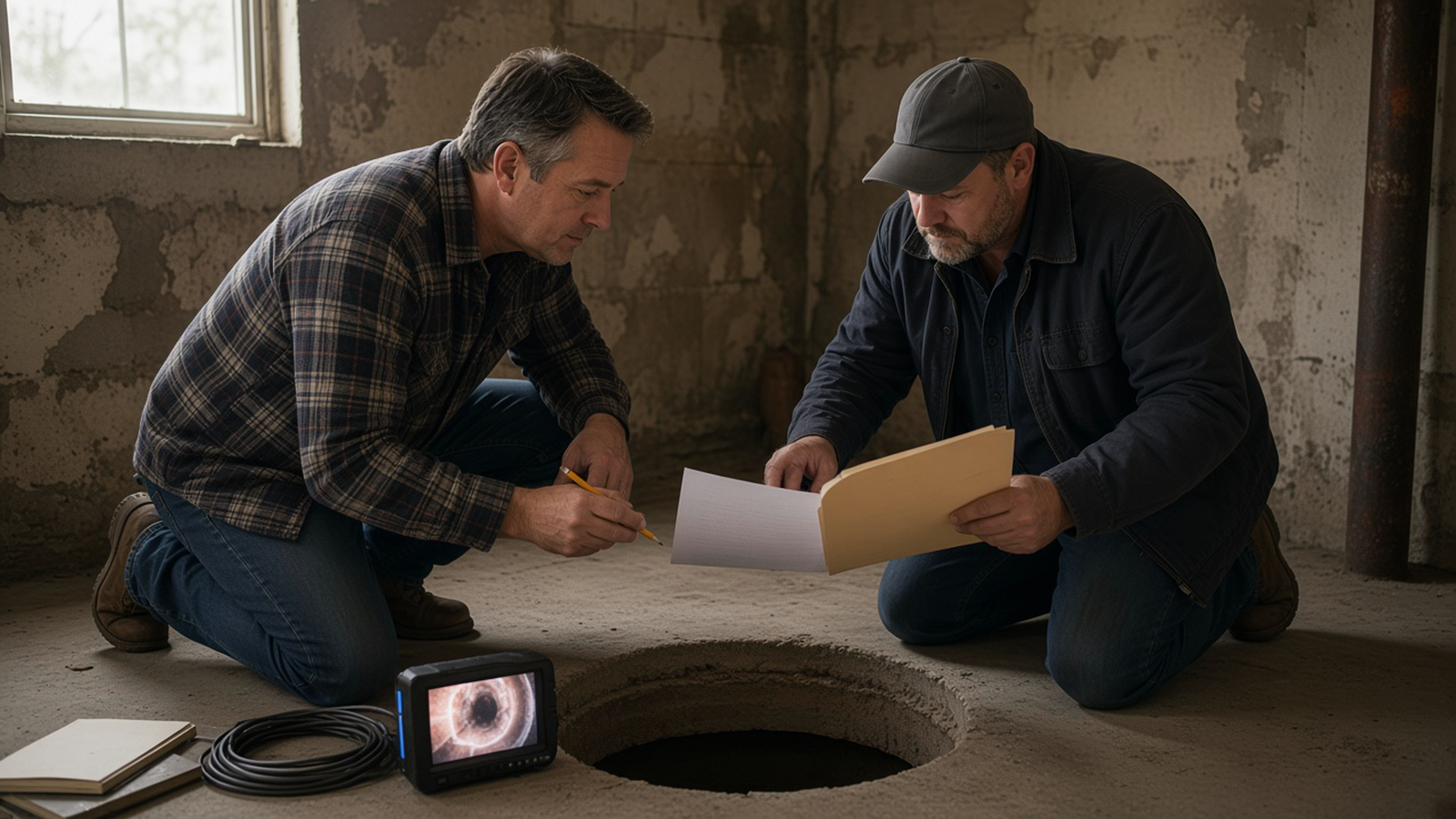
Written and reviewed by the Rehabfolio editorial team. Published and last reviewed October 21, 2026.
Who this guide is for. This guide is for United States residential investors buying a one-to-four-unit property they intend to renovate, then sell or hold. You might close in your own name or in an LLC, with cash or with a loan. The guide starts when a sewer-camera file arrives: video, stills, a written header, or a one-page summary. It ends when you have a written choice: proceed on the current repair budget, add a priced line, keep a named allowance for pipe nobody saw, change the purchase price, or walk. The full inspection window is the due diligence checklist. The general home inspection, which does not include this camera, is the home inspection report guide. The offer math that uses the new repair number is the maximum offer guide. Those pages can name a sewer scope. This page is how you read the video those checklists point at.
The Rehabfolio editorial team builds and reviews product workflows that connect a property record to documents, dates, photos, and the offer math. That is first-hand product experience with how a deal file is organized. It does not make the team a plumber, a pipeline-assessment trainer, an engineer, or an attorney. We do not hold PACP certifications, plumbing licenses, or local right-of-way permits, and we do not invent them.
Camera reports, lateral ownership, plumbing permits, and the number of days in your contract differ by city. A model plumbing code and a city ordinance can use the same words for different pipes. This page is educational. It is not a sewer inspection, a coding certificate, or legal advice. Use the video in your hand, the agreement you signed, the local utility, and a licensed plumber for the house you are buying.
Tip: Read this beside the repair budget guide, the scope of work guide, the contingency guide, the permits guide, and the free maximum offer calculator. A jetting quote is a maintenance price. A replacement bid is a different line. Do not paste one into the other and call them the same scope.
1. Decide what the video has to prove
Beginners treat the scope as a pass-fail sticker. A short text that says the line was jetted feels like a pass. A long defect log feels like a failed house. The camera has a narrower job. It records the inside of a pipe the operator could reach, on a stated date, from a stated access point, for a stated distance. Your job is to decide whether that record is complete enough to leave the repair budget alone.
Before you waive, you should be able to prove five things in writing.
- Which pipe was filmed, from which access, in which direction, and for how many feet.
- What material and size the operator reported, and where the description changes.
- Which observations are structural defects, which are maintenance, and which are only a recommendation.
- Where the camera stopped, if it stopped, and what length still has no picture.
- The repair number you will use, from a bid or a named allowance, and the offer math after that number.
If any line is blank, the scope is unfinished. Unfinished is a status you can manage. Calling it a pass is how a lateral becomes a surprise after the earnest money is harder to recover. The earnest money guide is the home for how a contingency protects the deposit. This page is the home for the evidence you need before you release that contingency.
A flip adds two questions a retail buyer sometimes skips. First, will the renovation add bathrooms, a laundry, or a kitchen load the existing pipe has to carry? A line that drains today's fixtures can still be the wrong line for the finished house. Second, will the repair require a plumbing permit, a street opening, or both? Those days belong in holding cost. The holding-cost guide is where extra days get a daily price. Leave them out of the plumber's bid so you can see them.
2. Name the pipe on the camera
Reports use lateral, house lateral, service lateral, building sewer, and side sewer for pipes that may or may not be the same physical tube. Start with a public definition, then ask the local utility which portion of that tube this purchase has to pay for.
The Wisconsin Department of Natural Resources brochure PUB-WT-848-2006 says a building sewer is the pipe that connects a building's plumbing system to the main sanitary sewer. The same brochure says building sewers are also called service laterals, house laterals, or sewer laterals. The main, in that description, is usually in the street and carries sewage to the treatment plant. That is a readable map. It is not a bill.
The 2015 International Plumbing Code, chapter 2, uses a tighter pair of terms. The building sewer is the part of the drainage system that extends from the end of the building drain and conveys the discharge to a public sewer, a private sewer, an individual sewage disposal system, or another point of disposal. Read the edition your city adopted before you treat the 2015 sentence as the local code. The useful point for a flip is the end of the sentence: the pipe on camera might be heading for a public main, a shared private main, or a septic tank. Those three endings produce three different repair plans. A scope header that says "to the city" and a header that says "to the tank" are different files.
Ownership is local, and two official pages already disagree with each other. Wisconsin's brochure says property owners are usually responsible for maintaining and repairing building sewers, that a municipality sometimes pays for all or part of the work, and that you should call the wastewater utility to verify local requirements. The utility may also want to inspect before a repair so it can see whether the problem is in the public main. Portland's city code, section 17.32.020, defines the building sewer as the portion of the horizontal piping that receives the building drains and extends to a public sewer, private sewer, or other approved discharge, and is located on private property. Under that definition the private-property portion is the named building sewer. The pipe under the street may be someone else's asset, with its own rules.
Write one sentence on the deal file before you price anything: "From the cleanout to the property line is ours to verify. From the property line to the main, we called the utility on this date and they said ____." If the second blank is empty, the bid you have is a partial bid. Partial bids can still be useful. They cannot close the objection by themselves.
A septic ending changes the page you are on. The camera may still be worth watching, because a crushed line between the house and the tank is a real repair. The tank, the drain field, and the health-department rules are a different inspection. Do not price a "lateral replacement to the main" on a house that has no main. Say which system the header names, and get the local private-disposal rules in writing before you waive.
3. Read the header before the defect list
The defect list is the dramatic page. The header is the page that tells you whether the dramatic page describes your pipe. Read the header out loud and copy six fields. If a field is missing, ask for it before the deadline. Guessing a missing field is how two houses get mixed up in the same file.
- Address and date. Match the house number, the unit, and the day. A scope from a previous listing is background. It is not today's pipe unless the operator filmed this purchase.
- Access point. Basement cleanout, yard cleanout, roof vent, or a pull from the public main are different entries. The Wisconsin brochure describes a cleanout as an access for cleaning or repair, often a small pipe about 4 inches across, inside the building or just outside the wall, with a cap. If the report does not name the access, you do not know which direction the footage runs.
- Direction and distance. "From the basement cleanout toward the street, 62 feet" can be checked against a tape on the site. "Entire line" cannot. Write the counter reading at the start and at the stop.
- Material and size. Clay, cast iron, plastic, and a flattened fiber pipe fail in different ways and bid at different prices. If the material changes at a stated footage, split the line into two segments. A single adjective for the whole run hides the segment you would actually replace.
- Who filmed it, and to what standard. Some operators code the run with NASSCO's Pipeline Assessment Certification Program or its lateral companion, LACP. Many residential plumbers deliver a narrative and a video with no code family at all. Both can be useful. A narrative without locations is the weak file. A code without video is also a weak file. Ask which one you hold.
- What the camera did not enter. Branch lines, a second cleanout, storm leaders, and the public main are easy to assume. Write "not filmed" next to each one the header omits.
NASSCO's PACP training syllabus describes an inspection form with a header section and a details section, and it says the purpose of the certification is consistent coding. You do not need the certificate to demand the header fields. You need them so a later bid refers to the same pipe the camera saw. If the operator offers a cloud link that expires in ten days, download the video into the deal file the same day. A waiver decision you cannot replay is a memory, not a record.
4. Separate structure from maintenance
Sort every observation into two stacks before you talk about price. Structural defects are about the pipe wall and the joints: cracks, fractures, broken pipe, holes, deformation, collapse, separated joints. Maintenance defects are about what is in the pipe or entering it: grease, scale, roots, debris, infiltration at a joint that is otherwise intact. A third pile is allowed: "recommendation only," which means a sentence with no observation you can point to on the video.

NASSCO publishes the same split for coded inspections. Its condition grading page says PACP reports structural ratings and operational and maintenance ratings separately, plus an overall rating. Structural defects are the ones tied to the pipe's integrity and to capital repair. High structural grades, NASSCO says, typically require an engineering assessment and drive more urgent rehabilitation or replacement. Operation and maintenance defects trigger cleaning, root removal, and infiltration control. NASSCO also says structural failures take precedence when a section shows both. That last sentence is the one flippers skip. A root mass sitting on a broken joint is not a jetting job with a structural footnote. The broken joint sets the stack.
Grades run from 1 to 5. The City of Santa Barbara's drainage master plan appendix quotes the PACP handbook, version 7.0.2, page C-1: grade 5 is the most significant defect grade, 4 is significant, 3 is moderate, 2 is minor to moderate, and 1 is minor. The same page says grades reflect the significance of the defect, the extent of damage, the restriction of flow, or wall loss. It then warns that the grading system alone is inadequate for deciding whether a segment should be rehabilitated or replaced, and that a grade 4 or grade 5 does not by itself mean immediate rehabilitation. PACP, that handbook passage says, does not replace the judgment of professional engineers.
The count matters as much as the grade. NASSCO's grading article uses a direct example: one hole and five holes can share the same hole structural grade, which that article states as grade 4, while the pipe with five holes is in worse condition because the defect occurs more often. Ratings are built from severity and from how many times that severity appears. The article also warns that a pipe rating, which adds those occurrences up, can mislead. Nine grade 5 defects and forty-five grade 1 defects can produce the same pipe rating of 45. The pipe rating index, an average severity on the 1-to-5 scale, is the figure NASSCO says asset owners prefer for a quick comparison. The quick rating is described there as an alphanumeric four-digit code aimed at the worst case in the pipe, including how often that peak grade occurs.
You can use that without becoming a coder. When the report is coded, write down three numbers and ignore the rest until a plumber or an engineer translates them: the worst structural grade, how many times that grade appears, and whether the same footage also carries an operation and maintenance grade. When the report is not coded, do the translation yourself in plain words at each footage mark: "broken clay at 28 feet" goes on the structure stack, "grease from 10 to 16 feet" goes on the maintenance stack, and "recommend replacement" with no footage mark goes in the recommendation pile until the video shows why.
LACP, NASSCO's lateral program, exists because private laterals are pipes too. The PACP syllabus says LACP uses the same observation and defect codes as mainline pipe, with a different treatment of taps, because a tap on a lateral is an access point rather than a connection to code the way a mainline tap is coded. A residential scope that never mentions LACP can still be a competent video. The syllabus is a reason to expect structural codes and maintenance codes on a lateral. It is not a reason to reject a clear video that uses sentences instead of letter codes.
Roots deserve a second look before they land entirely on the maintenance stack. A root mass in an otherwise round plastic pipe is often a cleaning item, plus a question about how the roots entered. Roots in a separated clay joint are evidence of the joint, and the joint is structural. The Wisconsin brochure tells owners not to plant trees or large shrubs where roots can enter the building sewer. On a flip, the landscaping plan and the pipe plan belong on the same page. Cutting roots the week before listing, then selling the house over the same opening, hands the next owner the defect you filmed.
5. Treat a stopped camera as an open length
The most expensive sentence in a scope is often a short one: "Unable to pass at 28 feet." Everything before that mark can be described. Everything after it has no grade, no material note, and no count of defects. NASSCO's ratings are built from defects that were observed. An unfilmed length was not observed. Leaving it off the repair budget treats the unseen pipe as perfect. That is the opposite of what the rating system is for.
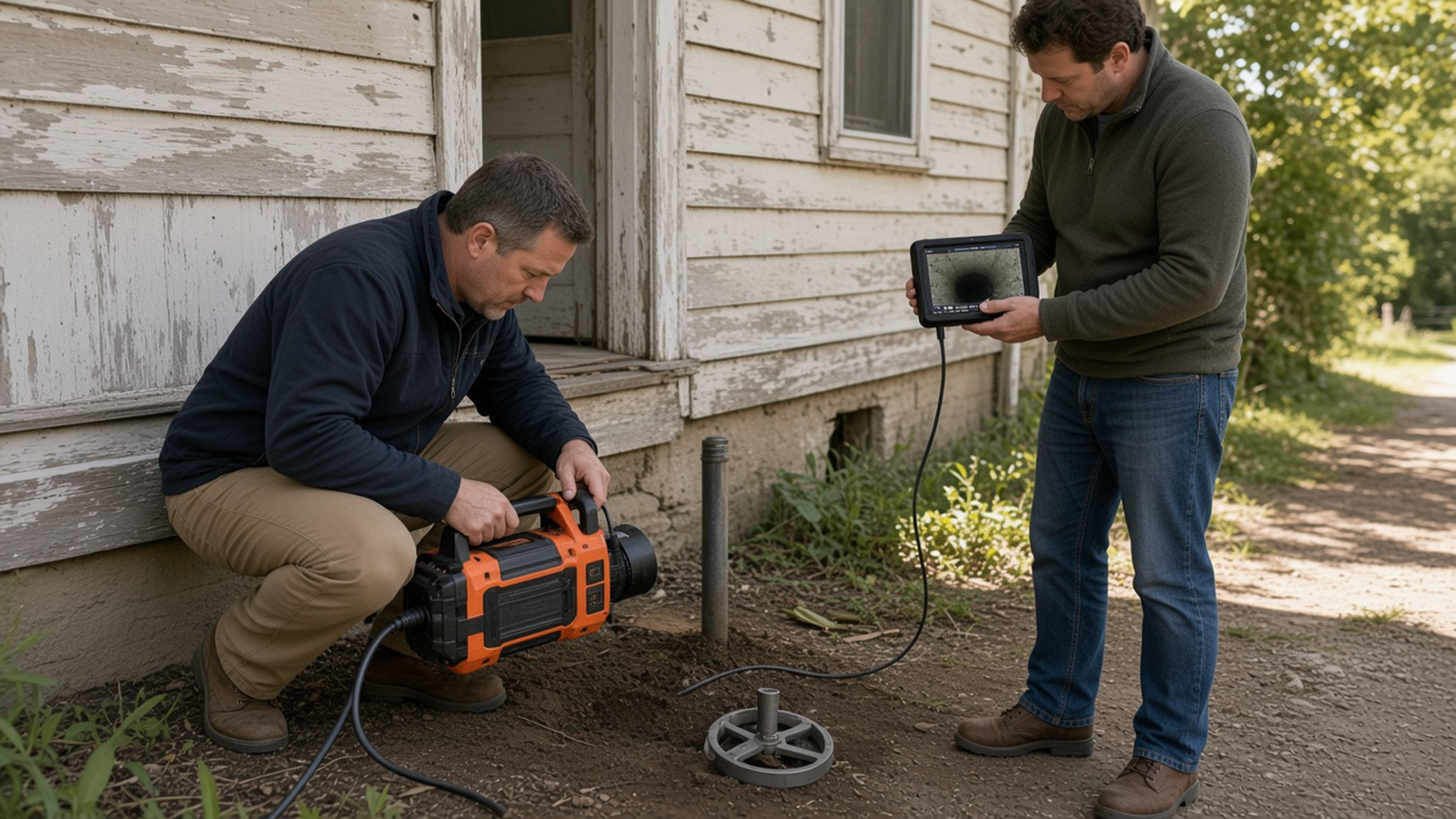
Write three distances. The distance filmed. The distance you expected, from a site tape or from the utility's sketch of the connection. The gap between them. The gap is the open length. If the operator can enter from the other end, at the city cleanout or from a mainline launch, that second pass can close the gap. If the deadline will pass first, the open length needs a named allowance or a price cut that assumes the worse repair you are willing to accept. A round percentage on the whole rehab budget is a different tool. The contingency guide keeps a reserve for unnamed uncertainty. A known gap in a sewer video is named. Give it its own line.
Also write why the camera stopped. A collapse, a heavy offset, a root ball the jet could not clear, and a full pipe of standing water are different next steps. Standing water can hide the invert. The operator may need to dewater and return. That return visit has to fit inside the objection period. If it does not, your choice is an allowance, a price change, or a walk. Hoping the hidden invert is smooth is not one of the three.
Shared pipes show up the same way. The camera leaves your building, then the picture includes a second building's flow, or the header says "tied into the neighbor." The first question is legal access, not jetting. The title commitment guide is where you look for an easement that lets you repair a pipe you do not solely own. The property survey guide is where you check whether the line you just filmed even sits on the parcel you are buying. A $700 jet on a shared line without an easement does not make the line yours.
6. Turn one finding into one budget line
A defect becomes a budget line only after you translate it. Copy this row for each item on the structure stack, and for each open length. Maintenance items get a row too when you will actually pay for cleaning, root treatment, or a return camera. Leave the price blank until a bid or a written allowance exists. An empty price is more honest than a round number you cannot explain.
| Field | What to write | Example, a stopped clay run |
|---|---|---|
| Access and direction | Where the camera entered and which way it traveled | Yard cleanout, toward the street |
| Footage filmed | Counter reading, and the expected length if you have one | 28 feet filmed. Utility sketch shows about 54 feet to the main |
| What was observed | Material, size, and the defect in the operator's words | 4-inch clay. Broken pipe and an offset at 28 feet |
| Stack | Structure, maintenance, or recommendation only | Structure. Roots are in the break. The break sets the stack |
| Open length | Feet with no picture, and why | About 26 feet past the break. Camera could not pass |
| Who pays | What the utility said, with the date | Called the utility. Private side is the owner. Street side not confirmed |
| Number you will use | A written bid, plus a separate allowance for the open length | $18,400 bid to the property line. $8,000 allowance beyond it, labeled as an assumption |
| Permit and days | Plumbing permit, street opening, and extra hold | Both permits in that city. Add the days to holding cost. Keep them out of the bid |
The repair budget guide is the home for quantities, labor, and allowances. The scope of work guide is the home for a line a contractor can bid: length, material, depth, surface restoration, and what is excluded. This page only gets the camera sentence onto that line. The operator's recommendation is not the bid. NASSCO's grades are not a price. The price comes from the plumber who will pull the permit, and from the utility's answer about the public portion.
Then rerun the offer. Rehabfolio's maximum offer calculator uses this detailed ceiling:
Detailed maximum offer = (after-repair value - repairs - financing - holding - selling costs - target profit) / (1 + buying-cost rate).
Selling costs in that calculator are a percent of after-repair value. Buying costs are a percent of the price you solve for, which is why the formula divides instead of subtracting a guessed closing figure at the end. In the examples below, selling costs are 8 percent of after-repair value and buying costs are 2 percent. Those rates are the examples' assumptions, matching the calculator's published inputs, not a survey of closing costs. Dollar figures are rounded to the nearest dollar where the division does not land evenly.
The 70 percent screen is a different number: after-repair value times 0.70, minus repairs. The 70 percent guide treats that screen as a quick filter. When the scope changes repairs, change both numbers, and write down which one is your walk-away. The cost breakdown guide is the home for the full stack this camera is about to edit.
One arithmetic point saves a bad negotiation. If you already have a contract price, profit at that price uses buying costs as a percent of that contract. The detailed ceiling solves for a different price, so buying costs shrink if the price drops. The dollar gap between the contract and the new ceiling is the price cut that restores the target profit. It is a bit smaller than the raw profit shortfall, because the buying-cost dollars move with the price. The examples show both figures so you can see they are the same decision.
7. Work three named scope files
These three buyers are original composites for teaching. The names, streets, bids, and outcomes are illustrative. They are not customer stories, not local price surveys, and not bids you should reuse. Each one uses the same calculator formula so you can see the scope move the ceiling by itself.
Nora Pell keeps a cleaning on the maintenance stack
Nora is under contract at $230,000 for 14 Cedar Lane. Her after-repair value is $380,000. Selling costs at 8 percent are $30,400. The repair budget before the scope is $55,000. Financing is $9,000. Holding is $7,000. Her target profit is $40,000. Buying costs at 2 percent of the contract are $4,600.
The detailed ceiling before the camera is ($380,000 - $55,000 - $9,000 - $7,000 - $30,400 - $40,000) / 1.02, which is $238,600 / 1.02, or $233,922. The contract sits $3,922 under that ceiling. Projected profit at the contract is $380,000 - $336,000 = $44,000, which is $4,000 over her target. The 70 percent screen is $266,000 - $55,000 = $211,000. The contract is already above that screen. She is in the common flip position: the quick rule would have said no, and the full stack still says yes, with a thin cushion. The scope is what can spend the cushion.
The camera runs 61 feet from the basement cleanout to a visible city connection. The pipe is plastic, round, and continuous. Grease and fine roots show in the middle third. There is no break, no offset, and no stop. The operator's code, where used, is operation and maintenance, not structural. A plumber bids $650 to jet and camera again, and Nora writes her own $400 allowance for a root treatment if the second camera still shows entry at a joint. Both numbers are teaching assumptions, not a price list.
New repairs are $56,050. Profit falls by $1,050, to $42,950, still above the $40,000 target. The new ceiling is ($238,600 - $1,050) / 1.02, or $232,892. The contract remains under it. Her decision is to proceed, with the $650 and the $400 written as their own lines. She does not replace the lateral because a maintenance note mentioned roots, and she does not waive with the lines left at zero.
Andre Castillo's broken clay moves the ceiling under the contract
Andre is under contract at $235,000 for 8 Maple Alley. After-repair value is $410,000. Selling costs are $32,800. Repairs before the scope are $68,000 and already include the kitchen, the bath, and a service panel. Financing is $11,000. Holding is $8,000 across a five-month plan, or $1,600 a month. Target profit is $42,000. Buying costs on the contract are $4,700.
The detailed ceiling before the camera is ($410,000 - $68,000 - $11,000 - $8,000 - $32,800 - $42,000) / 1.02, which is $248,200 / 1.02, or $243,333. The contract is $8,333 under that ceiling. Profit at the contract is $410,000 - $359,500 = $50,500. The 70 percent screen is $287,000 - $68,000 = $219,000, so this contract was already above the quick screen and still inside the detailed model. Same pattern as Nora. Different pipe.
The camera enters a yard cleanout and stops at 28 feet in broken 4-inch clay with an offset. Roots are growing through the break. NASSCO's split puts the break on the structural stack. The roots do not move it to maintenance. A plumber bids $18,400 to replace from the cleanout to the property line, which is the length filmed plus the short run to the line. The utility has not confirmed who owns the street portion. Andre's site tape and the plumber's sketch leave about 26 feet past the property line with no picture. He writes an $8,000 allowance for that open length and labels it as his assumption, not as a second bid. The permits guide is where he will later put the plumbing permit and any street opening. He does not bury those days inside the $18,400.
Using only the $18,400 bid, repairs become $86,400. Profit at the contract falls to $32,100, which is $9,900 under the $42,000 target. The new ceiling is ($248,200 - $18,400) / 1.02, or $225,294. The contract is $9,706 over that ceiling. The $9,706 price cut and the $9,900 profit gap describe one decision: $9,900 / 1.02 = $9,706, because a lower price also lowers the 2 percent buying-cost line.
Adding the $8,000 open-length allowance, repairs are $94,400. Profit falls to $24,100, short of the target by $17,900. The ceiling is ($248,200 - $26,400) / 1.02, or $217,451. The contract is $17,549 over it. $17,900 / 1.02 = $17,549. If the street permit adds three weeks, holding grows by about $1,200. That extra holding lowers the ceiling again, to ($410,000 - $94,400 - $11,000 - $9,200 - $32,800 - $42,000) / 1.02, or $216,275, and the price gap becomes $18,725.
Andre's decision is to object in writing. He asks for a $17,549 price reduction if he keeps the allowance and ignores the extra hold, or $18,725 if he also prices the three weeks. He does not accept a $9,706 cut that pretends the unfilmed 26 feet are free. A seller credit is a different tool, with lender and title limits of its own. The AS-IS credit guide is the page for that choice. If the seller will not move and the deadline is here, he walks. The footage does not get better because the earnest money is at risk.
Helen Cho's shared line still clears the calculator
Helen is under contract at $200,000 for 22 Dock Street. After-repair value is $360,000. Selling costs are $28,800. Repairs are $48,000. Financing is $8,000. Holding is $6,000. Target profit is $35,000. Buying costs on the contract are $4,000. The detailed ceiling is ($360,000 - $48,000 - $8,000 - $6,000 - $28,800 - $35,000) / 1.02, which is $234,200 / 1.02, or $229,608. Profit at the contract is $65,200. The 70 percent screen is $252,000 - $48,000 = $204,000. The contract is under both numbers. On price alone, this is the easiest of the three files.
The camera leaves her basement and, at 16 feet, shows flow from a second stack that is not in her building. The header says "possible shared lateral." The title file she has contains no easement for a neighbor's pipe and no easement letting her dig on the neighbor's lot. The operator's text says roots can be jetted for $700. That text is a maintenance price for a pipe she may not have the right to open.
She tests a stand-in number so the blank line cannot hide. If a private replacement she might not be allowed to build costs $22,000, repairs become $70,000 and the ceiling becomes ($234,200 - $22,000) / 1.02, or $208,039. The $200,000 contract would still sit under that ceiling, and profit would still be $43,200, above her $35,000 target. The calculator would say the money works. The camera and the title file say the work may not be hers to do. Her decision is to keep the inspection and title objections open until the path, the easement, and the paying party are in writing. If those answers will not arrive in time, she walks. She does not jet the shared pipe and call the contingency satisfied.
The three files are the worksheet. Nora adds a small maintenance pair and proceeds. Andre's structural stop pushes the contract through the detailed ceiling, so he reprices or walks. Helen's math still clears and she still refuses to waive, because a shared pipe is a title and access problem first. A scope that only changes a dollar figure has been only half read.
8. Use a sewer-scope checklist without an account
Copy this list into the notes you already keep. Check a line only when the video, the header, or a written answer supports it. A blank line stays on the objection list.
- The file matches this address, this unit, and a date inside the current contract.
- The video is saved in the deal file, not only linked from a page that expires.
- The access point, direction, and feet filmed are written down.
- Material and size are written down, including any change at a footage mark.
- The ending is named: public main, private main, shared line, or private disposal.
- Each observation is on the structure stack, the maintenance stack, or the recommendation pile.
- The worst structural grade, if the report uses grades, is copied with the number of times it appears.
- A pipe rating is not used by itself. The grade and the count are both on the page.
- If the camera stopped, the stop footage, the reason, and the unfilmed length are written down.
- The utility was called. The note says who pays for the private portion and who pays past the property line.
- Each structure item and each open length has a bid or a named allowance. Empty prices stay empty.
- Permit days and street-opening days are in holding cost, separate from the plumber's bid.
- The detailed ceiling and the 70 percent screen are both rerun with the new repair total.
- The written choice is proceed, reprice, or walk, dated before the deadline.
That list is enough to decide this contract. A workspace can hold the same lines later. You do not need one to refuse a waiver you cannot explain.
9. Keep the video on the property record
When you do use a workspace, put the scope where the offer already lives. Store the video, the header, the stills at each defect, the utility note, the bid, the allowance, and the objection deadline on the property. Then update the repair line and rerun the ceiling. Rehab estimating is the workflow for the line a contractor can price. Deal analysis is the workflow for the ceiling after that line changes. The fix-and-flip workflow is the path that keeps those two on one property from contract to resale.
A draft summary that says the plumbing "looks fine" loses to the footage. The AI page describes drafts a person accepts. A sewer scope is one of those drafts' source documents. The software does not watch the pipe, sign the report, or send the objection. If the summary and the video disagree, keep the video and correct the number.
Insurance sits beside the file and does not replace it. A policy can exclude sewer or drain backup even when flood is the hazard you already asked about. The insurance guide separates those coverages. Bind what you can bind for the vacant renovation. Still finish the camera. A backup endorsement pays a loss later, under its own terms. It does not tell you the clay joint is broken today.
If you buy, the same video becomes the baseline for the renovation. The plumber's invoice should name the same footage marks you wrote down. A change from jetting to replacement is a change order with its own cost and its own days, which is the subject of the change order guide. If you walk, keep the video on the pipeline card so the next offer does not start from a blank pipe.
10. Avoid the waivers that happen by text message
- Waiving because the text said "jet." Jetting is a maintenance price. Read the footage at the footage marks before you decide the stack.
- Treating a pipe rating as a verdict. NASSCO's own example shows nine grade 5 defects and forty-five grade 1 defects can share a pipe rating of 45. Write the peak grade and the count.
- Pricing only the filmed feet. The open length past a stopped camera needs a second pass or a named allowance. Zero is a claim that the unseen pipe is sound.
- Assuming the city pays past the sidewalk. Wisconsin and Portland already publish different boundaries. Call the utility that serves this address.
- Using backup insurance as the inspection. Coverage and condition are different files. Keep both.
- Hiding the lateral inside a blanket contingency. A percent reserve is for what you have not named. A broken joint at 28 feet is named.
- Letting the calculator waive a shared line. Helen's stand-in replacement still cleared her target. The missing easement did not. Price and permission are both required.
- Leaving the ceiling on the old repair number. Andre's $18,400 bid, before the allowance, moved the detailed ceiling by $18,039, from $243,333 to $225,294. The bid is not in the deal until the offer math uses it.
None of these require a careless plumber. They require an ordinary week in which the fastest path is to say the scope "came back fine." The two stacks and the open length are the slower path on purpose.
Frequently asked questions
What is a sewer scope on a house flip?
A sewer scope is a camera record of a named pipe, usually the building sewer that runs from the house toward a public main, a private main, or a private disposal system. The useful file names the access point, the direction of travel, the distance filmed, the pipe material and size the operator could see, and the defects at those distances, with video or stills you can replay. On a flip you use that file to decide which findings already sit in the repair budget, which need a plumber's price, and which lengths were never filmed. A one-line recommendation such as "jet and go" is not the scope.
Is a sewer scope the same as a home inspection?
No. A general home inspection and a sewer camera answer different questions. The home inspection guide explains the boundary: a general inspection looks at visible interior supply and drain piping and is not a camera run of the building sewer. The American Society of Home Inspectors posts a standard that does not require the inspector to inspect underground items. Order the camera as its own visit while the contract still gives you time to object, and keep the video with the inspection PDF instead of folding both into one sentence about plumbing.
Who pays to repair a private sewer lateral?
There is no single national payer. The Wisconsin Department of Natural Resources says property owners are usually responsible for maintaining and repairing building sewers, and that some municipalities pay for all or part of the work in special cases, so you call the local wastewater utility before you treat a bid as yours alone. Portland's city code defines the building sewer as the portion on private property. Those two public pages do not describe the same line. The price in your offer is the price the responsible party will actually bill to this purchase, after that call.
Does a PACP grade 5 mean the pipe must be replaced?
No. NASSCO's Pipeline Assessment Certification Program assigns condition grades from 1 to 5 and then builds ratings from those grades and from how many times each grade appears. NASSCO says high structural grades typically call for an engineering assessment and drive rehabilitation or replacement priority. The City of Santa Barbara's drainage appendix quotes the PACP handbook's warning that the grading system alone is inadequate for deciding rehabilitation or replacement, and that it does not replace the judgment of a professional engineer. A grade is a description of an observed defect. The replacement decision still needs the footage, the length, a bid, and the local rule for who owns that length.
What if the camera could not finish the run?
The unfilmed length has no grade. Write the distance where the camera stopped, the reason the operator gave, and the defect at that point if one was visible. Price what was seen from a bid. Keep a separate allowance, or a second entry from the other direction, for the length nobody saw. A stopped camera is an open item on the objection list. It is not a clean lateral and it is not a zero in the repair budget.
Does sewer-backup insurance replace a camera inspection?
No. Backup coverage, when a policy includes it, is about a loss after you own the building. The camera is about the condition of a pipe before you waive the right to object. The house flip insurance guide treats sewer or drain backup as a coverage question that is separate from flood. Ask the insurer whether the form you can actually bind excludes backup, and still watch the video. A binder does not show a collapsed clay joint.
Can software decide whether to waive the sewer contingency?
Software can store the video, the deadline, the bid, and the revised repair number next to the offer. It cannot see the pipe, certify a code, or decide that an unfinished run is acceptable. If a draft summary and the footage disagree, the footage wins. You still compare the new repair number with the contract deadline and send the objection yourself.
Editorial methodology, limitations, and sources
The Rehabfolio editorial team wrote this as the camera-reading page for a house flip. It does not replace the due diligence checklist, the home inspection guide, the repair budget, the scope of work, the contingency guide, the permits guide, the title guide, the survey guide, or the maximum-offer guide. Those pages remain the homes for the full window, the general inspection, the quantities, the bid-ready lines, the reserve, the city process, the easement, the land drawing, and the offer formula. This article answers a different question: what a buyer should be able to prove from the sewer video before waiving the right to object.
Pipe names start with the Wisconsin Department of Natural Resources brochure Building Sewer Maintenance and Repair, PUB-WT-848-2006. That brochure is the source for the plain definition of a building sewer, the aliases service lateral, house lateral, and sewer lateral, the description of a cleanout, the statement that owners are usually responsible for repair, the instruction to call the local wastewater utility because a municipality sometimes pays part of the work, and the caution against planting trees where roots enter the line. Portland's different boundary is section 17.32.020 of the Portland city code on public sewer permits, connections, and maintenance, which defines the building sewer as piping located on private property. The two pages are examples of local rules that do not match. They are not a national map.
The 2015 International Plumbing Code chapter 2 wording used here, that the building sewer extends from the end of the building drain to a public sewer, a private sewer, an individual sewage disposal system, or another point of disposal, is the published definition in that edition. Cities adopt different editions and amend them. Check the edition on the books where the house sits. The International Code Council hosts later editions, including the 2021 IPC chapter 2 definitions, for that check.
Coded ratings follow NASSCO. The PACP condition grading system page is the source for separate structural and operation-and-maintenance ratings, for the statement that high structural grades typically require engineering assessment, for the precedence of structural failures, for the one-hole versus five-hole example at a stated structural grade 4, for the warning that a pipe rating of 45 can come from nine grade 5 defects or from forty-five grade 1 defects, and for the description of the quick rating as a worst-case alphanumeric code. Grade labels from 5, most significant, through 1, minor, and the warning that grades alone do not decide replacement and do not replace an engineer, are quoted from the PACP handbook, version 7.0.2, page C-1, as reproduced in the City of Santa Barbara's drainage master plan appendix. LACP's use of PACP defect codes on laterals, with taps treated as access points, is described in NASSCO's PACP, LACP, and MACP syllabus. A residential narrative report can still be a competent video without those codes.
The boundary with a general home inspection is the subject of the inspection guide on this site. That guide cites the American Society of Home Inspectors Standard of Practice for the limit on underground items. This article does not restate the inspection standard. It only keeps the camera file from being mistaken for that report.
The offer arithmetic uses the detailed maximum-offer formula published on Rehabfolio's maximum offer calculator: (after-repair value - repairs - financing - holding - selling costs - target profit) / (1 + buying-cost rate). Selling costs in the examples are 8 percent of after-repair value. Buying costs are 2 percent. The 70 percent screen is after-repair value times 0.70, minus repairs, as stated on the maximum offer guide. Nora's, Andre's, and Helen's prices are computed from those inputs in the sections above. They are illustrations. They are not quotes, indexes, or results from a Rehabfolio account.
Public standards cannot tell you whether to waive, what a plumber in your city will charge, or where your utility draws the private line. Examples are original composites created for teaching. Names, prices, bids, and outcomes are illustrative. They are not case studies of real customers.
Editorial standard. We identify the audience, the author, the review date, the topic boundary, the assumptions, and the product limit. We do not invent credentials, licenses, testimonials, market statistics, or guaranteed results. AI may help organize research and draft, and a person reviews the claims, the links, the examples, and the limitations before publication. We revise the guide when a cited public page or a material product workflow changes. See the editorial methodology on the company page.
Keep the sewer scope, the deadline, and the revised repair number together.
Use a workspace for the video, the objection date, and the price or scope change. You still hire the camera operator, and you still send the objection, yourself.
Create free accountRun the free ARV calculator if you want the ceiling in the browser before you create an account.